
Vondran Legal® - Copyright Law Myth vs. Reality - The Hypothetical License.
By Attorney Steve® | Vondran Legal®
Have you received a copyright demand letter seeking thousands of dollars for a single photograph?
If so, you're not alone.
Across the country, photographers, stock image agencies, and copyright enforcement firms routinely send demand letters alleging unauthorized use of photographs on websites, blogs, social media pages, advertising campaigns, and marketing materials. Many of these demands rely on what is often described as a "hypothetical license"—an opinion about what the copyright owner says it would have charged had the business requested permission before using the image.
Sometimes these demands are entirely legitimate and supported by substantial evidence of actual licensing history. Other times, defendants are presented with a large number and little explanation of how it was calculated.
The important point is this:
A settlement demand is not evidence.
Nor is a claimed licensing fee automatically accepted by a court simply because the copyright owner says that is the value of the image.
If your business receives a demand for $5,000, $8,000, or even $25,000 for a single photograph, don't assume the number is legally unassailable. Courts routinely examine the evidence supporting damages, and they often reduce unsupported claims.
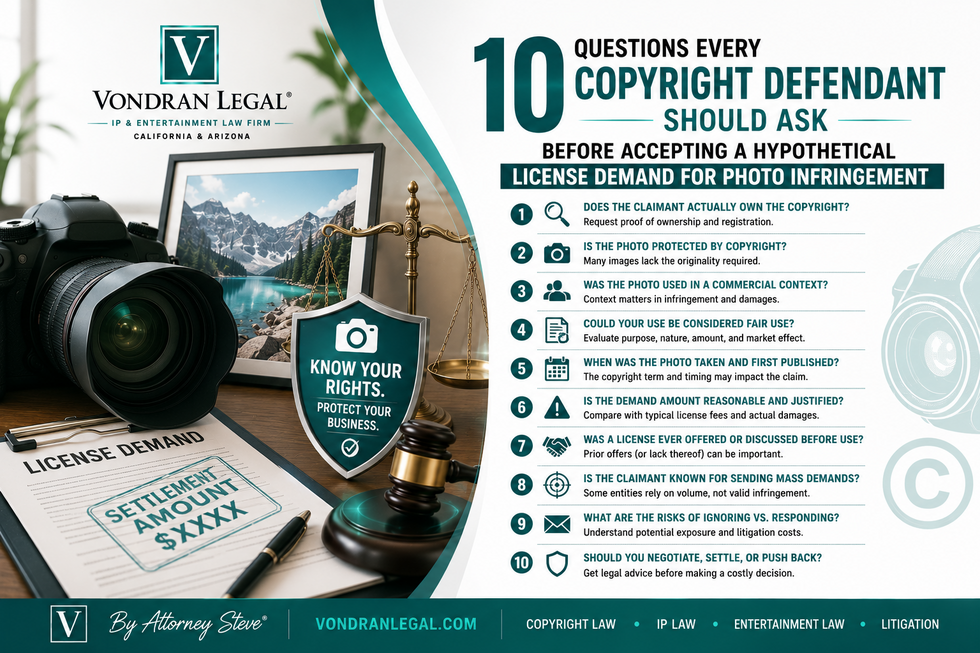
Below are ten questions every copyright defendant should ask before writing a settlement check.
1. Has This Photograph Ever Actually Been Licensed for the Amount Being Claimed?
This is often the first—and most important—question.
A plaintiff may claim that the image is "worth" $8,000.
But has anyone ever actually paid $8,000 for that image?
Courts generally look for objective evidence of fair market value rather than unsupported opinions.
One of the leading cases is On Davis v. The Gap, Inc., 246 F.3d 152 (2d Cir. 2001). There, the Second Circuit explained that actual damages may be measured by the fair market value of a license that would have been negotiated between a willing buyer and a willing seller.
That does not mean a copyright owner may simply invent a number after litigation begins.
Instead, courts look for evidence of what the marketplace would actually support.
Questions to ask include:
-
Has this exact photograph ever been licensed?
-
How many times?
-
For what amount?
-
Under what circumstances?
-
Were those transactions negotiated before litigation?
Without objective market evidence, a claimed licensing fee becomes much more vulnerable to challenge.
2. Is the Claimed License Based on Real Marketplace Transactions—or Litigation?
Businesses should distinguish between:
-
actual commercial licenses negotiated in the ordinary course of business, and
-
valuations prepared after infringement is discovered.
Those are not necessarily the same thing.
Many copyright owners understandably value their work highly.
The legal question, however, is whether there is objective evidence that a willing buyer would actually have paid the claimed amount before infringement occurred.
Courts are generally more persuaded by invoices, contracts, agency agreements, and historical licensing records than by litigation-generated valuations.
3. Is the Plaintiff Comparing Apples to Apples?
Context matters.
A worldwide advertising campaign by an international cosmetics company is not comparable to:
-
a local medical spa,
-
a dentist,
-
a realtor,
-
a law firm,
-
a small retailer, or
-
a neighborhood restaurant.
Ask whether the alleged comparable licenses involve:
-
similar duration,
-
similar audience,
-
similar geographic scope,
-
similar industry,
-
similar advertising value,
-
similar media,
-
similar exclusivity.
An exclusive worldwide advertising license naturally commands a significantly higher price than a non-exclusive social media use lasting a few months.
4. Does the Plaintiff Have a Consistent Licensing History?
One unusually favorable license does not necessarily establish fair market value.
Suppose a photographer once licensed a celebrity campaign for $10,000.
That does not automatically establish that every future use of every image is worth $10,000.
Courts frequently look for evidence of consistent historical licensing practices, not isolated examples.
In one recent Florida decision the court accepted a higher statutory damages request after the plaintiff produced evidence of prior commercial licenses, including licenses valued at approximately $5,600 and $9,700. Those prior transactions gave the court objective evidence supporting the requested statutory award.
Historical licensing evidence often carries far more weight than unsupported opinion testimony.
5. Is the Plaintiff Seeking Actual Damages or Statutory Damages?
This distinction is critical.
Many defendants assume the plaintiff is trying to recover the value of the alleged license.
Not necessarily.
The Copyright Act provides two different damage models.
Actual Damages
Actual damages generally attempt to compensate the copyright owner for economic loss.
One possible measure is the fair market value of a hypothetical license.
Statutory Damages
Under 17 U.S.C. § 504(c), a plaintiff may instead elect statutory damages ranging from:
-
$750 to $30,000 per work; or
-
up to $150,000 for willful infringement.
Statutory damages serve additional purposes, including deterrence.
This distinction matters because evidence supporting an actual licensing value does not automatically dictate the appropriate statutory damages award.
6. Is There Evidence of Lost Revenue?
Many demand letters imply that the copyright owner suffered enormous financial harm.
Ask:
-
Was a customer actually lost?
-
Was another license displaced?
-
Did someone refuse to purchase the image because of the alleged infringement?
The Ninth Circuit emphasized in Mackie v. Rieser, 296 F.3d 909 (9th Cir. 2002) that copyright damages cannot rest on speculation.
Similarly, Polar Bear Productions, Inc. v. Timex Corp., 384 F.3d 700 (9th Cir. 2004) discussed the importance of establishing a causal connection between infringement and claimed damages.
Evidence—not assumptions—is generally required.
7. Does the Claimed License Reflect the Actual Use?
Many settlement demands assume the broadest imaginable commercial use.
But what actually occurred?
Questions include:
-
Was the photograph used for one week or five years?
-
Was it buried on a blog?
-
Was it displayed on a homepage?
-
Was it part of paid advertising?
-
Was it merely informational?
-
Was it removed immediately after notice?
The value of a license frequently depends on these facts.
A one-time blog illustration is not necessarily comparable to a nationwide advertising campaign.
8. What Evidence Supports the Claimed Value?
Before accepting a large demand, consider asking for supporting documentation.
Examples include:
-
prior invoices,
-
executed licenses,
-
agency agreements,
-
Getty Images licensing history,
-
Shutterstock pricing,
-
Adobe Stock pricing,
-
commercial rate sheets,
-
expert reports,
-
historical negotiations.
Objective market evidence is generally far more persuasive than conclusory assertions.
9. How Have Courts Treated Similar Claims?
Recent cases demonstrate that courts independently evaluate damages.
For example, in Wareka v. Dryluxe LLC, the plaintiff sought $21,000 in statutory damages for six photographs.
Although the court inferred willfulness because the defendant defaulted, it nevertheless reduced the requested recovery to $9,000 because the plaintiff failed to provide sufficient evidence of customary licensing fees, lost revenue, or other economic proof supporting the higher request.
The court explained that while statutory damages serve a deterrent function, they should still bear a reasonable relationship to the available evidence.
Likewise, the court relied on Bryant v. Media Right Productions, Inc., 603 F.3d 135 (2d Cir. 2010), identifying several factors relevant to statutory damages, including:
-
the infringer's state of mind;
-
expenses saved;
-
profits earned;
-
revenue lost by the copyright owner;
-
deterrence;
-
cooperation in discovery; and
-
the parties' conduct.
Those factors remind defendants that courts perform an individualized analysis—not a mechanical multiplication exercise.
10. Should You Accept the Demand—or Investigate Further?
Every case is different.
Sometimes the evidence strongly supports the plaintiff's valuation.
Sometimes it does not.
Before agreeing to pay a significant settlement, consider asking your attorney to evaluate:
-
whether the plaintiff can establish ownership;
-
whether registration requirements have been satisfied;
-
whether the use was licensed;
-
whether a valid fair use defense exists;
-
whether an innocent infringement defense may apply;
-
whether the claimed licensing value is supported by objective evidence;
-
whether comparable marketplace transactions exist;
-
whether the plaintiff can establish actual damages;
-
whether statutory damages are likely to exceed the settlement demand; and
-
whether additional defenses or negotiation leverage exist.
A careful legal analysis may substantially affect settlement strategy.
Final Thoughts
Receiving a copyright demand letter can be stressful. Many businesses understandably want to resolve the matter quickly and move on.
That may be the right decision.
However, businesses should also understand that copyright damages are governed by legal standards—not simply by the amount demanded in a letter.
Courts frequently distinguish between well-supported market evidence and unsupported valuation opinions. They examine licensing history, the nature of the use, the plaintiff's proof, and the purposes of the Copyright Act before determining an appropriate award.
That does not mean every demand is excessive.
Nor does it mean every defendant should litigate.
It does mean that businesses should make informed decisions based on the evidence, applicable law, and experienced legal advice—not solely on the size of the initial demand.
If your company has received a photographer copyright demand letter, a hypothetical license valuation, or a federal copyright infringement lawsuit, experienced counsel can evaluate the strengths and weaknesses of the claim, assess potential defenses, and help negotiate a resolution supported by the law and the facts—not speculation.

