
Metadata vs. Provenance: What's the Difference? Why It Matters in Photographer Copyright Cases and DMCA § 1202 Litigation. California and Arizona Photo Infringement Lawyers!
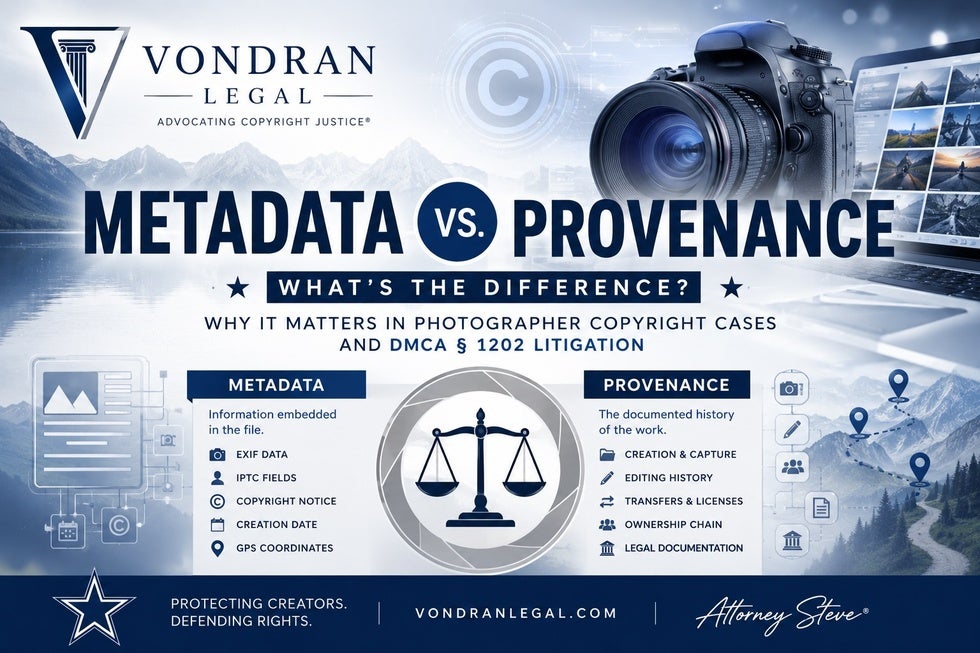
Understanding EXIF, IPTC, Copyright Management Information (CMI), and Why the Distinction Can Win—or Lose—a Federal Copyright Lawsuit
By Attorney Steve® | Vondran Legal®
Introduction: Two Words Every Photographer Should Know
If you are a professional photographer, content creator, stock photography contributor, or creative agency, you've probably heard people talk about metadata.
You may have also heard attorneys discussing provenance.
Although these terms are closely related, they are not the same thing.
Understanding the distinction can become critically important in copyright litigation involving:
-
photographer copyright infringement
-
DMCA § 1202 claims
-
Copyright Management Information (CMI)
-
stock photography disputes
-
celebrity photography
-
AI image training
-
licensing disputes
-
ownership challenges
-
commercial image exploitation
Many copyright lawsuits are won—or lost—not because someone copied a photograph, but because the parties cannot establish what information originally accompanied the image and how the image changed over time.
This article explains the differences and why they matter.
What Is Metadata?
Metadata simply means:
Data about data.
For photographs, metadata is information stored inside the image file itself.
Many photographers don't realize that every time they press the shutter button, their camera begins creating a digital record.
That record often contains valuable information.
Common Types of Metadata
EXIF Metadata
EXIF (Exchangeable Image File Format) is generally created automatically by the camera.
Examples include:
-
Camera manufacturer
-
Camera model
-
Lens used
-
Aperture
-
Shutter speed
-
ISO
-
Date
-
Time
-
GPS coordinates (if enabled)
-
Camera serial number
-
White balance
-
Exposure compensation
This information can become useful evidence showing when and how a photograph was created.
IPTC Metadata
Unlike EXIF, IPTC fields are often added or edited by photographers or agencies.
Common IPTC information includes:
-
Photographer name
-
Copyright owner
-
Copyright notice
-
Contact information
-
Licensing terms
-
Caption
-
Keywords
-
Description
-
Usage restrictions
-
Credit line
For copyright lawyers, IPTC information frequently becomes more important than camera settings.
What Is Copyright Management Information (CMI)?
Many people assume metadata automatically equals CMI.
That is not correct.
Under 17 U.S.C. § 1202, Copyright Management Information generally refers to information identifying:
-
the author,
-
the copyright owner,
-
licensing information,
-
copyright notices,
-
contributor information,
-
terms and conditions of use,
-
identifying numbers associated with the work.
Some IPTC fields may qualify as CMI.
Some EXIF fields may not.
Whether particular information qualifies often depends upon the specific facts and the applicable case law.
What Is Provenance?
Now let's zoom out.
Provenance is much broader.
While metadata is information contained inside the file...
Provenance is the complete documented history outside and inside the file.
It answers questions like:
-
Who created the photograph?
-
Where did it originate?
-
Who possessed it?
-
Who edited it?
-
Who licensed it?
-
Was it assigned?
-
Was ownership transferred?
-
Were copies created?
-
Did anyone alter the metadata?
-
Can every step be documented?
Think of provenance as the entire life story of the photograph.
An Easy Analogy
Imagine buying a classic 1967 Shelby Mustang.
The car itself contains information:
-
VIN number
-
Engine number
-
Manufacturing date
Those are like metadata.
But suppose you also have:
-
the original bill of sale,
-
maintenance records,
-
restoration photographs,
-
insurance records,
-
ownership history,
-
auction documents,
-
registration history.
That complete historical file represents provenance.
Metadata identifies the vehicle.
Provenance tells its entire story.
Metadata Is a Chapter. Provenance Is the Entire Book.
This is perhaps the easiest way to understand the difference.
Metadata may tell you:
This photograph was created on July 4, 2022 using a Canon EOS R5.
Provenance tells you:
-
who captured it,
-
where it was stored,
-
when it was edited,
-
when copyright information was added,
-
who licensed it,
-
who distributed it,
-
whether ownership changed,
-
whether the metadata later disappeared,
-
who possessed it throughout its life.
One helps identify the file.
The other helps prove ownership.
A Practical Example
Suppose photographer Sarah captures a famous athlete celebrating after winning a championship.
Immediately after the event:
The camera generates:
-
RAW file
-
EXIF metadata
-
Date
-
Camera serial number
Later Sarah:
-
imports the image into Lightroom;
-
edits the image;
-
adds IPTC copyright information;
-
exports a JPEG;
-
registers the copyright;
-
uploads the image to a licensing agency.
The agency distributes the image.
Years later Sarah discovers:
-
her photographer credit is gone;
-
IPTC author fields have disappeared;
-
another company appears as the licensing source;
-
the image continues generating revenue.
Sarah files suit.
The litigation immediately raises two different questions.
Question One:
What information originally existed inside the image?
That concerns metadata.
Question Two:
Can Sarah prove the complete history of the image from creation until today?
That concerns provenance.
The two concepts overlap.
They are not identical.
Why Metadata Matters in Copyright Cases
Metadata can help establish:
-
authorship,
-
creation dates,
-
ownership,
-
originality,
-
licensing history,
-
authenticity,
-
editing history.
It may also become relevant when evaluating claims involving removal or alteration of Copyright Management Information.
However, metadata is not infallible.
Metadata can be:
-
removed,
-
modified,
-
overwritten,
-
stripped,
-
corrupted,
-
recreated.
That is one reason provenance becomes so important.
Why Provenance Often Becomes the Bigger Issue
Suppose metadata has disappeared.
Can the photographer still prove ownership?
Sometimes yes.
If the photographer has:
-
RAW files,
-
Lightroom catalogs,
-
memory cards,
-
cloud backups,
-
registration certificates,
-
invoices,
-
agency agreements,
-
licensing records,
-
emails,
-
upload logs,
the provenance may independently establish ownership.
Strong provenance can compensate for incomplete metadata.
Conversely, pristine metadata may not cure serious gaps in provenance.
Why This Matters Under the DMCA
The Digital Millennium Copyright Act protects certain forms of Copyright Management Information.
Many photographer lawsuits allege that someone:
-
removed attribution,
-
deleted copyright notices,
-
stripped IPTC information,
-
replaced ownership information,
-
displayed false attribution.
Those allegations often require careful factual analysis.
Questions may include:
-
Was qualifying CMI actually present?
-
When did it disappear?
-
Who removed it?
-
Was it intentional?
-
What evidence documents the change?
Metadata may answer some of those questions.
Provenance may answer many others.
Together they often become powerful evidence.
Best Practices for Photographers
Professional photographers should consider developing consistent documentation practices.
Among other things:
✓ Preserve original RAW files.
✓ Back up memory cards.
✓ Maintain editing catalogs.
✓ Preserve IPTC information.
✓ Register important works.
✓ Save licensing agreements.
✓ Archive client communications.
✓ Preserve cloud backups.
✓ Maintain upload histories.
✓ Document assignments.
✓ Preserve version history.
The stronger your documentation today, the stronger your evidence tomorrow.
How Vondran Legal® Can Help
Modern copyright litigation increasingly involves technical issues surrounding:
-
metadata
-
provenance
-
Copyright Management Information (CMI)
-
DMCA § 1202
-
photographer copyright
-
image licensing
-
AI training datasets
-
commercial photography
-
digital asset management
-
copyright ownership disputes
At Vondran Legal®, we assist photographers, creators, agencies, publishers, technology companies, and businesses in evaluating and litigating sophisticated copyright disputes nationwide.
Whether you are enforcing your rights or defending against allegations, we can help analyze the digital evidence, identify strengths and weaknesses, and develop an effective litigation strategy.
Contact Attorney Steve®
If you are involved in a dispute concerning photographer attribution, metadata removal, Copyright Management Information, provenance, image ownership, licensing, or federal copyright litigation, contact Vondran Legal® to schedule a confidential consultation.
In today's digital world, protecting creative works means more than simply registering copyrights—it means preserving the evidence that proves who created the work and how it has been used over time.
Frequently Asked Questions
Is metadata the same as Copyright Management Information (CMI)?
No. Some metadata may qualify as CMI under the DMCA, but not all metadata is protected as Copyright Management Information.
Can metadata prove copyright ownership?
Metadata can be helpful evidence, but it is usually only one part of the overall proof. Courts often consider many other documents establishing ownership and authenticity.
Can metadata be altered?
Yes. Metadata can sometimes be edited, removed, overwritten, stripped during file processing, or recreated. That is why additional evidence is often important.
What is the difference between metadata and provenance?
Metadata consists of information embedded within a digital file. Provenance is the documented history of the work, including its creation, storage, editing, licensing, transfers, and ownership over time.
Why are provenance and metadata important in DMCA lawsuits?
They may help establish what Copyright Management Information originally accompanied the work, whether it was altered or removed, and the overall history of the copyrighted image. Depending on the facts, this evidence may be relevant to both copyright infringement and DMCA § 1202 claims.
Related Articles
-
What Is Provenance in Copyright Law? Why Every Photographer Should Care
-
Can Removing Metadata Lead to Federal Copyright Liability?
-
Understanding Copyright Management Information (CMI) Under the DMCA
-
Photographer Copyright Registration: Best Practices Before You Publish
- Chain of title in copyright law photo infringement
