
Idea Submission Lawyer | Protect Your Toy, Game, Film & Entertainment Ideas Before You Pitch. Call us at (877) 276-5084.
Entertainment IP Lawyers | Modern Legal
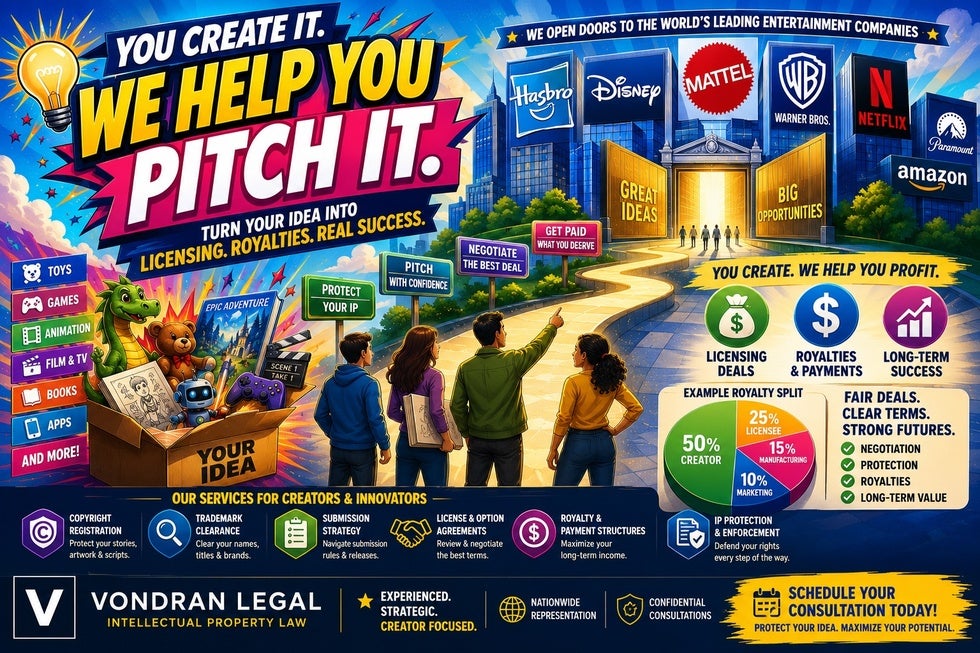
Have a Great Idea for Hasbro, Mattel, Disney, Netflix, or Another Entertainment Company?
Every year, thousands of inventors, writers, toy designers, game developers, artists, filmmakers, and entrepreneurs develop exciting new ideas that they hope will become the next Monopoly, Transformers, My Little Pony, Magic: The Gathering, Barbie, or blockbuster streaming series.
Unfortunately, many creators spend months—or even years—developing their concepts only to discover that they have overlooked critical legal issues involving copyright, trademarks, intellectual property ownership, confidentiality, licensing, or idea submission procedures.
At Modern Legal, we help creators evaluate, protect, and strategically present their ideas before they approach major entertainment companies.
Whether your goal is a licensing agreement, royalty arrangement, acquisition, or strategic partnership, we can help you understand the legal landscape and position your project professionally.
What Is an Idea Submission?
An idea submission occurs when an individual or company presents an original concept to another business in hopes that the recipient will:
-
License the idea
-
Purchase the concept
-
Develop the project
-
Invest in production
-
Acquire intellectual property rights
-
Enter into a royalty agreement
-
Form a joint venture
-
Negotiate a production or publishing deal
Examples include:
-
Toy concepts
-
Board games
-
Trading card games
-
Children's books
-
Mobile apps
-
Television series
-
Animated films
-
Feature films
-
Comic books
-
Video game concepts
-
Character designs
-
Plush toys
-
Collectibles
-
Consumer products
-
Educational products
-
Interactive experiences
-
AI-powered entertainment platforms
Why You Should Never Simply "Send Your Idea"
One of the biggest misconceptions among creators is that copyright law protects ideas.
Generally speaking, it does not.
Copyright protects the original expression of an idea—not the underlying concept itself.
For example:
An idea for "a family of magical dragons protecting children" may not be protectable.
However:
-
Original artwork
-
Scripts
-
Dialogue
-
Character descriptions
-
Storylines
-
Game mechanics (to a limited extent)
-
Original illustrations
-
Written materials
-
Software code
-
Musical compositions
may all receive varying forms of legal protection.
Understanding this distinction is one of the most important steps before approaching a major entertainment company.
Companies Often Reject Unsolicited Ideas
Many entertainment companies maintain strict policies regarding unsolicited submissions.
These policies are designed to reduce the risk of lawsuits alleging that a company "stole" someone's idea after independently developing a similar concept.
Companies may:
-
Refuse to review unsolicited materials
-
Require online submission portals
-
Require submission releases
-
Reject confidential materials
-
Require acknowledgments regarding independent development
-
Limit what legal rights a submitter retains
Understanding these procedures before submitting materials can help avoid misunderstandings and better position your project.
Common Legal Issues in Entertainment Idea Submissions
Our attorneys can help evaluate issues including:
Copyright Protection
Questions often include:
-
Can this script be copyrighted?
-
Should I register before pitching?
-
What materials should be registered?
-
Should artwork be separately registered?
-
What about AI-generated content?
Trademark Protection
We evaluate:
-
Titles
-
Brand names
-
Character names
-
Toy lines
-
Game names
-
Product branding
-
Logos
-
Slogans
Trademark clearance before pitching may reduce future conflicts.
Character Protection
Many entertainment projects revolve around memorable characters.
We evaluate:
-
Character originality
-
Similarity risks
-
Existing franchises
-
Potential infringement concerns
-
Character branding opportunities
Licensing Strategy
Sometimes selling the idea outright is not the best option.
Alternative structures may include:
-
Exclusive licenses
-
Non-exclusive licenses
-
Royalty agreements
-
Option agreements
-
Merchandising rights
-
Territory restrictions
-
Streaming rights
-
International rights
-
Publishing rights
-
Sequel rights
-
Spin-off rights
Understanding these possibilities can dramatically affect the long-term value of your intellectual property.
Chain of Title
Entertainment companies often require proof that you actually own what you are pitching.
This may include documentation concerning:
-
Copyright ownership
-
Independent contractors
-
Artists
-
Writers
-
Co-creators
-
Assignment agreements
-
Work-made-for-hire issues
Failure to establish a clear chain of title can delay or derail negotiations.
How the Idea Submission Process Typically Works
Every company has its own procedures, but the process often looks something like this:
Step 1
Develop the concept.
Step 2
Document creation dates.
Step 3
Evaluate copyright issues.
Step 4
Consider copyright registration.
Step 5
Conduct trademark clearance.
Step 6
Review ownership documentation.
Step 7
Develop presentation materials.
Step 8
Identify appropriate submission channels.
Step 9
Review submission agreements.
Step 10
Negotiate licensing or acquisition terms if interest develops.
Entertainment Companies That Frequently Receive Idea Submissions
Depending upon the project, creators may wish to approach companies such as:
-
Hasbro
-
Mattel
-
Disney
-
Pixar
-
Nickelodeon
-
DreamWorks
-
Universal
-
Warner Bros.
-
Netflix
-
Amazon MGM Studios
-
Apple TV+
-
Sony Pictures
-
Lionsgate
-
Cartoon Network
-
LEGO
-
Spin Master
-
Ravensburger
-
Asmodee
-
Electronic Arts
-
Ubisoft
-
Epic Games
Each company typically has its own submission procedures and internal review processes.
Potential Rights That May Be Negotiated
Every deal is different.
Potential rights may include:
-
Copyright ownership
-
Trademark licenses
-
Character licensing
-
Publishing rights
-
Television rights
-
Film rights
-
Streaming rights
-
Digital rights
-
Mobile application rights
-
Video game rights
-
Merchandising rights
-
Toy manufacturing rights
-
International distribution
-
Translation rights
-
Audio rights
-
Podcast rights
-
Theme park rights
-
Promotional rights
-
AI training rights
-
NFT or digital collectible rights (where applicable)
-
Future derivative works
-
Sequel rights
-
Prequel rights
Can You License an Idea Instead of Selling It?
Sometimes.
Rather than assigning ownership outright, creators may negotiate:
-
Royalties
-
Milestone payments
-
Advances
-
Minimum guarantees
-
Performance obligations
-
Renewal options
-
Sales-based compensation
-
Revenue sharing
-
Profit participation
Every agreement should be carefully reviewed by qualified legal counsel.
Illustrative Example: Toy Concept Licensing
Imagine an inventor develops an innovative educational board game for children ages 6–10.
Instead of attempting to manufacture and distribute the product independently, the inventor may decide to approach a major toy company.
If the company expresses interest, discussions could include:
-
Exclusive licensing rights
-
Product development
-
Manufacturing
-
Marketing support
-
Retail distribution
-
International expansion
-
Royalty payments based on sales
-
Audit rights
-
Quality control provisions
-
Termination rights if sales targets are not met
The specific terms depend on the negotiations and the value of the intellectual property.
Illustrative Example: Animated Series Pitch
A creator develops:
-
Original characters
-
Pilot script
-
Story bible
-
Character artwork
-
Season outline
Before pitching the project, legal counsel may assist with:
-
Copyright registration
-
Trademark searches
-
Character review
-
Submission agreement analysis
-
Option agreement review
-
Production agreement negotiations
If a studio wishes to move forward, the parties may negotiate development rights, compensation, credit, royalties, and ownership.
Frequently Asked Questions
Can someone steal my idea?
Ideas themselves often receive limited legal protection. However, original expression, artwork, scripts, code, and other protectable works may qualify for copyright protection. Proper planning before submission is important.
Should I copyright my idea?
You generally cannot copyright a mere idea, but many materials associated with the project may be eligible for copyright registration.
Do I need a trademark?
If your project includes a distinctive brand name, product line, character name, or logo, trademark protection may be worth considering.
Should I use a nondisclosure agreement (NDA)?
Some companies will not sign NDAs before reviewing submissions. Whether an NDA is appropriate depends on the circumstances and the recipient's policies.
What is a submission release?
Many entertainment companies require creators to sign agreements acknowledging that the company may already be developing similar concepts and limiting certain legal claims. These documents should be reviewed carefully.
Can I negotiate royalties?
Possibly. Compensation structures vary depending on the bargaining power of the parties, the uniqueness of the property, market demand, and the company's business model.
What if multiple people created the project?
Ownership should be clarified before any submission. Co-creators, contractors, and collaborators may each have legal rights unless ownership has been properly assigned.
What if AI helped create my project?
Artificial intelligence raises evolving questions concerning copyright eligibility, ownership, licensing terms, and disclosure obligations. Legal review may be appropriate before commercialization.
How Modern Legal May Be Able to Help
We offer strategic legal services designed to help creators reduce risk and present their projects professionally.
Our services may include:
-
Entertainment IP consultations
-
Copyright strategy
-
Copyright registration
-
Trademark clearance
-
Trademark applications
-
Character similarity analysis
-
Idea submission counseling
-
Submission agreement review
-
NDA review
-
Option agreement review
-
Licensing agreement review
-
Royalty agreement review
-
Publishing agreement review
-
Chain-of-title review
-
AI intellectual property counseling
-
Entertainment contract negotiations
-
Cease-and-desist analysis
-
Copyright infringement opinions
-
Fair use evaluations
-
Entertainment dispute counseling
Why Work With Vondran Legal?
Vondran Legal focuses on intellectual property and technology-related legal matters, including copyright, trademark, licensing, digital media, AI, entertainment, and online content disputes.
We understand that every creative project represents significant time, talent, and investment. Our goal is to help clients identify legal issues early, develop thoughtful protection strategies, and navigate negotiations with greater confidence.
No attorney can guarantee that a company will purchase, license, or develop a submitted idea. However, experienced legal guidance may help creators avoid common pitfalls, better understand their rights, and prepare for productive business discussions.
Schedule a Consultation
If you are preparing to submit a toy, game, screenplay, television concept, film project, mobile application, digital product, or other creative work to an entertainment company, Vondran Legal can help you evaluate the legal issues before you press "Send."
Contact us today to schedule a confidential consultation and discuss your entertainment intellectual property strategy.
