
Vondran Legal® Photo Infringement Insigts: What Photographers, Content Creators, and Copyright Owners Need to Know about CMI 1202 claims.
By Attorney Steve® | Vondran Legal® – Copyright & DMCA Litigation Lawyers
Has It Become Harder to Win a DMCA Metadata Lawsuit?
For many years, photographers and copyright owners believed that whenever someone removed their name, copyright notice, or embedded metadata from a photograph, they automatically had a claim under the Digital Millennium Copyright Act (DMCA).
Not anymore.
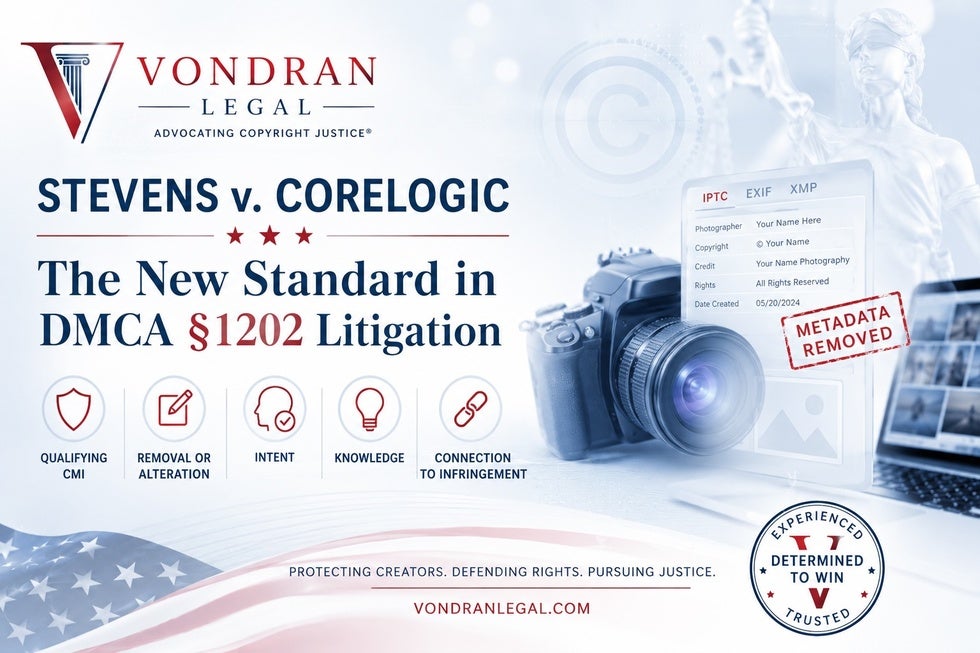
One of the most significant copyright decisions affecting photographers is Stevens v. CoreLogic, Inc., 899 F.3d 666 (9th Cir. 2018). The Ninth Circuit dramatically narrowed the circumstances under which a plaintiff may recover for removal or alteration of Copyright Management Information ("CMI") under 17 U.S.C. §1202.
The case has become one of the most frequently cited decisions in DMCA metadata litigation and has changed how lawyers evaluate photographer copyright cases.
If you believe your metadata has been removed or your photographs have been improperly attributed, understanding Stevens is critical before filing suit.
What Is Copyright Management Information (CMI)?
Copyright Management Information refers to information identifying the copyright owner or author of a copyrighted work.
Examples include:
-
Photographer names
-
Copyright notices
-
Embedded IPTC metadata
-
EXIF ownership fields
-
Copyright symbols
-
Licensing information
-
Contributor information
-
Rights management data
-
Digital attribution fields
Congress created protections for this information through the DMCA because removing authorship information can make copyright infringement easier to commit and harder to detect.
The Law: 17 U.S.C. §1202
Section 1202 generally prohibits knowingly:
-
removing CMI,
-
altering CMI,
-
distributing works with false CMI,
-
distributing works knowing CMI has been removed,
-
importing works containing altered CMI.
Congress enacted these provisions to discourage digital piracy and preserve information identifying copyright ownership.
Unlike traditional copyright infringement, these claims focus on the handling of attribution and ownership information—not merely unauthorized copying.
The Stevens v. CoreLogic Case
The Facts
Several professional photographers licensed photographs to various real estate Multiple Listing Services (MLSs).
CoreLogic developed software that processed millions of MLS photographs.
During processing, certain metadata fields—including copyright-related information—were removed.
The photographers sued under §1202, arguing that removing the metadata violated the DMCA.
At first glance, the case appeared straightforward:
-
copyrighted photographs
-
removed metadata
-
commercial software
-
widespread distribution
But the Ninth Circuit disagreed.
The Court's Key Holding
The Ninth Circuit held that removing metadata alone is not enough.
Instead, plaintiffs must prove something more.
Specifically, they must show that the defendant:
knew, or had reasonable grounds to know, that removal of the CMI would induce, enable, facilitate, or conceal copyright infringement.
This additional requirement is often referred to as the "double scienter" requirement.
The Five Elements Plaintiffs Must Now Establish
Although each case is fact-specific, Stevens effectively requires plaintiffs to prove several important components.
1. Qualifying Copyright Management Information
Not every piece of metadata qualifies.
Plaintiffs should first establish that the information allegedly removed actually constitutes CMI under the statute.
Examples include:
-
photographer credit
-
copyright owner
-
licensing information
-
author identification
Technical metadata unrelated to ownership may not qualify.
2. Removal or Alteration
Next, the plaintiff must demonstrate that qualifying CMI was actually removed or altered.
This often requires:
-
comparing original files
-
examining IPTC metadata
-
reviewing EXIF fields
-
evaluating asset management systems
-
forensic analysis
Many cases now require technical experts.
3. Intent
The defendant must have intentionally removed or altered the CMI.
Accidental software processing, automated compression, or routine file conversion may create factual disputes regarding intent.
The distinction between intentional conduct and automated system behavior frequently becomes a central issue.
4. Knowledge
This is where Stevens significantly raised the bar.
The plaintiff generally must establish that the defendant knew—or had reasonable grounds to know—that removing the CMI would likely facilitate or conceal future infringement.
Simply proving that metadata disappeared is usually insufficient.
Instead, courts often require evidence demonstrating awareness of the downstream consequences.
5. A Connection to Copyright Infringement
Perhaps the most important lesson from Stevens is that there must be a meaningful connection between the removal of CMI and future copyright infringement.
The Ninth Circuit rejected the notion that every metadata deletion automatically satisfies this requirement.
Instead, plaintiffs typically must present evidence that removal was likely to:
-
facilitate infringement,
-
encourage infringement,
-
conceal infringement, or
-
make infringement more difficult to detect.
Without that connection, §1202 claims frequently fail.
Why Stevens Made Photographer Cases More Difficult
Before Stevens, many plaintiffs believed proving two facts was enough:
-
the metadata existed; and
-
the metadata disappeared.
Today, courts generally require much more.
Modern DMCA cases often involve extensive discovery regarding:
-
digital asset management systems
-
workflow automation
-
software architecture
-
licensing databases
-
upload procedures
-
internal policies
-
employee knowledge
-
third-party distributors
The focus has shifted from merely asking "Was metadata removed?" to asking:
"Why was it removed, who removed it, and what did the defendant know would happen afterward?"
What Evidence Can Strengthen a §1202 Claim?
Every case is different, but strong evidence may include:
-
Original RAW image files
-
Original IPTC metadata
-
EXIF records
-
Copyright registration certificates
-
Licensing agreements
-
Distribution history
-
Internal emails
-
Asset management logs
-
Version histories
-
Software processing documentation
-
Expert forensic analysis
-
Evidence of repeated attribution changes
-
False copyright notices
-
Misidentification of ownership
The stronger the evidence linking intentional removal to infringement, the stronger the claim.
Common Defenses After Stevens
Defendants frequently argue:
-
The information was not qualifying CMI.
-
Metadata removal occurred automatically.
-
No employee intentionally removed anything.
-
The software stripped metadata during normal processing.
-
The defendant lacked the required knowledge.
-
No future infringement was enabled.
-
The plaintiff cannot establish causation.
-
Third parties—not the defendant—removed the metadata.
These defenses have become increasingly common in photographer litigation.
What About False Attribution?
Section 1202 also prohibits certain forms of false copyright management information.
Potential examples may include:
-
replacing the photographer's name with another entity,
-
falsely claiming ownership,
-
inserting incorrect contributor information,
-
displaying inaccurate licensing information.
False attribution claims often require careful factual development and may overlap with traditional copyright infringement claims.
Practical Lessons for Photographers
Professional photographers should:
-
Preserve original RAW files.
-
Maintain original metadata.
-
Register copyrights promptly.
-
Keep licensing records.
-
Archive correspondence.
-
Preserve upload histories.
-
Document ownership.
-
Monitor online use of images.
The better your documentation, the stronger your position if litigation becomes necessary.
Why Experienced Copyright Counsel Matters
Modern §1202 litigation is highly technical.
Successful cases frequently require an understanding of:
-
metadata architecture,
-
copyright registrations,
-
forensic computer evidence,
-
digital licensing systems,
-
federal copyright law,
-
DMCA statutory interpretation,
-
software workflows,
-
electronic discovery.
An experienced copyright attorney can evaluate whether the evidence satisfies the demanding standards established after Stevens v. CoreLogic.
Contact Vondran Legal®
At Vondran Legal®, we represent photographers, artists, filmmakers, software developers, publishers, content creators, and businesses in complex copyright and DMCA litigation nationwide.
Our firm handles matters involving:
-
Copyright infringement
-
DMCA §1202 claims
-
Metadata removal litigation
-
Photographer rights
-
Copyright ownership disputes
-
Licensing disagreements
-
False attribution claims
-
Digital media disputes
-
Copyright registration strategy
-
Federal copyright litigation
If you believe your photographs, artwork, or other copyrighted works have been improperly exploited or your copyright management information has been removed or altered, contact Vondran Legal® to discuss your rights.
Frequently Asked Questions
Can I sue simply because my metadata disappeared?
Not necessarily. Following Stevens v. CoreLogic, courts often require proof that the removal was intentional and that the defendant knew it would likely facilitate, induce, enable, or conceal copyright infringement.
Is IPTC metadata considered Copyright Management Information?
It can be. Fields identifying the author, copyright owner, licensing terms, or similar ownership information may qualify as CMI under 17 U.S.C. §1202, depending on the facts.
Can automated software create liability under §1202?
It depends. If metadata is stripped as part of an automated workflow, courts will closely examine whether the required intent and knowledge can be established.
Can I bring both a copyright infringement claim and a §1202 claim?
Yes. In many cases, plaintiffs assert both traditional copyright infringement claims and DMCA claims. Each has separate legal elements and should be evaluated independently.
Does Stevens apply outside the Ninth Circuit?
Stevens is binding in the Ninth Circuit and has been influential elsewhere. Other courts may adopt similar reasoning or apply different standards depending on the jurisdiction.

