
VONDRAN LEGAL® – COPYRIGHT REGISTRATION FOR AI-ASSISTED WORKS – CALL US IF YOU NEED HELP FILING OR DEFENDING AN AI-RELATED COPYRIGHT APPLICATION (877) 276-5084.
INTRODUCTION
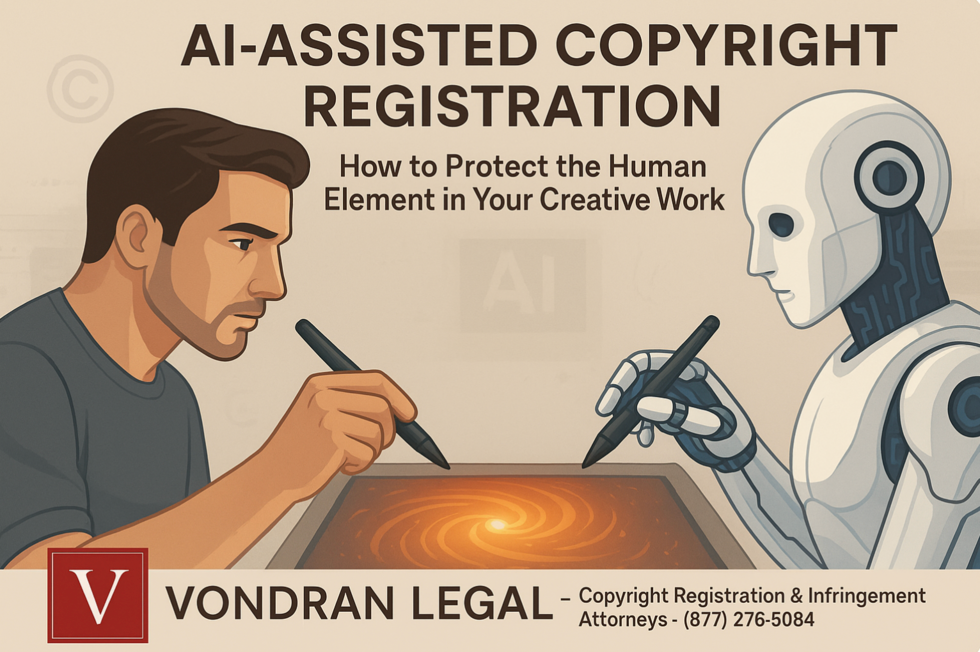
Artificial intelligence is changing the creative world faster than the law can keep up. Artists, designers, and meme creators are now using AI tools to brainstorm, illustrate, and even finish parts of their work. But the Copyright Office has drawn a hard line. Only the parts created by a human being can be protected.
That means if AI helped create your image, text, or meme, you could still get protection for the parts that came from your own mind and hands. The key is knowing how to present your work the right way to the Copyright Office. Over the past few years, we have seen both full refusals and partial grants. The difference usually comes down to how clearly the applicant explains the human contribution.
This memo breaks down what you need to know before filing. It explains the current Copyright Office policy, reviews recent cases like Thaler v. Perlmutter and Zarya of the Dawn and sets out practical steps to maximize your chances of approval. Whether your goal is to protect digital art, memes, or AI-assisted visuals you plan to license, following these rules can make the difference between a rejection and a valid registration.
POLICY BACKGROUND AND KEY CASES
The Copyright Office's 2023 Guidance on Works Containing Material Generated by Artificial Intelligence and its 2025 Artificial Intelligence and Copyright: Part II – Copyrightability report confirm a consistent rule. AI-assisted works can be registered when a human exercises creative control over selection, arrangement, or modification. Applicants must disclose AI use, specify what they created, and exclude machine-generated material.
The courts have reinforced this boundary.
- Thaler v. Perlmutter (D.D.C. 2023; aff'd D.C. Cir. 2025): The inventor of “Creativity Machine” sought registration for an image autonomously produced by AI. The court rejected the claim, holding that “human authorship is a bedrock requirement of copyright.”
- Zarya of the Dawn (U.S. Copyright Office, 2023): The Office granted partial registration to artist Kris Kashtanova, protecting her written text and the arrangement of text and images but not the AI-generated visuals.
- Jason Allen (Théâtre d'Opéra Spatial) (2023–present): Registration was denied because prompting and light editing were deemed insufficient to establish human authorship.
- Burrow-Giles Lithographic Co. v. Sarony (1884): The Supreme Court held that a photograph could be copyrighted because the photographer made creative choices about lighting and pose. The same logic applies to AI-assisted art—the human's decisions, not the machine's process, create copyrightable authorship.
- Naruto v. Slater (9th Cir. 2018): The “monkey selfie” case reaffirmed that only human beings can own copyrights.
These precedents all point to one conclusion. Copyright law protects human creativity, not mechanical output. AI can be a tool, but only people can be authors.
5 TIPS TO GET YOUR AI-ASSISTED WORK REGISTERED
1) DEFINE YOUR HUMAN AUTHORSHIP
The first step is to isolate what you personally created. The Copyright Office protects your expressive decisions, not the raw AI output. When preparing your application, identify exactly what reflects your authorship, like text captions, arrangement of images, color corrections, or other creative edits.
In Burrow-Giles, the Court found that a photograph was protectable because the photographer chose how to frame and pose the subject. The same applies here. AI may provide the raw material, but your input shapes the final expression. Describe those creative acts clearly in your application.
2) KEEP DETAILED RECORDS OF YOUR PROCESS
Documenting your process strengthens your registration. The Zarya of the Dawn outcome turned on the artist's written explanation of her workflow. Keep your prompts, drafts, and screenshots showing your edits. Save the raw AI image alongside your final version. These materials prove the human role in transforming the work.
If multiple people are involved, record each person's creative contribution. Only those who made expressive decisions should be listed as authors. Organized documentation will help both at filing and later if ownership or authorship is challenged.
3) BE TRANSPARENT ABOUT AI USE
The 2023 Copyright Office Guidance requires disclosure of AI involvement. Applicants who omit this risk cancellation of their registration. Transparency is not a penalty; it is a prerequisite.
In Zarya of the Dawn, the artist preserved her registration by filing a supplementary statement clarifying the AI components. Use the “Author Created” field to describe your contributions; for example, “Original text and human arrangement of text with image.” Use “Material Excluded” to specify what was generated by AI.
This approach aligns with the 2025 Office report, which confirms that partial registrations are valid when human authorship is clearly defined.
4) FILE CAREFULLY AND CLAIM ONLY WHATS IS YOURS
Specificity matters. The Jason Allen case shows that prompting alone is rarely enough to establish authorship. When completing your application, avoid broad terms like “digital artwork.” Instead, detail your contributions, such as “Human-authored captions and selection, coordination, and arrangement of elements.”
Follow the Compendium of U.S. Copyright Office Practices (Third Edition, §§ 306, 313.2, 313.4(C), 721.9), which instructs examiners to register only the expressive content that reflects human creativity. If you produce multiple memes or visuals, consider registering them as a collective work to protect the compilation as a whole.
5) KEEP EVERYTHING FOR FUTURE PROOF AND LICENSING
Your creative records (like notes, drafts, version histories) are not only for registration. They become valuable proof of ownership if you later license or enforce your work. In Naruto v. Slater, the court rejected non-human authorship, reinforcing that copyright protection flows from identifiable human creators.
Maintain organized folders with dated materials showing your creative control. These records can support licensing deals and demonstrate originality to collaborators or clients.
CONCLUSION
AI tools are here to stay, and they are already changing how art, design, and digital content are made. But no matter how advanced the technology becomes, copyright protection still begins and ends with human creativity. The Copyright Office wants to see that a real person made expressive choices, shaped the final look, and guided the outcome.
When filing, the focus should always be on the human element. Explain clearly what was created by a person and what came from AI assistance. Keep records, drafts, and prompts that show the creative process. These details can make the difference between a registration that gets approved and one that gets refused.
The takeaway is simple: AI can be part of the creative journey, but it cannot be the author.
CONTACT A CALIFORNIA COPYRIGHT ATTORNEY
Since 2004, Vondran Legal® has been a trusted leader in copyright and trademark infringement matters across the United States. The firm has handled over one thousand copyright-related cases, including fair use opinions, DMCA takedown and counternotice disputes, federal court litigation, and online platform conflicts involving YouTube, Etsy, TikTok, Shopify, Amazon, and other digital marketplaces.
If assistance is needed with filing a copyright application for AI-assisted works or defending a copyright claim, contact Vondran Legal® for a no-cost initial confidential consultation.

