
California Right of Publicity Counsel: Vondran Legagl® - Call us at (877) 276-5084. We have helped many recover largely with contingency cases for most misappropriations.
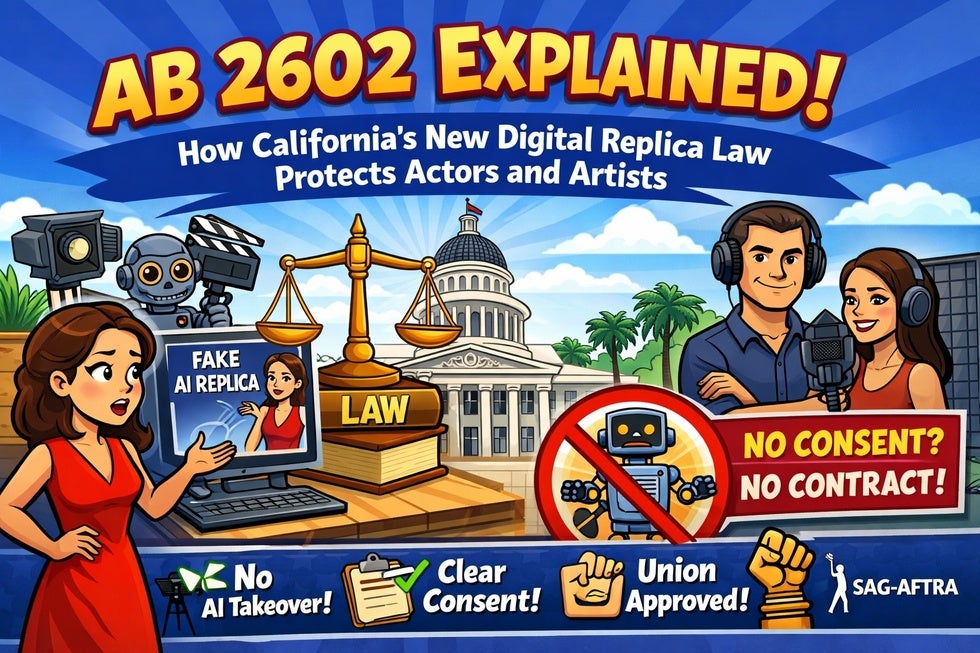
Introduction to AB 2602 (Text of the Law)—codified at Cal. Lab. Code §927.
CHAPTER 1. Contracts Against Public Policy [920 - 927]
Section 927.
(a) A provision in an agreement between an individual and any other person for the performance of personal or professional services is unenforceable only as it relates to a new performance, fixed on or after January 1, 2025, by a digital replica of the individual if the provision meets all of the following conditions:
(1) The provision allows for the creation and use of a digital replica of the individual's voice or likeness in place of work the individual would otherwise have performed in person.
(2) (A) Except as provided in subparagraph (B), the provision does not include a reasonably specific description of the intended uses of the digital replica.
(B) Failure to include a reasonably specific description of the intended uses of a digital replica does not render the provision unenforceable if the uses are consistent with the terms of the contract for the performance of personal or professional services and the fundamental character of the photography or soundtrack as recorded or performed.
(3) The individual was not represented in any of the following manners:
(A) By legal counsel who negotiated on behalf of the individual licensing the individual's digital replica rights, and the commercial terms are stated clearly and conspicuously in a contract or other writing signed or initialed by the individual.
(B) By a labor union representing workers who do the proposed work, and the terms of their collective bargaining agreement expressly addresses uses of digital replicas.
(b) This section does not affect provisions of a contract other than a provision that falls under subdivision (a) and does not impact, abrogate, or otherwise affect any exclusivity grants contained in, or related to, a provision subject to subdivision (a).
(c) (1) As used in this section, “digital replica” means a computer-generated, highly realistic electronic representation that is readily identifiable as the voice or visual likeness of an individual that is embodied in a sound recording, image, audiovisual work, or transmission in which the actual individual either did not actually perform or appear, or the actual individual did perform or appear, but the fundamental character of the performance or appearance has been materially altered.
(2) “Digital replica” does not include the electronic reproduction, use of a sample of one sound recording or audiovisual work into another, remixing, mastering, or digital remastering of a sound recording or audiovisual work authorized by the copyrightholder.
Core Purpose of § 927
The statute is designed to address a growing problem:
Employers using AI to recreate an actor's voice or likeness without meaningful consent, clarity, or compensation structure.
It aims to prevent:
- “Sign once, use forever” AI clauses
- Replacement of human labor with synthetic versions
- Vague, open-ended licensing of identity rights
2. Definition of “Digital Replica”
The law applies only if the contract involves a digital replica, meaning:
- A computer-generated or AI-altered version
- Of a person's voice or likeness
- That is realistic enough to be mistaken for the actual individual
- AND is not actually performed by the person
Key legal implication:
This excludes:
- Traditional acting performances
- Basic CGI enhancements
- Non-realistic or clearly fictional avatars
This definition is crucial—if it's not a “digital replica,” § 927 doesn't apply.
3. When a Digital Replica Clause Is VOID
The statute doesn't outlaw contracts—it invalidates specific provisions that fail compliance.
A digital replica provision is unenforceable if ANY of the following are present:
(A) Replacement of Human Performance
If the clause allows the employer to:
- Use a digital replica instead of hiring the performer again
- Substitute AI for future work that would otherwise require the person
👉 This is the “anti-replacement rule”
Legal effect:
Courts will likely interpret this broadly—if the clause functionally eliminates future employment opportunities, it's void.
(B) Lack of Specificity (Vagueness Problem)
The contract must clearly describe:
- How the replica will be used
- Where (media/platforms)
- For how long
- In what types of projects
If the clause is vague like:
“Producer may use digital likeness in any manner in perpetuity”
👉 That clause is likely void under § 927.
Why this matters:
This aligns with California's long-standing hostility to:
- Overbroad IP assignments
- Indefinite personal rights transfers
(C) No Legal or Union Representation
If the performer signed the agreement:
- Without legal counsel, AND
- Outside of collective bargaining protection
👉 The digital replica clause is voidable under the statute
This is a major shift—it effectively imposes a procedural safeguard requirement.
4. When the Clause IS Enforceable
A digital replica provision can be valid if:
(1) Union Negotiation (e.g., SAG-AFTRA)
- If the terms are part of a collective bargaining agreement, they are presumed valid.
(2) Legal Representation
- If the performer had lawyer review/negotiation, the clause is more likely enforceable.
👉 This creates a safe harbor for studios:
- Use unions or lawyers → lower risk
- DIY contracts with individuals → high risk
5. Carve-Outs (Important Limitation)
The statute does NOT apply to traditional industry practices like:
- ADR (automated dialogue replacement)
- Voice smoothing / mastering
- Standard post-production editing
- Minor digital touch-ups
👉 In other words:
Enhancing a real performance ≠ creating a digital replica
This is critical because it avoids disrupting normal filmmaking workflows.
6. Scope and Legislative Context
§ 927 is part of California's broader 2024 AI protection framework, alongside:
- Right of publicity expansions
- Deepfake restrictions
- AI transparency initiatives
It is especially aimed at:
- Film & TV actors
- Voice actors
- Influencers / digital personalities
7. Partial Invalidity Rule (Very Important)
The statute explicitly states:
Only the offending digital replica clause is void—not the entire contract.
Legal consequences:
- The rest of the agreement remains enforceable
- Courts will likely sever the bad provision
- Employers lose only the AI-related rights, not the whole deal
8. Practical Litigation Issues (What Lawyers Should Watch)
(1) What counts as “replacement”?
Expect disputes like:
- “We used AI for background dialogue, not replacement”
- “This was supplemental, not substitution”
(2) How specific is “specific enough”?
Courts will likely require:
- Medium + purpose + duration + scope
Not just general language.
(3) Retroactive vs prospective use
- If the contract allows reuse in new works not contemplated, that's risky.
(4) Intersection with Right of Publicity
Even if a clause survives § 927:
- It could still be challenged under California Civil Code § 3344 or common law publicity rights.
9. Practical Drafting Guidance (For Your Practice)
If you're advising clients, a compliant clause should include:
- Clear description of:
- Specific project(s)
- Type of replica use
- Duration (no vague “forever”)
- Explicit statement:
- Not intended to replace future employment
- Compensation structure for replica use
- Confirmation of:
- Legal counsel OR union coverage
10. Bottom-Line Summary
California Labor Code § 927:
- Does NOT ban AI replicas
- DOES regulate consent and contract fairness
- Targets:
- Replacement of human labor
- Vague, overbroad licensing
- Unrepresented performers
👉 It is fundamentally a contract enforceability statute, not a tort statute.
Summary
Artificial intelligence is rapidly transforming the entertainment industry, and California's AB 2602 is designed to ensure that actors and artists maintain control over their voice and likeness in this evolving landscape. Beginning January 1, 2025, this law targets the growing use of digital replicas—AI-generated versions of a person's voice or appearance—and places limits on how those replicas can be used in contracts.
AB 2602 provides that certain contractual provisions authorizing the use of a digital replica will be legally unenforceable if they are overly broad, vague, or obtained without proper representation. In particular, a provision may not be enforceable if it allows a digital replica to replace work the individual would otherwise have performed in person, fails to clearly and specifically describe the intended uses of the replica, and was not negotiated with appropriate representation, such as legal counsel or a labor union agreement that expressly addresses digital replica rights.
The law still permits the use of digital replicas when properly negotiated. If an individual is represented by legal counsel who clearly negotiates and documents the commercial terms, or if a union agreement governs the use of digital replicas, those provisions may remain enforceable. The key requirement is transparency and informed consent.
Under AB 2602, and consistent with AB 1836, a digital replica is defined as a highly realistic, computer-generated representation of an individual's voice or likeness that is readily identifiable as that person. This includes situations where the individual did not actually perform, as well as cases where the individual did perform but the performance has been materially altered using technology.
Importantly, the law does not apply to standard industry practices such as sampling, remixing, mastering, or digital remastering, as long as those uses are authorized by the copyright holder. These traditional forms of content use remain unaffected.
The significance of AB 2602 lies in its response to the rapid rise of artificial intelligence in content creation. Companies now have the ability to replicate voices, recreate performances, and extend the use of a performer's identity far beyond the original production. Without proper safeguards, individuals could unknowingly grant rights that allow for indefinite or unforeseen uses of their likeness.
This law ensures that companies must be clear, specific, and fair when negotiating for digital replica rights. For actors, artists, and creators, the takeaway is straightforward: any agreement involving your voice, face, or likeness deserves careful legal review. Understanding and negotiating these terms upfront can help protect your identity, your brand, and your future earnings.
Contact Us
If you are a performer, content creator, voice artist, influencer, or creative professional concerned about how your voice, image, or likeness may be used in the age of artificial intelligence—or if you are a producer, studio, or business seeking to lawfully and ethically incorporate digital replica technology into your projects—it may be time to get experienced legal guidance.
Attorney Steve Vondran has extensive experience in intellectual property, entertainment law, and emerging technology issues, and can help you draft compliant agreements, review contracts for hidden risks, and protect your valuable identity rights.
Don't wait until your likeness is used in ways you never agreed to. Contact us today to safeguard your rights and stay ahead of the rapidly evolving digital landscape. We can be reached at (877) 275-5084 or fill out the contact form on the right side of this page.

