
AI Music Licensing Lawsuit: Why the AFM's Case Against Universal and Warner Could Reshape AI Compensation
By Attorney Steve® | AI, Copyright & Entertainment Lawyer
Artificial intelligence has already transformed the legal debate over music licensing.
For the past several years, record labels, publishers, artists, and music organizations have argued that AI developers should not be permitted to train generative AI systems on copyrighted recordings without permission. Lawsuits involving AI music generators such as Suno and Udio have placed that issue squarely before the courts.
Now, however, a new lawsuit raises an entirely different legal question.
What happens after permission has already been granted?
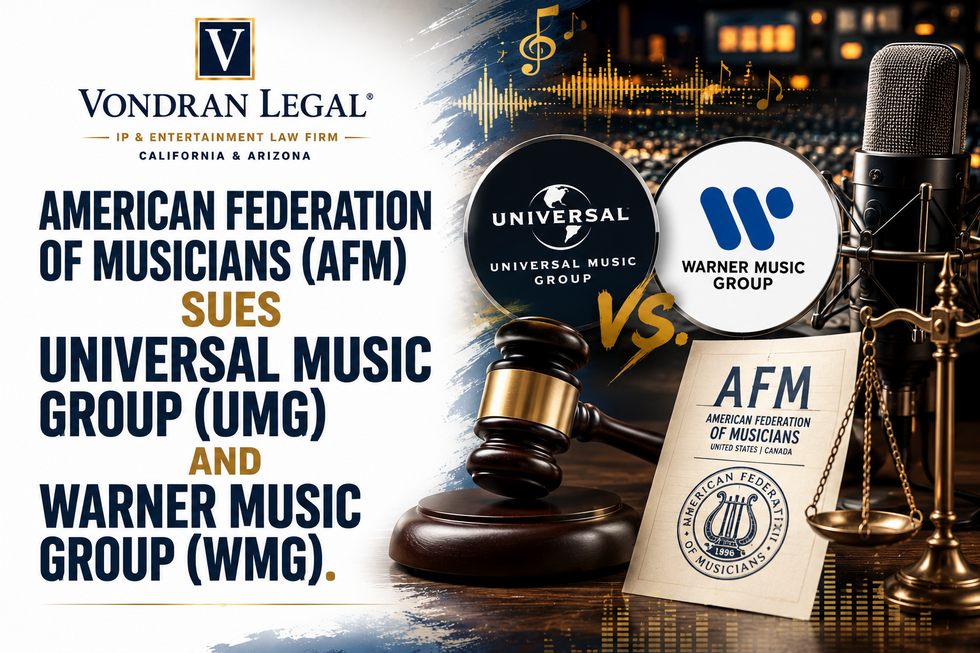
That is precisely the issue presented in a lawsuit filed by the American Federation of Musicians (AFM) against Universal Music Group (UMG) and Warner Music Group (WMG).
Rather than challenging AI companies directly, the AFM alleges that the major record labels licensed recordings containing performances by union musicians for AI training purposes without properly compensating or crediting those musicians.
The lawsuit could become one of the first major cases addressing who shares in AI licensing revenue, rather than whether AI training itself is lawful.
The Lawsuit at a Glance
According to the AFM, Universal and Warner entered into licensing arrangements allowing AI music companies—including reportedly Suno and Udio—to access sound recordings for AI model training.
The union alleges that many of those recordings contain performances by AFM musicians, including session musicians whose instrumental performances helped create commercially released songs.
The AFM argues that licensing these recordings for AI training constitutes a new commercial exploitation of those performances.
If that is true, the musicians contend they are entitled to additional compensation under existing collective bargaining agreements and industry contracts.
Importantly, the lawsuit is not primarily about copyright infringement by AI developers.
Instead, it is largely about:
- contractual rights,
- performer compensation,
- royalty allocation,
- collective bargaining agreements,
- and ownership of economic interests generated through AI licensing.
That distinction makes this case especially interesting.
Copyright Ownership Is Only Part of the Story
Many people assume that whoever owns the copyright automatically receives all future licensing revenue.
Reality is far more complicated.
A commercially released song may involve numerous stakeholders, including:
- record labels
- featured artists
- songwriters
- music publishers
- producers
- engineers
- background vocalists
- session musicians
- unions
- collective rights organizations
Each participant may have different contractual rights.
Owning the master recording does not necessarily eliminate contractual obligations owed to the individuals who created it.
That appears to be one of the central themes of the AFM lawsuit.
Session Musicians Often Receive More Than Just a Recording Fee
Many listeners never realize how many musicians contribute to famous recordings.
Session musicians perform on countless hit songs while remaining largely anonymous.
Industry agreements frequently address:
- reuse payments
- soundtrack uses
- synchronization rights
- television broadcasts
- international exploitation
- digital distribution
- neighboring rights
- new technologies
The AFM argues that AI training represents another new category of commercial exploitation that should trigger additional compensation.
Whether existing agreements actually provide for that compensation will likely become a major issue.
The Lawsuit Shifts the AI Debate
Until now, most AI litigation has centered around one question:
Did the AI company have permission to use copyrighted works?
Examples include lawsuits involving:
- Getty Images
- The New York Times
- Authors Guild members
- record labels
- publishers
- visual artists
Those cases focus on whether AI companies copied protected works without authorization.
The AFM lawsuit assumes something different.
It assumes licensing occurred.
The dispute instead asks:
Who gets paid after the license is signed?
That represents an important evolution in AI-related intellectual property disputes.
AI Licensing May Become a New Revenue Stream
Large AI developers are increasingly entering negotiated licensing arrangements rather than relying solely on legal defenses such as fair use.
If AI licensing becomes widespread, entirely new revenue streams may emerge involving:
- music catalogs
- photography archives
- film libraries
- software repositories
- books
- news archives
- academic databases
- artwork
- sound effects
- voice recordings
Once those revenues exist, contributors may begin asking whether they deserve a share.
This issue extends well beyond the music industry.
The Same Questions Will Arise Across Creative Industries
The AFM lawsuit illustrates broader issues affecting many industries.
Consider:
Photography
A photography agency licenses millions of images for AI training.
Should individual photographers receive additional compensation?
Software
A software company licenses source code for AI coding assistants.
Should former developers receive royalties?
What if employment agreements promised future participation?
Film
A studio licenses decades of movies to train video generation systems.
Should actors receive compensation?
What about directors?
Editors?
Cinematographers?
Publishing
A publisher licenses thousands of books.
Do authors receive a percentage?
What about illustrators?
Narrators?
Translators?
These issues are likely to become increasingly common.
Businesses Should Carefully Review Existing Contracts
One of the biggest lessons from the AFM lawsuit is that existing agreements may not clearly address AI.
Many contracts drafted years ago contain provisions covering:
- future technologies
- media now known or later developed
- digital exploitation
- electronic distribution
- archival uses
Whether those provisions encompass AI training will likely become a frequent point of dispute.
Businesses should review:
- employment agreements
- independent contractor agreements
- union agreements
- collective bargaining agreements
- royalty provisions
- work-for-hire clauses
- assignment provisions
- licensing agreements
Simply owning intellectual property may not answer every legal question.
Four Important Questions Every Business Should Ask Before Licensing Content for AI
1. Who actually owns the intellectual property?
Ownership is rarely as simple as it appears.
Determine whether copyrights, neighboring rights, contractual rights, or performer rights are implicated.
2. Are additional approvals required?
Existing contracts may require:
- artist approval
- union approval
- creator consent
- royalty participation
- notice provisions
Failure to obtain required permissions could expose a company to breach-of-contract claims.
3. Will AI licensing revenue need to be shared?
Many agreements include:
- royalty percentages
- participation rights
- backend compensation
- reuse fees
- contingent payments
AI licensing could trigger these provisions depending on the contract language.
4. Does the agreement specifically mention AI?
Many legacy agreements never contemplated generative AI.
Companies should determine whether:
- existing provisions already cover AI,
- amendments are needed,
- or new agreements should be negotiated.
Why This Lawsuit Matters
The AFM lawsuit demonstrates that the next generation of AI disputes may not involve copyright infringement alone.
Instead, they may involve:
- contract interpretation,
- royalty obligations,
- performer compensation,
- attribution,
- collective bargaining,
- ownership interests,
- and allocation of AI-generated revenue.
Those questions may prove even more complicated than determining whether AI training required permission in the first place.
Practical Takeaways for Businesses
If your company is entering into AI licensing agreements involving music, images, software, videos, books, or other creative works, consider taking these proactive steps:
- Identify everyone who may have rights in the underlying content.
- Review contracts for AI-related language, future technologies, and revenue-sharing obligations.
- Confirm that all necessary permissions have been obtained.
- Evaluate whether contributors, employees, contractors, or unions may have participation rights.
- Document ownership, licensing authority, and payment obligations before signing any AI agreement.
Careful planning today may prevent expensive litigation tomorrow.
How Vondran Legal® Can Help
Artificial intelligence is rapidly changing the legal landscape for creators, technology companies, publishers, software developers, and entertainment businesses. We advise clients on a broad range of AI and intellectual property matters, including:
- AI licensing agreements
- Copyright and copyright registration
- Music and entertainment law
- Software licensing and audit defense
- Intellectual property ownership disputes
- Contract drafting and interpretation
- Royalty and compensation disputes
- AI policy development
- Copyright infringement litigation
- Trademark and brand protection
Whether you are a content owner licensing assets for AI training, a technology company developing AI products, or a creator seeking to protect your rights, experienced legal guidance can help you identify risks before they become lawsuits.
Contact Vondran Legal® to discuss your AI licensing, copyright, entertainment, or intellectual property matter. Early planning can often avoid costly disputes as AI continues to reshape the creative economy.

