
ATTORNEY STEVE® – CALL US IF YOU NEED HELP WITH COPYRIGHT REGISTRATION, O-1 VISA SUPPORTING IP ISSUES, CREATOR RIGHTS, SOFTWARE PROTECTION, OR INTELLECTUAL PROPERTY ENFORCEMENT – (877) 276-5084
INTRODUCTION
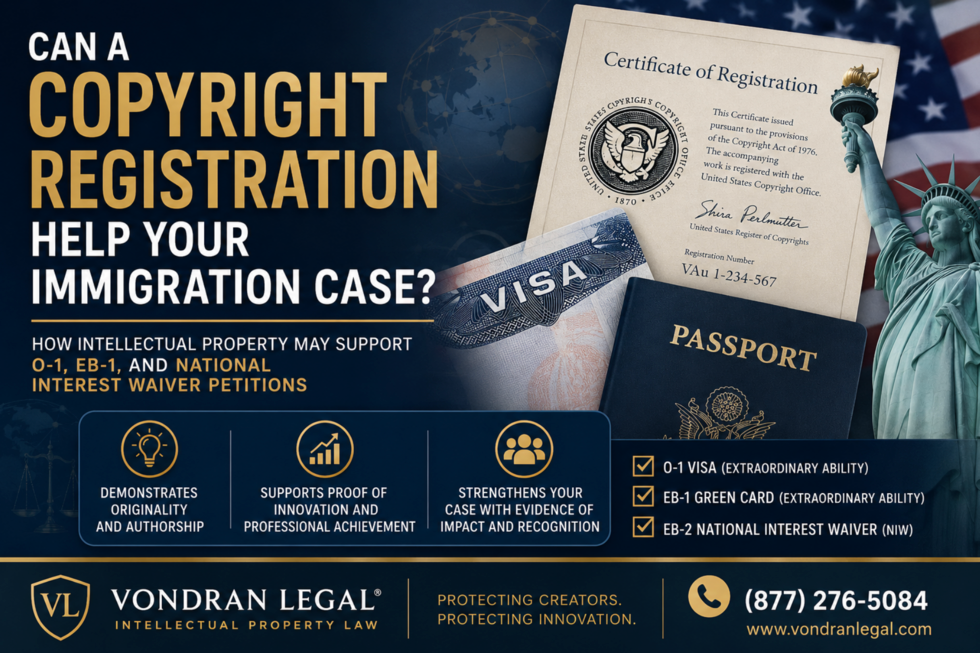
Many professionals working in creative, technical, entertainment, and research-driven industries eventually ask the same question: can owning intellectual property help support a U.S. visa or green card application?
In some cases, the answer is yes.
While a copyright registration alone will almost never guarantee approval of an immigration petition, it can become valuable supporting evidence in certain immigration categories that focus on originality, innovation, extraordinary ability, or professional achievement.
For artists, filmmakers, musicians, software developers, engineers, researchers, writers, and digital creators, copyright registrations may help strengthen the overall narrative presented to immigration authorities. As the creator economy and technology sectors continue to grow, intellectual property assets are increasingly becoming part of a professional résumé rather than just a legal protection tool.
WHAT A COPYRIGHT REGISTRATION ACTUALLY SHOWS
A copyright protects original works of authorship fixed in a tangible medium. This can include films, music, books, software code, photography, graphics, educational materials, and online content.
Although copyright protection technically exists once the work is created, registration with the United States Copyright Office creates an official government record of authorship and ownership. That official recognition can sometimes be useful in immigration petitions where originality or creative contribution is relevant.
That said, immigration authorities generally do not view a copyright registration as extraordinary by itself. Thousands of registrations are filed every day. The registration is usually considered supporting evidence, not definitive proof of distinction or importance.
The more significant issue is often whether the underlying work achieved meaningful recognition, commercial success, or industry impact.
COPYRIGHTS IN O-1 VISA PETITIONS
The O-1 Visa is designed for individuals with extraordinary ability in areas such as the arts, entertainment, business, science, athletics, or education.
One of the primary goals in an O-1 petition is demonstrating that the applicant has achieved distinction within their field. Intellectual property can sometimes help support that argument.
For example, a filmmaker with registered screenplays, a software developer with registered code, or a musician with registered compositions may use those materials to demonstrate original authorship and professional creative output. A copyright registration can help establish that the applicant independently created valuable work in their industry.
However, immigration officers usually want to see much more than a registration certificate alone. In practice, stronger O-1 cases often include evidence such as:
- Press or media recognition
- Awards or nominations
- Commercial distribution
- Industry reviews
- Significant audience reach
- Licensing deals or monetization
- High-profile collaborations
A YouTube creator with copyrighted content and millions of views will generally present a stronger case than someone with several registrations but little public visibility or professional recognition.
EB-1 GREEN CARDS AND “ORIGINAL CONTRIBUTIONS”
The EB-1 Green Card involves an even higher standard. Applicants generally must show sustained national or international acclaim and establish that they are among the small percentage at the top of their field.
One evidentiary category commonly discussed in EB-1 cases involves proof of “original contributions of major significance.” This is where copyrights and other intellectual property rights may become relevant.
For example, a software engineer who developed copyrighted tools widely adopted within an industry, or a filmmaker whose productions received major festival attention, may use those works as part of a broader evidentiary package. The copyright registration itself may help authenticate authorship and originality, while additional evidence demonstrates actual impact.
Immigration authorities are often focused on whether the work truly mattered in a professional sense. Did it influence others? Was it commercially successful? Did it receive meaningful recognition? Those issues typically carry far more weight than the registration alone.
EB-2 NATIONAL INTEREST WAIVER PETITIONS
The EB-2 National Interest Waiver may also intersect with intellectual property issues, especially in technology, research, and innovation-focused industries.
Applicants often attempt to show that their work has substantial merit and national importance. Copyrighted works can sometimes support that narrative by demonstrating innovation, authorship, technical development, or specialized expertise.
For example, a developer who created proprietary software tools, or a researcher who authored widely used educational materials, may potentially use those works to support an argument that their contributions provide broader societal or industry value.
Again, however, immigration authorities usually focus heavily on measurable real-world impact. Evidence that others use, cite, distribute, recognize, or rely upon the applicant's work is often significantly more persuasive than the mere existence of intellectual property rights.
THE BIGGEST MISCONCEPTION
One of the biggest misconceptions is that obtaining a copyright registration automatically demonstrates extraordinary ability or guarantees immigration success.
It does not.
A copyright registration primarily proves that:
- the work exists,
- the applicant claims authorship, and
- the work was formally registered.
The harder question in most immigration cases is whether the work achieved professional significance.
This is why many successful petitions combine intellectual property with broader evidence of accomplishment, including press coverage, audience reach, commercial performance, speaking engagements, awards, scholarly citations, or industry influence.
In many situations, a single successful copyrighted work with substantial visibility may be more persuasive than dozens of registrations with no measurable impact.
THE GROWING CONNECTION BETWEEN IP LAW AND IMMIGRATION
As online business, digital media, AI, entertainment, and creator-driven industries continue to expand, intellectual property is increasingly tied to professional identity and economic value.
Today, many careers are built around original content, proprietary software, educational platforms, digital branding, and monetized creative works. Because of this, intellectual property assets may continue to play a growing role in immigration petitions involving innovation or extraordinary ability.
For creators, entrepreneurs, and technical professionals, building and protecting an IP portfolio may therefore provide strategic benefits extending far beyond litigation or licensing alone.
HOW VONDRAN LEGAL® CAN ASSIST
Our firm represents creators, entrepreneurs, developers, entertainers, and online businesses nationwide in copyright and intellectual property matters. We assist with copyright registrations, software protection, content creator legal issues, licensing matters, IP portfolio strategy, and brand protection.
While we are not an immigration law firm, we understand how intellectual property assets may intersect with broader professional and business goals, including visa and residency pathways involving extraordinary ability or innovation-based petitions.
We understand the importance of protecting original work and positioning clients to maximize the long-term value of their intellectual property portfolios. You can contact us at (877) 276-5084 or reach out by email for a free initial consultation to discuss your copyright or intellectual property matter.

