
Vondran Legal® - Tattoo Copyright Law and Video Games: Understanding the Growing Legal Battle Between Tattoo Artists, Athletes, and Video Game Developers
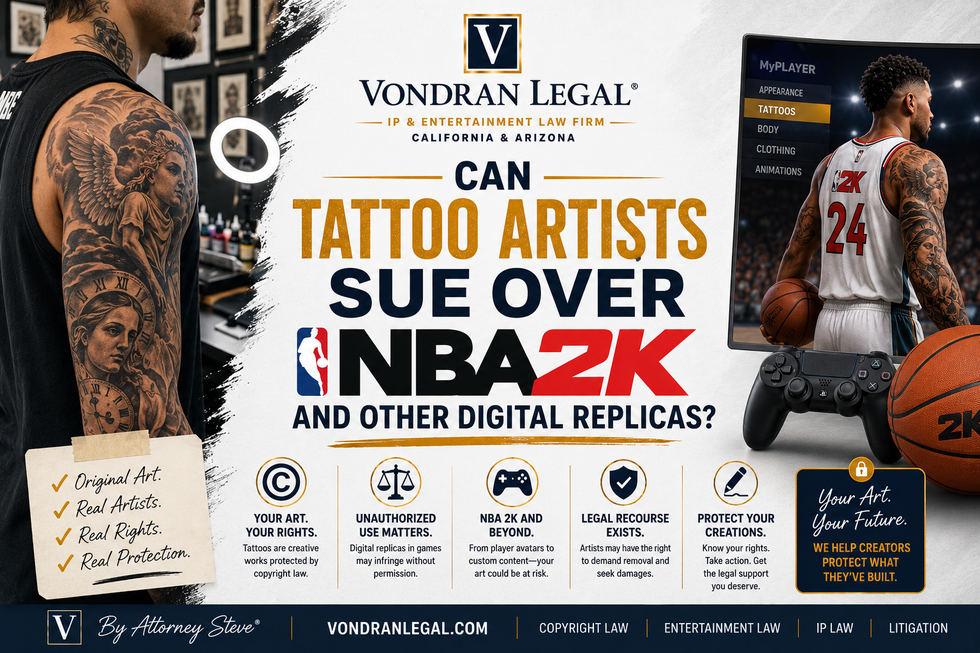
As video games become increasingly realistic, intellectual property disputes are emerging in unexpected places. One fascinating area of copyright law involves tattoos and whether tattoo artists can claim infringement when their artwork appears in video games, movies, advertisements, or other digital media.
Sports video game franchises such as NBA 2K, WWE 2K, Madden NFL, and EA Sports College Football strive to create highly realistic player avatars. These digital recreations often include distinctive tattoos that have become part of an athlete's public identity.
But who owns the rights to those tattoos?
Can a tattoo artist stop a video game developer from reproducing a player's tattoos? Does the athlete have the right to license their own image? And how do copyright laws apply when artwork is permanently inked onto a human body?
These questions have generated significant litigation in recent years and continue to shape the intersection of copyright law, publicity rights, entertainment law, and emerging technologies such as artificial intelligence and digital avatars.
Are Tattoos Protected by Copyright?
In most circumstances, the answer is yes.
Under United States copyright law, original artistic works fixed in a tangible medium of expression may qualify for copyright protection. Courts have generally recognized that tattoos can satisfy these requirements.
Like paintings, illustrations, sculptures, and graphic designs, tattoos often involve creative choices regarding:
- Artistic style
- Composition
- Shading
- Color selection
- Symbolism
- Original design elements
As a result, tattoo artists may own copyrights in their tattoo artwork unless ownership has been transferred through a written agreement.
Importantly, the copyright generally belongs to the tattoo artist—not the individual wearing the tattoo.
This creates an unusual legal situation because the copyrighted work becomes permanently attached to another person's body.
The Landmark NBA 2K Tattoo Lawsuit
One of the most important tattoo copyright cases involved the popular NBA 2K video game franchise.
Solid Oak Sketches v. Take-Two Interactive
In 2016, Solid Oak Sketches LLC, a company that acquired rights to several athlete tattoos, sued Take-Two Interactive Software and 2K Games.
The lawsuit centered on tattoos appearing on digital versions of NBA players, including:
- LeBron James
- Kenyon Martin
- Eric Bledsoe
Solid Oak argued that Take-Two unlawfully copied copyrighted tattoos when creating player avatars for NBA 2K.
The plaintiff sought damages and alleged that reproducing the tattoos without authorization constituted copyright infringement.
The Legal Issues Presented
The litigation raised several novel legal questions:
1. Are Tattoos Copyrightable Works?
The court assumed that the tattoos were sufficiently original to qualify for copyright protection.
2. Does Reproducing Tattoos in a Video Game Constitute Copying?
The court found that copying technically occurred because the tattoos were digitally recreated.
The key question became whether that copying was legally actionable.
3. Can Athletes License Their Own Likeness?
Professional athletes routinely license their names, images, and likenesses for:
- Video games
- Advertising campaigns
- Trading cards
- Merchandise
- Television appearances
The case raised the question of whether a player's image rights implicitly include tattoos that have become part of the athlete's public appearance.
Why the Court Ruled in Favor of NBA 2K
In a major victory for the gaming industry, the federal court ruled in favor of Take-Two Interactive.
Several defenses proved successful.
De Minimis Use
The court found the copying to be minimal.
The tattoos occupied only a tiny percentage of the overall game and were generally difficult to observe during actual gameplay.
Factors considered included:
- Small size of the tattoo depictions
- Fast-moving gameplay
- Limited visibility
- Minor economic significance
Because the copying was insignificant, the court found no actionable infringement.
Implied License
The court also concluded that tattoo artists effectively granted an implied license.
When tattoo artists create tattoos for professional athletes, they understand that those athletes will likely appear in:
- Televised sporting events
- Photographs
- Commercial endorsements
- Merchandise
- Video games
The court reasoned that tattoo artists could reasonably expect their work to be reproduced whenever the athlete's likeness was exploited commercially.
Fair Use
The court additionally found support under the fair use doctrine.
The tattoos were not copied for the purpose of exploiting the tattoo artwork itself.
Instead, the tattoos were reproduced as part of a larger effort to accurately depict real-world basketball players.
The transformative nature of the use favored the defendants.
The Mike Tyson Tattoo Lawsuit
Long before the NBA 2K litigation, tattoo copyright law entered mainstream discussion through the movie industry.
Whitmill v. Warner Bros.
Tattoo artist S. Victor Whitmill sued Warner Bros. over the film The Hangover Part II.
The movie featured actor Ed Helms wearing a tattoo that closely resembled Mike Tyson's famous facial tattoo.
Whitmill claimed copyright infringement and sought an injunction to stop the movie's release.
Although the case settled before trial, the court expressed concerns regarding the alleged copying and recognized that the tattoo likely qualified for copyright protection.
The lawsuit demonstrated that tattoo copyrights could create substantial legal risks for major entertainment companies.
The WWE 2K Tattoo Litigation
Another important case involved professional wrestler Randy Orton.
Alexander v. Take-Two Interactive
Tattoo artist Catherine Alexander sued Take-Two for reproducing Orton's tattoos in WWE video games.
Unlike the NBA 2K case, the plaintiff prevailed at trial.
A jury found infringement and awarded damages.
Although the damages award was relatively modest, the verdict showed that tattoo artists can succeed under certain factual circumstances.
The contrasting outcomes between the NBA and WWE cases highlight the evolving and fact-specific nature of tattoo copyright litigation.
Tattoos, Image Rights, and the Right of Publicity
One of the most difficult legal questions concerns the relationship between copyright ownership and image rights.
Professional athletes, actors, musicians, influencers, and public figures routinely monetize their identities.
Their tattoos often become inseparable from their public persona.
Consider:
- LeBron James
- Mike Tyson
- David Beckham
- Post Malone
- Travis Barker
- Dwayne "The Rock" Johnson
Their tattoos are immediately recognizable and contribute to their brand identity.
If tattoo artists retain absolute control over reproductions, public figures could theoretically lose the ability to fully commercialize their own appearance.
Courts are increasingly being asked to balance these competing interests.
How Artificial Intelligence May Complicate Tattoo Copyright Issues
The next wave of tattoo copyright disputes may involve artificial intelligence.
AI systems are now capable of generating:
- Photorealistic athlete images
- Digital twins
- Virtual influencers
- Deepfakes
- AI-generated video content
- Metaverse avatars
Future litigation may address questions such as:
- Can AI models reproduce copyrighted tattoos?
- Does AI training on tattoo images constitute infringement?
- Can digital clones include copyrighted tattoos?
- Who is liable when AI generates unauthorized reproductions?
As AI technology advances, tattoo copyright law is likely to become even more important.
What About International Copyright Law?
The answer varies significantly by country.
France
French courts generally require originality and often provide stronger protection to authors than U.S. courts.
French law does not contain the broad fair use doctrine available in the United States.
As a result, French courts could potentially reach different conclusions regarding unauthorized reproductions of tattoos.
European Union
European copyright law tends to emphasize author rights and may provide tattoo artists with stronger legal arguments than those available under U.S. law.
United Kingdom
UK courts have not yet extensively addressed tattoo copyright disputes, but similar questions regarding originality, licensing, and fair dealing could arise.
Key Lessons for Athletes, Influencers, and Content Creators
Anyone whose appearance generates commercial value should carefully consider tattoo ownership issues.
Potential best practices include:
- Obtaining written licenses from tattoo artists
- Negotiating broad reproduction rights
- Reviewing endorsement agreements
- Addressing tattoo ownership during branding negotiations
- Considering intellectual property implications before major commercial projects
For game developers, filmmakers, advertisers, and AI companies, tattoo copyrights should be included in intellectual property due diligence reviews.
Frequently Asked Questions (FAQ)
Can a tattoo be copyrighted?
Yes. Courts generally recognize original tattoo artwork as eligible for copyright protection.
Who owns the copyright in a tattoo?
Typically, the tattoo artist owns the copyright unless ownership has been transferred through a written agreement.
Can an athlete license their image if they have copyrighted tattoos?
Generally yes, but disputes may arise regarding the scope of the athlete's rights versus the tattoo artist's rights.
Did NBA 2K win the tattoo lawsuit?
Yes. The court ruled in favor of Take-Two Interactive and dismissed the infringement claims.
Did tattoo artists ever win a video game lawsuit?
Yes. In the Randy Orton WWE video game case, a jury found infringement and awarded damages to the tattoo artist.
Does fair use always protect tattoo reproductions?
No. Fair use is highly fact-dependent and must be analyzed on a case-by-case basis.
Could AI-generated avatars create tattoo copyright problems?
Potentially yes. AI-generated reproductions may raise new copyright and licensing issues that courts have not yet fully addressed.
Conclusion: Tattoo Copyright Law Is Still Evolving
The intersection of tattoo copyrights, publicity rights, video games, film, and artificial intelligence represents one of the most fascinating developments in modern intellectual property law.
Cases such as Solid Oak Sketches v. Take-Two Interactive, Whitmill v. Warner Bros., and Alexander v. Take-Two Interactive demonstrate that courts continue to grapple with competing interests involving artistic ownership, celebrity identity, technological innovation, and freedom of expression.
As digital avatars become more realistic and AI-generated content becomes more widespread, tattoo copyright disputes are likely to become increasingly common. Businesses involved in gaming, entertainment, advertising, sports, branding, and content creation should stay informed about these rapidly evolving legal issues.
Contact Vondran Legal
If you are a video game developer, athlete, influencer, content creator, entertainment company, tattoo artist, filmmaker, advertising agency, or technology company facing copyright, right of publicity, trademark, licensing, or intellectual property issues, the attorneys at Vondran Legal can help.
Our firm handles a wide range of intellectual property matters, including:
- Copyright registration and enforcement
- Entertainment law disputes
- Right of publicity claims
- Trademark protection
- Licensing agreements
- Digital media and content disputes
- Social media legal issues
- AI and emerging technology law
- Brand protection strategies
To discuss your legal matter, contact Vondran Legal today to schedule a consultation and learn how we can help protect your intellectual property rights and business interests.

