
Vondran Legal® Trademark College - things that can be trademarked.
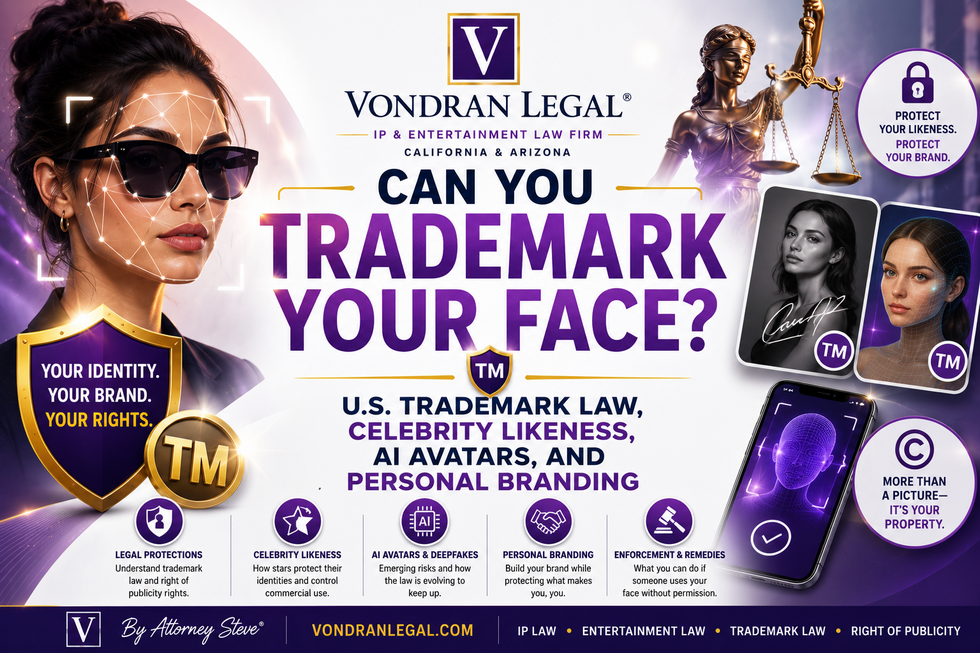
Can you trademark your face?
It sounds like a strange question, but in the modern world of influencers, athletes, streamers, actors, AI avatars, digital replicas, NIL deals, and celebrity licensing, it is becoming a very real intellectual property issue.
The short answer is: sometimes, but not simply because it is your face.
In the United States, trademark law does not usually protect a person's natural face merely as a personal identity. Trademark law protects symbols, words, designs, names, logos, images, and other source identifiers that tell consumers where goods or services come from. So, if your face or likeness functions as a brand identifier, there may be a path to trademark protection.
But if you simply want to stop people from using your image, that usually falls more under right of publicity, privacy law, copyright law, false endorsement, or unfair competition, not trademark registration alone.
Can a Face Function as a Trademark?
Yes. A face can potentially function as a trademark if consumers recognize that face as identifying a particular brand, business, product, or service.
Think of famous commercial portraits such as:
-
Colonel Sanders for KFC
-
The Wendy's girl logo
-
Betty Crocker
-
Aunt Jemima, historically
-
Uncle Ben's, historically
These are not protected merely because they depict faces. They are protected because consumers associate those images with a commercial source.
The USPTO recognizes that names, portraits, signatures, and likenesses can appear in trademark applications, but if the mark identifies a living person, written consent is generally required.
The Best U.S. Example: Colonel Sanders
One of the strongest examples of a face functioning as a trademark in the United States is Colonel Sanders.
KFC has used the image of Colonel Harland Sanders for decades. Consumers see the white-haired, bespectacled Colonel with the bow tie and immediately think of KFC. That is classic trademark significance.
KFC owns federal trademark registrations involving Colonel Sanders imagery, including registrations tied to the KFC brand and food products.
This is the key point: Colonel Sanders' face is not protected merely as a historical photograph. It is protected because it has become part of a commercial brand identity.
Can a Celebrity Trademark Their Face?
Celebrities often own trademarks in their names, signatures, logos, brands, production companies, cosmetics lines, clothing lines, or catchphrases.
But owning a trademark in your name is different from owning a trademark in your face.
For example, a celebrity might register:
-
Their stage name
-
Their signature
-
A logo based on their initials
-
A stylized image
-
A product brand
-
A clothing line
-
A cosmetics brand
-
A podcast or entertainment service name
But a broad claim to “my face” is much harder.
Why? Because trademark law is not designed to give someone ownership over their personal appearance in the abstract. The question is whether the image is being used as a mark.
Trademark vs. Right of Publicity
This is where many people get confused.
A person's face may be protected by several different legal doctrines:
Trademark Law
Trademark law protects consumer source identification. The question is: does the face identify the source of goods or services?
Right of Publicity
The right of publicity protects against unauthorized commercial exploitation of a person's name, image, likeness, identity, voice, or persona. This varies by state.
Copyright Law
A photograph of your face may be protected by copyright, but usually the photographer owns the copyright unless there is a work-made-for-hire agreement or assignment.
False Endorsement
If someone uses your face in a way that falsely suggests you endorsed their product or service, you may have a claim under Section 43(a) of the Lanham Act.
Important Case Law
White v. Samsung Electronics America, Inc.
In White v. Samsung Electronics America, Inc., 971 F.2d 1395 (9th Cir. 1992), Samsung used a robot dressed to evoke Vanna White standing near a Wheel of Fortune-style game board. The ad did not use her actual name or photograph, but the Ninth Circuit held that the right of publicity can protect a celebrity's identity even where the defendant does not use the person's literal name or likeness.
This case is important because it shows that identity rights can extend beyond a literal face.
ETW Corp. v. Jireh Publishing, Inc.
In ETW Corp. v. Jireh Publishing, Inc., 332 F.3d 915 (6th Cir. 2003), Tiger Woods' licensing company sued over an artist's print depicting Woods. The Sixth Circuit rejected broad trademark and publicity claims, emphasizing First Amendment protection for expressive works. The case is a warning that even famous people do not automatically control every image or artistic depiction of themselves.
Parks v. LaFace Records
In Parks v. LaFace Records, 329 F.3d 437 (6th Cir. 2003), Rosa Parks sued over OutKast's song titled “Rosa Parks.” The case involved Lanham Act false endorsement and right of publicity issues. The Sixth Circuit found that summary judgment was improper on certain claims, showing how personal identity, artistic expression, and consumer confusion can overlap.
In re Nieves & Nieves LLC
In In re Nieves & Nieves LLC, 113 U.S.P.Q.2d 1629 (TTAB 2015), the TTAB affirmed refusals involving the mark ROYAL KATE because of its connection to Catherine, Princess of Wales. The case is a good example of how the USPTO may refuse marks that falsely suggest a connection with a famous person.
What Does the USPTO Require?
To register a face or likeness as a trademark, the applicant usually needs to show:
-
The image is used in commerce;
-
The image identifies the source of goods or services;
-
The image is not merely ornamental;
-
The image does not falsely suggest a connection with someone else;
-
If it identifies a living person, written consent has been provided;
-
If the mark is not inherently distinctive, it has acquired distinctiveness or secondary meaning.
The USPTO's acquired distinctiveness rule allows registration where the applicant can show that consumers recognize the matter as a mark for the applicant's goods or services.
Can You Trademark a Selfie?
Usually, no.
A selfie is typically just a photograph. If you place a selfie on a T-shirt, mug, poster, or social media page, consumers may view it as decoration, expression, or personal branding, not necessarily as a trademark.
However, a stylized version of your face used consistently as a logo may be different.
For example, a podcaster, YouTuber, comedian, musician, chef, athlete, or influencer might build a brand around a stylized face logo. If that logo is used consistently on merchandise, digital services, entertainment services, educational content, or consumer products, trademark protection may become possible.
Why This Matters in the Age of AI
This issue is becoming more important because of:
-
AI-generated avatars
-
Deepfakes
-
Influencer cloning
-
Digital replicas
-
Celebrity voice and face licensing
-
NIL deals for athletes
-
Virtual influencers
-
YouTube and TikTok personal brands
-
Unauthorized merchandise
-
Fake endorsements
As AI tools make it easier to copy a person's face, voice, and persona, trademark law may become one part of a larger protection strategy.
But again, trademark law is not a magic shield. A strong protection plan may involve:
-
Trademark registration
-
Copyright assignments
-
NIL agreements
-
Right of publicity enforcement
-
DMCA takedowns
-
Platform takedown notices
-
Licensing contracts
-
Cease-and-desist letters
-
False endorsement claims
-
Brand monitoring
Practical Examples
Example 1: The Influencer Logo
An influencer creates a cartoon version of her face and uses it on her YouTube channel, clothing line, website, digital courses, and product packaging.
This may be a good candidate for trademark protection.
Example 2: The Unauthorized Celebrity T-Shirt
A seller puts a famous actor's face on T-shirts without permission.
That may trigger right of publicity claims, copyright claims if a protected photo was used, and possibly false endorsement claims. But it does not necessarily mean the actor has a trademark in every image of their face.
Example 3: The AI Fake Endorsement
A company uses an AI-generated version of a lawyer, athlete, doctor, or influencer to promote a product.
This could raise serious issues involving false endorsement, right of publicity, unfair competition, consumer deception, and potentially trademark infringement if the person's brand identifiers are used.
Example 4: The Business Founder as Brand
A chef uses his face as the logo for a restaurant chain. Over time, customers associate that stylized face with the restaurant.
That may support trademark registration, similar in concept to Colonel Sanders.
So, Can You Trademark Your Face?
The best answer is:
You cannot usually trademark your face just because it is your face. But you may be able to trademark a particular image, portrait, drawing, logo, or stylized likeness of your face if it functions as a source identifier for your goods or services.
The more your face functions like a logo, the stronger your trademark argument becomes.
The more it functions like decoration, personality, biography, or expressive content, the harder registration becomes.
Trademark Services for Personal Brands, Creators, and Businesses
Vondran Legal helps creators, entrepreneurs, influencers, software companies, athletes, entertainers, and business owners evaluate, file, enforce, and defend trademark rights.
Our trademark services may include:
-
Trademark clearance searches
-
USPTO trademark applications
-
Office Action responses
-
Trademark portfolio strategy
-
Brand protection for influencers and creators
-
Personal brand trademark analysis
-
Logo and character trademark filings
-
False endorsement analysis
-
Right of publicity enforcement
-
Cease-and-desist letters
-
Marketplace takedown strategy
-
Trademark infringement defense
-
TTAB opposition and cancellation matters
-
Licensing and brand deal agreements
If you are building a personal brand around your name, face, image, logo, avatar, or character, it is important to understand what can be protected, what cannot, and which legal tools fit your situation.
Final Takeaway
Faces are powerful. In today's creator economy, a face can be a brand, a business asset, a licensing tool, and a target for infringement.
But U.S. trademark law asks a specific question:
Does the face identify the source of goods or services?
If the answer is yes, trademark protection may be possible.
If the answer is no, other legal rights may still apply.
The smartest approach is to build a layered protection strategy that includes trademark, copyright, publicity rights, contracts, and enforcement planning.
Attorney Steve® Tip: If your face, avatar, character, or likeness is becoming part of your brand, do not wait until someone copies it. Get your intellectual property strategy in place early.

