
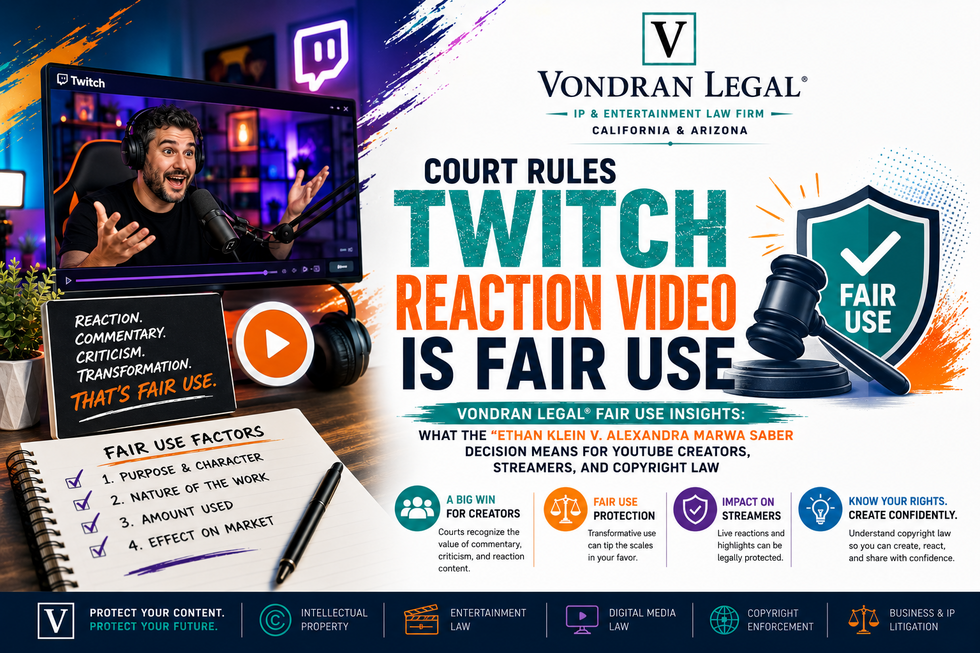
Vondran Legal® Fair Use Insights: What the Ethan Klein v. Alexandra Marwa Saber Decision Means for YouTube Creators, Streamers, and Copyright Law
By Attorney Steve® | Vondran Legal®
Reaction videos have become one of the most popular forms of online content, generating millions of views across YouTube, Twitch, Kick, and other streaming platforms. But they also raise one of the most frequently asked questions in copyright law: When does reacting to someone else's video cross the line into copyright infringement?
A recent federal court decision provides another important answer. In Ted Entertainment Inc. v. Alexandra Marwa Saber, a federal district court held that a Twitch livestream reacting to and criticizing YouTuber Ethan Klein's documentary constituted fair use under Section 107 of the Copyright Act. Even though the streamer displayed much, if not all, of the documentary during the broadcast, the court concluded that her extensive criticism, commentary, and opposing viewpoints transformed the original work into something legally distinct.
This decision is significant for YouTubers, Twitch streamers, podcasters, educators, journalists, and anyone who creates reaction content. While every fair use case remains highly fact-specific, the opinion reinforces an important principle: copyright law protects meaningful commentary and criticism—not merely the original creator's exclusive right to control every discussion about his or her work.
Background of the Case
Plaintiff Ted Entertainment Inc., owned by popular YouTube creator Ethan Klein, produced and published a documentary entitled "Content Nuke: Hasan Piker." The documentary focused on Twitch personality Hasan Piker and criticized his political viewpoints relating to the Israel-Palestine conflict.
Defendant Alexandra Marwa Saber, herself a Twitch streamer, later livestreamed while watching the documentary. Throughout the broadcast she provided continuous reactions, criticism, commentary, and analysis regarding the documentary's editing, factual support, presentation, sources, arguments, and overall persuasive value. According to the allegations, Saber's commentary frequently challenged Klein's conclusions and advocated viewpoints largely opposite those expressed in the documentary.
Ted Entertainment sued Saber for copyright infringement, alleging that her livestream unlawfully reproduced and publicly displayed the documentary to a new audience.
Rather than waiting for discovery or trial, Saber moved for judgment on the pleadings, arguing that—even accepting all allegations in the complaint as true—the complaint itself established that her use constituted fair use as a matter of law.
The district court agreed.
What Is a Motion for Judgment on the Pleadings?
A motion for judgment on the pleadings, typically brought under Federal Rule of Civil Procedure 12(c), asks the court to decide the case based solely upon the pleadings—the complaint, answer, and any documents properly incorporated into them.
Unlike summary judgment, no evidence outside the pleadings is considered. Instead, the court assumes the factual allegations in the complaint are true and determines whether, as a matter of law, the plaintiff has stated a legally viable claim.
Although fair use is often considered a fact-intensive defense that proceeds through discovery, courts have increasingly resolved fair use disputes at the pleading stage when the copyrighted works themselves are before the court and the transformative nature of the use is apparent from the complaint.
That is precisely what occurred here.
IRAC Analysis
Issue
Did Alexandra Marwa Saber's Twitch reaction livestream infringe Ted Entertainment's copyright in Ethan Klein's documentary, or did the livestream qualify as protected fair use under Section 107 of the Copyright Act?
Rule
Section 107 of the Copyright Act identifies four non-exclusive factors courts consider when determining whether a particular use constitutes fair use:
-
The purpose and character of the use, including whether the use is transformative.
-
The nature of the copyrighted work.
-
The amount and substantiality of the copyrighted work used.
-
The effect of the use upon the potential market for or value of the original work.
No single factor controls the outcome. Courts balance all four factors while focusing on copyright's broader constitutional purpose of encouraging creativity and public discourse.
Analysis
Factor One: Purpose and Character of the Use
The first factor strongly favored Saber because her livestream did considerably more than simply rebroadcast Ethan Klein's documentary. Throughout the broadcast she continuously criticized the documentary's factual assertions, editing decisions, sources, presentation style, and underlying political conclusions.
The court emphasized an important principle frequently misunderstood by creators: the law does not evaluate whether criticism is accurate, polite, fair, or respectful. Rather, the inquiry asks whether the copyrighted work has been used for a genuinely different expressive purpose.
Here, the answer was yes.
The court observed that Saber's purpose was to challenge, mock, criticize, and dispute Klein's message rather than merely exploit his creative expression.
Ironically, the plaintiff's own complaint strengthened Saber's fair use defense. Ted Entertainment alleged that Saber's purpose was to persuade viewers to adopt views directly opposite those advanced in the documentary. Those allegations demonstrated that the livestream served a fundamentally different expressive purpose.
Although Saber monetized her Twitch broadcasts through subscriptions, donations, and advertising revenue, the court held that commerciality did not outweigh the highly transformative nature of the work.
Accordingly, the first factor strongly favored fair use.
Factor Two: Nature of the Copyrighted Work
The court recognized that Ethan Klein's documentary was a creative audiovisual work deserving meaningful copyright protection. At the same time, it contained substantial factual and informational material discussing public events and political issues.
Because creative works generally receive stronger copyright protection, this factor favored the plaintiff.
However, courts routinely describe this factor as carrying relatively little weight where the secondary use consists of criticism, commentary, or public discussion.
Factor Three: Amount and Substantiality Used
Ted Entertainment argued that Saber displayed essentially the entire documentary during her livestream.
Ordinarily, copying an entire copyrighted work weighs against fair use.
The court, however, recognized that criticism often requires showing substantial portions of the original work. One cannot effectively critique editing, pacing, factual assertions, or rhetorical techniques without allowing viewers to see the material being discussed.
Accordingly, the amount used was considered reasonable in relation to Saber's transformative purpose.
The court therefore declined to weigh this factor against the defendant.
Factor Four: Market Effect
The fourth factor also favored Saber.
The court concluded that Saber's reaction stream was not a substitute for Ethan Klein's documentary. Someone watching Klein's original documentary sought one type of viewing experience. Someone watching Saber's reaction stream received a fundamentally different experience built upon criticism, disagreement, and opposing political viewpoints.
Because the reaction stream occupied a different expressive space and did not serve as a market replacement for the original documentary, the court found little likelihood of market substitution.
Again, the plaintiff's own allegations proved significant because they described Saber's work as advocating the opposite viewpoint rather than duplicating Klein's message.
Conclusion
Balancing all four statutory factors, the district court concluded that three of the four factors favored Saber, with the second factor carrying comparatively little weight. The court therefore held that Saber's Twitch reaction stream constituted fair use and granted judgment on the pleadings in her favor, dismissing the copyright infringement claim before discovery ever began.
Why This Decision Matters
This opinion joins a growing body of federal decisions recognizing that meaningful reaction content occupies an important place within the First Amendment and the Copyright Act.
The court reinforced several important principles:
A creator may show substantial portions of another work when doing so is reasonably necessary to provide meaningful criticism or commentary.
Courts focus primarily upon whether the new work adds new expression, meaning, or message, rather than merely republishing the original.
Commercial monetization through advertising, subscriptions, or donations does not automatically defeat fair use where the work is highly transformative.
Perhaps most importantly, criticism need not be polite or even accurate. Copyright law protects commentary itself, not merely favorable commentary.
Attorney Steve® Takeaways
As someone who has represented creators, photographers, YouTubers, software companies, and copyright owners in infringement disputes across the country, I believe this case provides several practical lessons.
First, creators should understand that simply calling something a "reaction video" does not automatically create fair use. Courts continue to examine what the creator actually contributes to the new work. Passive viewing, silent watching, or merely reposting another person's content remains legally risky.
Second, meaningful commentary matters. The more analysis, criticism, education, humor, insight, or original discussion a creator adds, the stronger the fair use argument generally becomes.
Third, copyright owners should carefully evaluate fair use before sending DMCA takedown notices. Numerous federal decisions—including Lenz v. Universal Music Corp., Hosseinzadeh v. Klein, and now Ted Entertainment v. Saber—demonstrate that courts take transformative uses seriously. Filing an aggressive takedown against clearly transformative content may expose a copyright owner to unnecessary litigation and, in some circumstances, potential claims under Section 512(f) of the DMCA for knowingly material misrepresenting infringement.
Finally, remember that fair use remains one of the most fact-specific doctrines in copyright law. Small factual differences can produce dramatically different legal outcomes. A successful reaction channel typically involves continuous commentary, criticism, education, or analysis throughout the presentation—not simply rebroadcasting someone else's work.
Final Thoughts
The Ted Entertainment v. Saber decision is another important victory for transformative online content. It confirms that copyright law exists not only to protect original creators but also to encourage criticism, debate, commentary, and public discussion. As online media continues to evolve, courts appear increasingly willing to distinguish genuine transformative reaction content from unauthorized copying.
For YouTubers, Twitch streamers, educators, journalists, and commentators, this decision provides additional guidance that thoughtful, substantive commentary remains one of the strongest foundations for asserting a fair use defense.
Need Help with a Fair Use Dispute?
Whether you have received a DMCA takedown notice, a copyright infringement demand letter, a YouTube copyright strike, or are defending a reaction video, parody, documentary, livestream, or commentary channel, Vondran Legal®represents creators, businesses, influencers, photographers, software companies, and online publishers in copyright matters throughout the United States.
To schedule a consultation regarding your copyright or fair use issue, contact Attorney Steve® at Vondran Legal®. We help clients evaluate fair use defenses, respond to infringement allegations, negotiate settlements, litigate copyright claims, and protect valuable creative works.

