
ATTORNEY STEVE® – CALL US IF YOU NEED HELP WITH COPYRIGHT ENFORCEMENT, FAIR USE, OR CREATOR RIGHTS DISPUTES – (877) 276-5084.
INTRODUCTION
The American Law Institute (ALI) recently completed its Restatement of the Law, Copyright, a nearly decade-long project intended to guide courts in areas of copyright law where judicial discretion is broad. While ALI Restatements have historically focused on common law subjects such as torts and contracts, this marked the first time the organization attempted to restate a comprehensive federal statutory scheme like copyright.
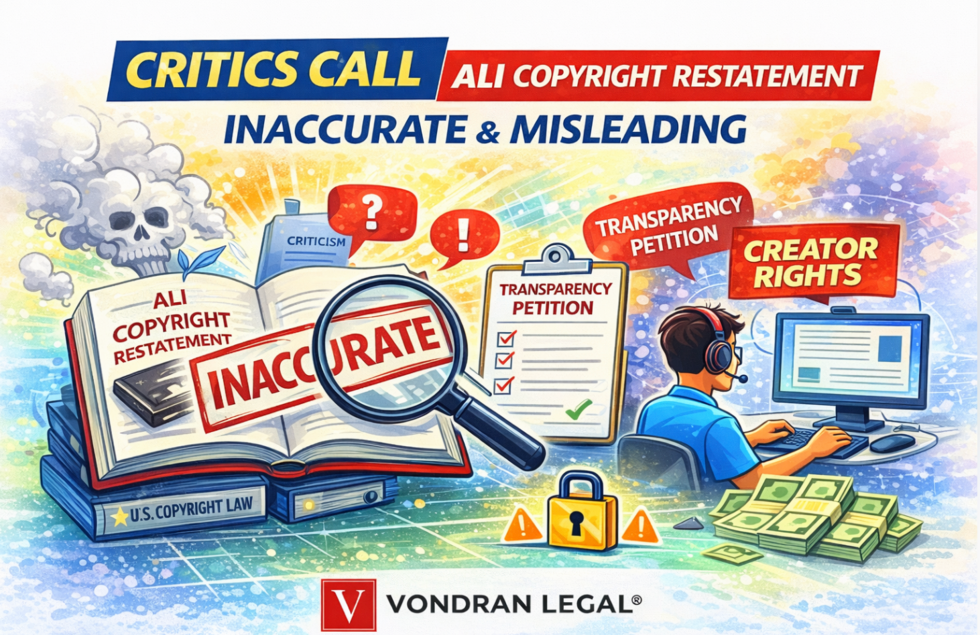
The project has drawn sharp criticism from leading copyright scholars, former judges, and creators' groups. In response, a coalition of rights-holder organizations launched the Copyright Restatement Transparency Project, urging courts to exercise caution when relying on the Restatement and warning that it may misstate existing copyright law.
BACKGROUND – THE ALI COPYRIGHT RESTATEMENT
The ALI describes its Copyright Restatement as an effort to synthesize “general copyright law” and provide guidance in complex or unsettled areas. However, throughout the drafting process, representatives from the U.S. Copyright Office, prominent copyright academics, and experienced practitioners raised concerns about the Restatement's methodology and conclusions.
Those concerns escalated when more than one-third of the project's advisers and liaisons reportedly resigned, citing unresolved objections and fear that the Restatement departed from black-letter law.
CORE CRITICISMS OF THE RESTATEMENT
Critics argue that the Restatement does not simply summarize existing law, but instead reshapes it in ways that could weaken copyright protections.
Key criticisms include:
-
Overreliance on fringe or exceptional cases while downplaying controlling Supreme Court and appellate precedent.
-
Fair use analysis that emphasizes pro-defendant outcomes and creates the impression of broader fair use rights than currently recognized by courts.
-
Fixation standards that introduce novel concepts such as “enjoyment or exploitation” tests that have no grounding in the Copyright Act.
-
Shadow statutes, where Restatement language appears to create new doctrinal rules unsupported by precedent.
Prominent copyright scholars including Ginsburg, Menell, Balganesh, and Nimmer warned ALI members that adoption of the Restatement could mislead courts and practitioners about the actual scope of copyright law.
THE COPYRIGHT RESTATEMENT TRANSPARENCY PETITION
In response, creator-focused organizations formed the Copyright Restatement Transparency Project (CRTP). The petition does not seek to overturn the Restatement outright, but instead calls for transparency and caution in its use.
The petition urges courts and practitioners to recognize that:
-
The Restatement has faced extensive criticism from leading experts.
-
It does not override statutory law or binding precedent.
-
Courts should be informed of its contested status before relying on it.
-
ALI should consider restructuring or limiting the Restatement's scope.
The petition emphasizes participation from digital creators, warning that expanded fair use doctrines or weakened fixation standards could materially reduce copyright protection for online content.
WHY THIS MATTERS FOR CREATORS AND COPYRIGHT OWNERS
Although the Restatement does not change the law by itself, it can influence judicial reasoning, especially in close cases involving fair use, user-generated content, platform liability, and emerging technologies.
If courts rely on Restatement sections that narrow distribution rights, expand fair use, or redefine fixation, creators could face:
-
Reduced enforcement leverage
-
Increased litigation risk
-
Greater uncertainty in licensing and monetization
For copyright owners, awareness of this debate is critical when litigating or briefing copyright issues in federal court.
CONCLUSION
Copyright law is complicated enough without adding new “rules” that do not actually exist in the statute. The debate around the ALI Copyright Restatement shows why experience matters. Knowing the difference between binding law, persuasive commentary, and creative reinterpretation can make or break a copyright case.
At Vondran Legal®, we spend our days in the weeds of copyright law. We know what courts must follow, what they may consider, and what deserves a healthy dose of skepticism. When new guidance documents start blurring those lines, we know how to spot the issues early and protect our clients from unintended consequences.
If you are a creator, rights holder, or business navigating fair use, enforcement, or emerging copyright arguments, having counsel who understands both the statute and the strategy matters. This is not theoretical law. It is real-world copyright protection.
CONTACT A CALIFORNIA COPYRIGHT ATTORNEY
Since 2004, Vondran Legal® has been a clear leader in copyright and trademark infringement matters in the United States. We have handled over 1,000 copyright and DMCA cases, including fair use opinions, enforcement actions, federal court litigation, and platform disputes involving YouTube, Amazon, TikTok, and online content creators. If you have questions about copyright enforcement, fair use, or evolving legal standards affecting creators, contact Vondran Legal® for a no-cost confidential consultation at (877) 276-5084.

