
VONDRAN LEGAL® | FALSE ADVERTISING AND UNFAIR COMPETITION LAW
INTRODUCTION
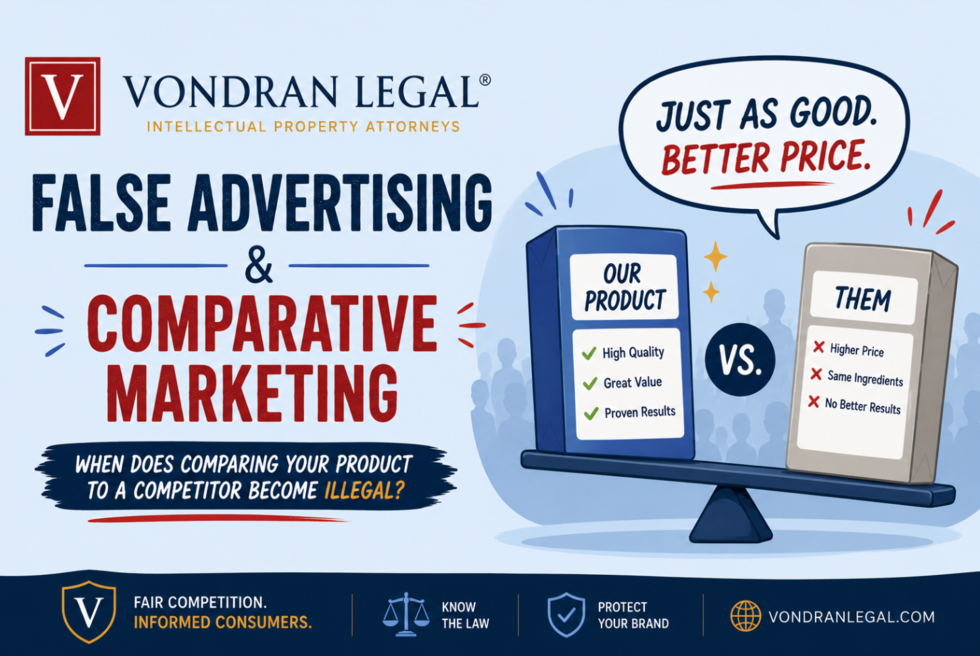
Comparative advertising has become one of the most effective marketing tools in today's marketplace.
Businesses routinely compare their products to competitors by emphasizing price, quality, performance, durability, ingredients, or overall value. Consumers also encounter these comparisons every day through social media influencers, online retailers, and advertising campaigns promoting lower priced alternatives to premium products.
Many businesses understandably ask the following question.
Can I legally advertise my product as being comparable to another company's product?
In many situations, the answer is yes.
Truthful comparative advertising is generally lawful and is often encouraged because it promotes competition and helps consumers make informed purchasing decisions.
However, businesses that make false, misleading, or unsupported claims may expose themselves to significant liability under the Lanham Act, state unfair competition laws, and, in some cases, enforcement actions by the Federal Trade Commission.
Understanding where the legal line is drawn can help businesses market their products aggressively while minimizing unnecessary legal risk.
WHAT IS COMPARATIVE ADVERTISING?
Comparative advertising occurs when a business compares its product or service to that of a competitor.
The comparison may identify the competing brand directly or indirectly.
Examples include statements such as:
- "Comparable to Brand X."
- "Luxury quality for half the price."
- "Works just like the leading brand."
- "The affordable alternative."
- "Contains the same active ingredients."
These comparisons have become increasingly common across numerous industries, including fashion, cosmetics, food products, dietary supplements, consumer electronics, home goods, and pharmaceuticals.
Simply comparing one product to another does not violate the law.
The legal issue arises when the comparison is false, misleading, or cannot be supported with reliable evidence.
WHAT DOES THE LAW CONSIDER FALSE ADVERTISING?
False advertising is not limited to statements that are completely false.
In many cases, advertising may violate the law because it creates a misleading impression, even if every individual sentence is technically accurate.
Courts generally evaluate advertisements from the perspective of the ordinary consumer.
The question is not simply whether every statement is literally true. Instead, courts examine whether the advertisement, viewed as a whole, is likely to mislead consumers about an important aspect of the product.
For that reason, businesses should carefully evaluate not only the words they choose, but also the overall message conveyed through images, product comparisons, headlines, graphics, and advertising context.
THE LANHAM ACT PROHIBITS FALSE OR MISLEADING ADVERTISING
Section 43(a) of the Lanham Act provides businesses with an important cause of action against competitors that make false or misleading representations in commercial advertising or promotion.
Unlike trademark infringement, these claims focus primarily on the truthfulness of advertising rather than consumer confusion regarding brand identity.
Generally speaking, a plaintiff pursuing a Lanham Act false advertising claim must establish that:
- The defendant made a false or misleading statement of fact.
- The statement appeared in commercial advertising or promotion.
- The statement deceived, or had the tendency to deceive, a substantial segment of consumers.
- The deception was material to purchasing decisions.
- The statement entered interstate commerce.
- The plaintiff suffered or is likely to suffer commercial injury.
Because these claims often involve detailed factual disputes, businesses should carefully review advertising claims before publication.
LITERAL FALSITY VERSUS IMPLIED FALSITY
False advertising claims generally fall into two categories.
The first involves literal falsity.
These are objective factual statements that are simply untrue.
Examples include:
- "Contains twice the active ingredient."
- "Made entirely in the United States."
- "Clinically proven to outperform Brand X."
- "Lasts twice as long as the leading competitor."
If these statements are false, liability may follow without extensive evidence regarding consumer perception.
The second category involves implied falsity.
These cases are often more complicated because the advertisement may not contain any statement that is literally false. Instead, the overall message conveyed to consumers may be misleading.
For example, advertising a product as "virtually identical" to a luxury competitor may lead consumers to believe the products share the same ingredients, quality, manufacturing process, or performance characteristics when no such evidence exists.
These cases frequently require consumer surveys or other evidence demonstrating how consumers interpret the advertisement.
THE IMPORTANCE OF SUBSTANTIATION
One of the most important principles of advertising law is substantiation.
Businesses should possess a reasonable basis for objective advertising claims before those claims are published.
For example, if a company advertises that its product:
- Performs better.
- Lasts longer.
- Contains superior ingredients.
- Provides identical performance.
- Delivers the same quality at a lower price.
the advertiser should have competent evidence supporting those representations.
Waiting until litigation begins to gather supporting evidence may be too late.
Businesses should remember that objective claims generally require objective proof.
NOT EVERY ADVERTISING CLAIM IS ILLEGAL
The law recognizes an important distinction between factual representations and advertising puffery.
Statements such as:
- "The world's best coffee."
- "The ultimate experience."
- "Exceptional quality."
- "The finest craftsmanship."
are generally viewed as subjective opinions that consumers do not interpret as objective facts.
By contrast, measurable claims involving ingredients, testing, performance, durability, or product comparisons may require reliable substantiation.
Understanding this distinction is critical when developing advertising campaigns.
THE FEDERAL TRADE COMMISSION ALSO PLAYS AN IMPORTANT ROLE
In addition to private lawsuits under the Lanham Act, businesses should also consider the Federal Trade Commission.
Section 5 of the FTC Act prohibits unfair or deceptive acts or practices affecting commerce.
The FTC expects advertisers to possess competent and reliable evidence supporting objective claims before advertisements are disseminated.
This is particularly important when advertisements involve:
- Scientific testing
- Health claims
- Environmental claims
- Comparative product testing
- Performance claims
Businesses should not assume that competitors are following these rules simply because similar advertising already exists in the marketplace.
Each advertiser remains responsible for substantiating its own claims.
IMPORTANT COURT DECISIONS
Several important court decisions continue to shape false advertising law.
In Lexmark International, Inc. v. Static Control Components, Inc., 572 U.S. 118 (2014), the United States Supreme Court clarified which businesses have standing to pursue false advertising claims under the Lanham Act. The Court held that plaintiffs must demonstrate injuries to commercial interests that fall within the zone of interests protected by the statute.
Another significant decision is POM Wonderful LLC v. Coca Cola Co., 573 U.S. 102 (2014).
There, the Supreme Court held that compliance with federal food labeling regulations does not automatically shield a business from Lanham Act false advertising claims brought by competitors.
The Court reaffirmed that businesses remain responsible for ensuring their marketing accurately represents their products.
Another frequently cited case is Castrol Inc. v. Pennzoil Co., 987 F.2d 939 (3d Cir. 1993).
In Castrol, the Third Circuit affirmed an injunction against comparative advertising claims after concluding that certain superiority claims lacked adequate substantiation. The decision remains an important reminder that businesses should possess competent evidence supporting objective performance claims before advertising them to consumers.
SOCIAL MEDIA HAS CHANGED THE LANDSCAPE
The growth of TikTok, Instagram, YouTube, and other social media platforms has transformed comparative advertising.
Today, millions of consumers discover products through influencers rather than traditional advertising.
Many promotional videos include statements such as:
"This is the best dupe I have ever found."
"It works exactly like the luxury version."
"Nobody can tell the difference."
"It performs just like the original."
These statements often blur the line between personal opinion and commercial advertising.
If an influencer has a material relationship with the company promoting the product, those statements may become commercial advertising subject to FTC endorsement guidelines and, in some circumstances, Lanham Act scrutiny.
Businesses working with influencers should establish clear marketing guidelines and periodically review promotional content for legal compliance.
FALSE ADVERTISING CLAIMS ARE BECOMING MORE COMMON IN DUPE LITIGATION
One of the most interesting developments discussed during the recent webinar involved the growing use of false advertising claims in litigation involving copycat products.
Historically, businesses primarily relied upon trademark, copyright, or trade dress claims.
That strategy is evolving.
Increasingly, companies are alleging that competitors mislead consumers by exaggerating the similarity between competing products.
Rather than arguing that a competitor copied a trademark or product design, plaintiffs may contend that advertising falsely suggests the competing product offers the same quality, ingredients, durability, effectiveness, or overall performance.
This shift reflects an important reality.
Consumers purchasing dupe products often understand they are not purchasing the original brand.
As a result, proving traditional trademark infringement may become more difficult.
False advertising claims allow businesses to focus on the accuracy of marketing statements rather than solely on the appearance of the product.
As discussed during the webinar, false advertising has become one of the fastest growing legal theories in litigation involving dupe products. It is likely to remain an important area of intellectual property litigation as copycat products continue to expand across numerous industries.
STATE LAWS MAY PROVIDE ADDITIONAL REMEDIES
Businesses should also remember that many states maintain their own unfair competition and false advertising statutes.
For example, California businesses frequently litigate claims under California's Unfair Competition Law and False Advertising Law in addition to the Lanham Act.
These state statutes may provide additional remedies depending upon the facts of the case.
Businesses operating nationwide should evaluate advertising campaigns under both federal law and applicable state law.
PRACTICAL TIPS FOR BUSINESSES
Businesses should consider several best practices before launching comparative advertising campaigns.
These include:
- Verify factual claims through reliable testing.
- Maintain documentation supporting advertising claims.
- Distinguish objective facts from advertising opinions.
- Carefully review influencer marketing campaigns.
- Consult experienced legal counsel before making comparative performance claims.
- Regularly monitor advertising materials for continued compliance.
Taking these steps early may significantly reduce the likelihood of costly litigation.
FINAL THOUGHTS
Comparative advertising remains a valuable and lawful marketing strategy when used responsibly.
Businesses are generally free to compare their products to competitors, provided those comparisons are truthful, accurate, and supported by reliable evidence.
As litigation involving copycat products continues to evolve, false advertising and unfair competition claims are becoming increasingly important tools for businesses seeking to protect their brands and challenge misleading marketing practices.
At Vondran Legal®, our intellectual property attorneys regularly advise businesses regarding false advertising, unfair competition, comparative marketing, trademark law, trade dress, Lanham Act litigation, influencer marketing, and comprehensive brand protection strategies.
If your business has questions regarding comparative advertising, false advertising claims, or unfair competition, contact Vondran Legal® at (877) 276-5084 for a free consultation.
