
Vondran Legal® Music Law Question of the Day - Music Licenses and public performance. Call us at (877) 276-5084.

Grok Music Law Question & Answer
Introduction
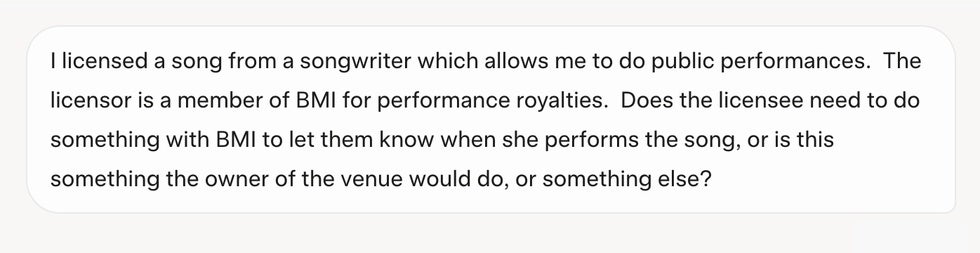
When you license a song for public performance from a songwriter who is a member of BMI (Broadcast Music, Inc.), the responsibility for reporting performances and paying royalties typically falls on the venue or event organizer, not the licensee (you) or the songwriter. Here's a breakdown of how it works:
-
Venue's Responsibility:
- In the United States, venues (e.g., concert halls, bars, restaurants, or any public spaces where music is performed) are generally required to obtain blanket licenses from performing rights organizations (PROs) like BMI, ASCAP, or SESAC. These licenses cover the public performance of all songs in the PROs' catalogs.
- The venue reports the performances (often through setlists or general music usage reports) to BMI, which then distributes royalties to the songwriter and publisher based on the performance data.
-
Your Responsibility as the Licensee:
- As the performer with a license to perform the song, you typically do not need to directly notify BMI about your performances, assuming the venue is properly licensed.
- However, to ensure the songwriter receives their due royalties, you should:
- Provide the venue with accurate setlist information, including the title of the song, the songwriter's name, and ideally the BMI work ID (if known). This helps BMI attribute royalties correctly.
- Confirm with the venue that they have a valid BMI license (and other PRO licenses, if applicable) to cover the performance of the song.
-
Songwriter's Role:
- The songwriter, as a BMI member, has already registered the song with BMI. They rely on BMI to collect performance royalties from licensed venues and distribute them accordingly.
- The songwriter does not typically need to take additional steps for individual performances, as long as the venue is licensed and reports the performance.
-
What If the Venue Isn't Licensed?:
- If the venue does not have a BMI license, you (as the performer) could technically be held liable for performing copyrighted music without authorization, as your license may not cover the venue's public performance obligations.
- In such cases, you should inform the venue that they need to secure a BMI license or contact BMI directly to clarify the situation. Alternatively, you may need to negotiate with the songwriter to ensure the performance is covered under your license terms.
-
Special Cases:
- If you're performing at a private event or a venue not typically covered by a BMI blanket license (e.g., a non-commercial setting), you may need to contact BMI directly to report the performance or secure a specific license for that event.
- For large-scale events like festivals or televised performances, BMI may require additional reporting from the event organizer or broadcaster, but this is still typically handled by the organizer, not you.
Recommended Actions:
-
Verify Venue Licensing: Before performing, ask the venue if they have a current BMI license (and licenses from other PROs like ASCAP or SESAC, as needed).
-
Submit Setlists: Provide the venue with a setlist that includes the licensed song's details (title, songwriter, and BMI affiliation, if possible). Some venues have online portals or forms for submitting this information.
-
Check Your License Terms: Review the license agreement with the songwriter to confirm whether it places any specific obligations on you regarding performance reporting or PRO notifications.
- Contact BMI if Unsure: If you're uncertain about the venue's licensing status or your obligations, you can reach out to BMI directly (via their website, www.bmi.com, or customer service) to clarify. Provide details about the performance (date, location, song) to ensure proper tracking.
Additional Notes:
- BMI's royalty distribution process relies on data from venues, radio, TV, streaming platforms, and other sources. Smaller venues may use sampling or general music usage reports rather than precise setlists, so royalty payments may not always be tied to specific performances.
- If you're performing in a country outside the U.S., the process may involve the local PRO (e.g., PRS in the UK, SOCAN in Canada), and you should check with the venue or the songwriter about international reporting requirements.
By ensuring the venue is licensed and providing accurate setlist information, you can help ensure the songwriter receives their performance royalties without needing to take on additional reporting responsibilities yourself. If you have further details about the performance context (e.g., venue type, location, or license terms).

