
Library of Congress Mandatory Deposit Requirements: A Complete Guide for Authors, Publishers, Musicians, Photographers, Software Companies, and Copyright Owners
By Attorney Steve® | Copyright Lawyer
Keywords: Library of Congress mandatory deposit, mandatory deposit copyright, 17 U.S.C. § 407, Library of Congress deposit requirements, Copyright Office deposit, copyright registration vs mandatory deposit, best edition copyright, published works copyright, copyright compliance.
Introduction
Many creators believe that once they create an original work, their legal obligations under copyright law are finished. Others believe that filing a copyright registration with the U.S. Copyright Office is the only filing requirement that exists.
Not exactly.
One of the least understood provisions of the Copyright Act is the mandatory deposit requirement found in 17 U.S.C. § 407. Although this provision has existed for decades, surprisingly few authors, photographers, software companies, filmmakers, musicians, or independent publishers understand what it requires—or when it applies.
If you publish works in the United States, understanding mandatory deposit is important. While failure to comply generally does not destroy your copyright ownership, Congress has given the Register of Copyrights authority to demand deposits and assess monetary penalties when publishers fail to comply after receiving notice.
This guide explains:
- What mandatory deposit is
- Who must comply
- Which works are covered
- The difference between registration and mandatory deposit
- The "best edition" rule
- Digital publication issues
- Potential penalties
- Frequently asked questions
- Practical tips for copyright owners
Whether you are an author, publisher, software developer, photographer, artist, musician, filmmaker, or business owner, this guide will help you understand one of the most overlooked areas of U.S. copyright law.
What Is Mandatory Deposit?
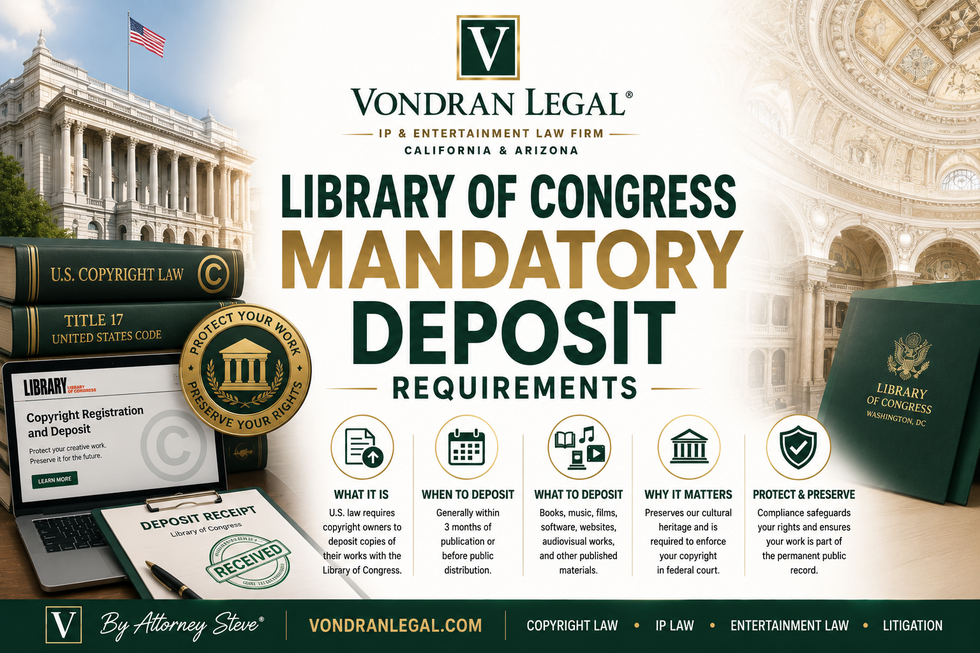
Mandatory deposit is a statutory obligation requiring certain published works to be deposited with the United States Copyright Office for the benefit of the Library of Congress.
Unlike copyright registration, the purpose of mandatory deposit is not to create copyright protection.
Instead, Congress created the system to preserve America's published cultural, literary, artistic, musical, historical, and scientific works for future generations.
The Library of Congress is one of the largest research libraries in the world. Mandatory deposit helps build and preserve that collection.
The Statutory Authority
Mandatory deposit is governed primarily by:
- 17 U.S.C. § 407
- 37 C.F.R. § 202.19
- Copyright Office Circular 7D
Section 407 provides that the owner of copyright or the owner of the exclusive right of publication in a work published in the United States generally must deposit copies with the Copyright Office for the Library of Congress.
Why Did Congress Create Mandatory Deposit?
The United States has long recognized that preserving published works serves an important public interest.
Congress wanted to ensure that:
- books are preserved
- newspapers are archived
- musical works remain available
- films are maintained
- software history is documented
- photographs are preserved
- educational materials remain accessible
The Library of Congress therefore acts not only as a copyright repository but as the nation's permanent archive of published creative works.
Copyright Registration and Mandatory Deposit Are Different
One of the biggest misconceptions is that mandatory deposit and copyright registration are the same thing.
They are not.
Copyright Registration
Registration under 17 U.S.C. § 408 is largely voluntary (although registration is generally required before filing most copyright infringement lawsuits involving U.S. works).
Registration provides important legal benefits, including:
- ability to file infringement lawsuits
- eligibility for statutory damages
- possible attorney's fees
- prima facie evidence of validity when timely registered
- public ownership record
- Customs recordation opportunities
Mandatory Deposit
Mandatory deposit under 17 U.S.C. § 407 serves a completely different purpose.
Its purpose is to:
- preserve published works
- build Library of Congress collections
- support research
- preserve American culture
It is not intended to establish ownership.
Does Failure to Deposit Destroy Copyright?
Absolutely not.
This is perhaps the most important point in the entire statute.
Congress expressly provides that mandatory deposit is not a condition of copyright protection.
Your copyright exists once an original work is fixed in a tangible medium of expression. Mandatory deposit does not create or destroy those rights.
Failure to comply may expose a publisher to statutory consequences after a formal demand, but it does not invalidate the copyright itself.
Who Must Comply?
Section 407 generally applies to:
- book publishers
- magazine publishers
- newspaper publishers
- music publishers
- software publishers
- filmmakers
- photographers
- map publishers
- educational publishers
- corporations publishing proprietary works
- independent self-publishers
The obligation generally falls upon:
the owner of copyright or the owner of the exclusive right of publication.
Does It Apply to Self-Published Authors?
Yes.
Self-published authors often assume mandatory deposit only applies to major publishing companies.
It does not.
If you publish your own book in the United States, the statute may apply to you just as it applies to a large commercial publisher, subject to applicable regulations and any exemptions.
Does Mandatory Deposit Apply to Software?
Yes.
Computer software may be subject to mandatory deposit.
However, software deposits involve specialized regulations that often permit limited portions of source code, trade secret redactions, or identifying material depending upon the nature of the registration and deposit.
Software publishers should consult the Copyright Office's software deposit regulations before making submissions.
Does It Apply to Photographers?
Potentially.
Published photographic works may become subject to mandatory deposit.
The analysis often depends upon whether the photographs were actually "published" under copyright law, which is a legal term with a specific statutory meaning.
Many photographers mistakenly assume posting images online automatically answers the publication question. In reality, publication under the Copyright Act can involve nuanced factual and legal issues, and the answer may vary depending on how the images were distributed or licensed.
Does It Apply to Musicians?
Yes.
Published:
- CDs
- vinyl albums
- digital music
- sound recordings
- accompanying printed materials
may all involve mandatory deposit considerations.
What Must Be Deposited?
The statute generally requires:
Two complete copies of the best edition of the published work.
For sound recordings:
- two complete phonorecords
- plus accompanying printed material when applicable
What Is the "Best Edition"?
The "best edition" rule surprises many publishers.
Congress did not simply ask for "a copy."
Instead, publishers generally must provide the edition that the Library of Congress considers most suitable for permanent preservation.
The Library publishes detailed Best Edition Statements ranking preferred formats.
For example:
A hardcover edition may be preferred over paperback.
Archival-quality paper may be preferred over lower-grade paper.
Higher-resolution reproductions may be preferred over lower-quality versions.
The goal is long-term preservation.
When Must Deposit Occur?
Generally:
within three months after first publication in the United States.
Many publishers satisfy this obligation automatically during the copyright registration process.
Can Copyright Registration Satisfy Mandatory Deposit?
Usually, yes.
If the registration deposit satisfies the statutory requirements—including submission of the proper "best edition" copies—it generally fulfills the mandatory deposit obligation as well.
This is one reason many publishers register promptly after publication.
One filing can often accomplish multiple objectives.
What About E-Books and Online Publications?
Digital publishing has complicated mandatory deposit.
Historically, the Copyright Act focused on physical copies.
Today, the Copyright Office has gradually expanded mandatory deposit to cover certain electronic-only publications, including some ebooks and online serials.
Importantly, not every digital publication is automatically subject to immediate deposit. In many situations, the Copyright Office issues a formal demand before requiring electronic deposits, and the applicable regulations continue to evolve as publishing technologies change.
Publishers of digital works should review current Copyright Office guidance for the categories that presently fall within the electronic mandatory deposit program.
What Happens If You Ignore Mandatory Deposit?
Many creators assume nothing happens.
In practice, the Copyright Office often does not pursue every published work.
However, Congress created an enforcement mechanism.
The Register of Copyrights may issue a written demand requesting the required deposit.
If the publisher refuses after receiving that demand, the statute authorizes:
- monetary fines,
- payment of the retail price or acquisition cost of the requested copies, and
- additional penalties for willful or repeated noncompliance.
While these penalties are modest compared with many other federal statutes, receiving a formal demand from the Copyright Office should not be ignored.
Common Misconceptions
"Mandatory deposit creates my copyright."
False.
Copyright arises automatically upon fixation.
"Registration and mandatory deposit are identical."
False.
They serve different legal purposes.
"If I forget mandatory deposit, I lose my copyright."
False.
Copyright protection continues.
"Only large publishing companies must comply."
False.
Independent authors and self-publishers may also have obligations.
"Everything posted online automatically becomes subject to mandatory deposit."
Not necessarily.
The analysis depends on publication status, the category of work, applicable regulations, and whether the Copyright Office has required electronic deposit for that class of works.
Frequently Asked Questions
Is mandatory deposit required before filing a lawsuit?
No.
Registration—not mandatory deposit—is generally the prerequisite to filing most copyright infringement actions involving U.S. works.
Does every copyrighted work require mandatory deposit?
No.
The work generally must be published in the United States, and numerous regulations and exemptions affect particular categories of works.
Can unpublished works be subject to mandatory deposit?
Generally, no. Section 407 is tied to publication.
Can the Copyright Office demand my book years later?
Potentially, yes.
The statute authorizes the Register to issue written demands for required deposits. Publishers should not assume that the passage of time automatically eliminates the possibility of a demand.
Should independent creators worry?
Most creators will never receive a mandatory deposit demand.
Nevertheless, publishers should understand the law and comply when required.
Practical Tips for Publishers
Before publishing, consider the following checklist:
✔ Determine whether your work will be considered "published" under copyright law.
✔ Consider filing a copyright registration shortly after publication.
✔ Review the Library of Congress Best Edition Statement.
✔ Maintain publication records.
✔ Keep copies of all deposited materials.
✔ Respond promptly to any Copyright Office correspondence.
✔ Consult experienced copyright counsel if you receive a mandatory deposit demand or have questions about your obligations.
Why This Matters
Mandatory deposit may seem like an obscure administrative requirement, but it reflects an important public policy. By contributing copies of published works to the Library of Congress, publishers help preserve the nation's creative output for scholars, historians, and future generations.
At the same time, understanding the distinction between mandatory deposit and copyright registration can help creators avoid confusion, comply with federal law, and protect their rights more effectively.
For businesses that publish books, software, music, photographs, or other copyrighted works, integrating mandatory deposit compliance into your publishing workflow can prevent unnecessary issues if the Copyright Office ever contacts you.
How Vondran Legal® Can Help
At Vondran Legal®, we represent clients nationwide in a wide range of copyright matters, including:
- Copyright registration strategy
- Copyright infringement litigation
- DMCA takedown and counternotice disputes
- Software licensing and audit defense
- Publishing agreements
- Copyright ownership and chain-of-title issues
- Copyright transfers and assignments
- Fair use analysis
- Copyright opinions and risk assessments
- Photographer, artist, author, filmmaker, and software developer representation
- Licensing negotiations and settlement agreements
Whether you are an independent creator, technology company, publisher, or established media business, we can help you navigate the complexities of U.S. copyright law.
Need help with a copyright issue? Contact Vondran Legal® to schedule a consultation and discuss your publishing, licensing, or enforcement strategy.

