
Vondran Legal® - DMCA Litigation Updates - Sony, Warner, UMG et al vs. Verizon. Massive music infringement case filed in New York.
Introduction
In 2024, Sony and Warner initiated a lawsuit against Verizon, accusing the telecommunications giant of neglecting to prevent ongoing copyright infringements. The music industry leaders argue that Verizon failed to take adequate measures to stop its users from repeatedly accessing and distributing copyrighted material illegally. The lawsuit emphasizes the responsibility of internet service providers to enforce stricter controls and policies to protect intellectual property rights. This legal action highlights the ongoing conflicts between content creators and ISPs over the handling of digital piracy.
Watch the video on Vondran Legal® Piracy Log
Don't forget to SUBSCRIBE to join 44,000 others who love our free legal channel!
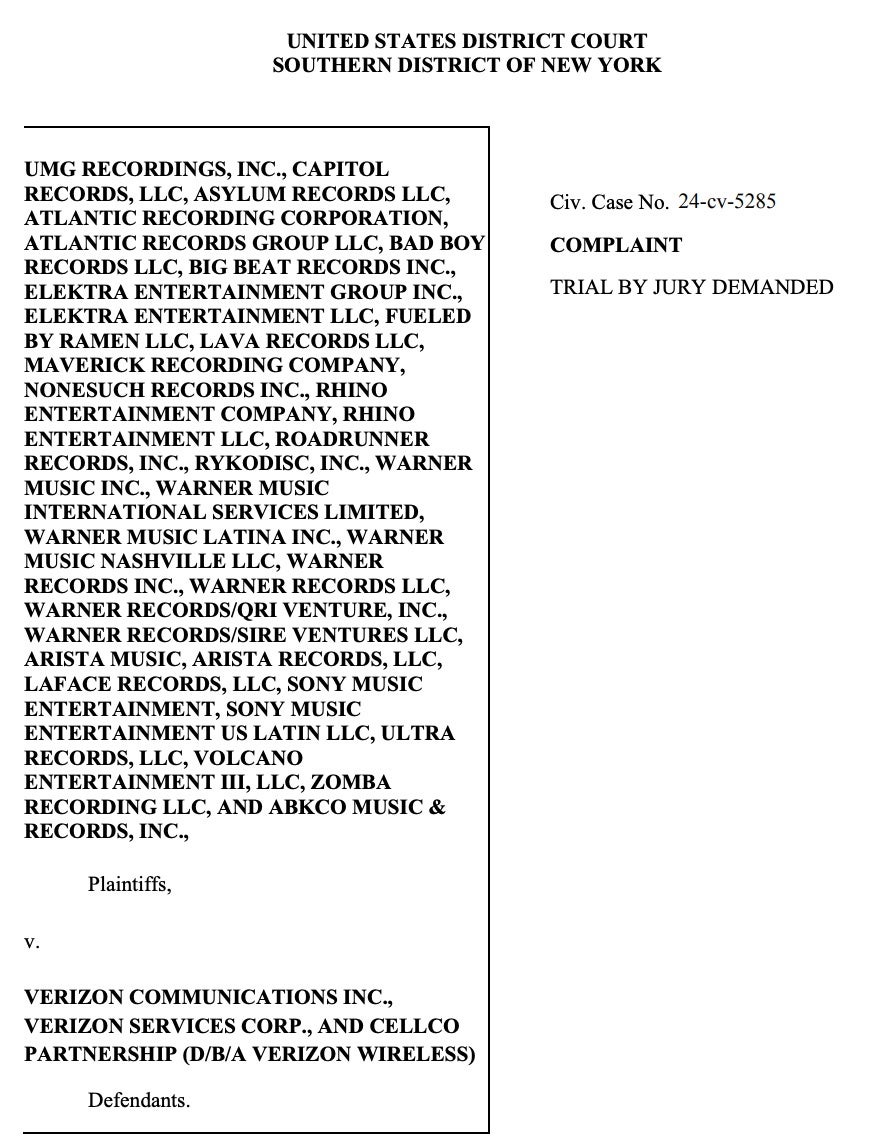
Complaint allegations
Click here to view the complaint.
Here is what the complaint alleges:
1. Verizon is one of the largest Internet Service Providers (“ISPs”) in the country and knowingly provides its high-speed service to a massive community of online pirates, who it knows repeatedly use that service to infringe Plaintiffs' copyrights. Over the past few years alone, 3 Plaintiffs sent Verizon hundreds of thousands of copyright infringement notices. Those notices identify specific subscribers on Verizon's network stealing Plaintiffs' sound recordings through peer-to-peer (“P2P”) file-sharing networks that are notorious hotbeds for copyright infringement. While Verizon is famous for its “Can you hear me now?” advertising campaign, it has intentionally chosen not to listen to complaints from copyright owners. Instead of taking action in response to those infringement notices as the law requires, Verizon ignored Plaintiffs' notices and buried its head in the sand. Undeterred, infringing subscribers identified in Plaintiffs' notices continued to use Verizon's services to infringe Plaintiffs' copyrights with impunity. Meanwhile, Verizon continued to provide its high-speed service to thousands of known repeat infringers so it could continue to collect millions of dollars from them.
2. Plaintiffs bring this action against Verizon for contributory and vicarious copyright infringement. Verizon has knowingly contributed to, and reaped substantial profits from, massive copyright infringement committed by tens of thousands of its subscribers. By ignoring Plaintiffs' notices and its own legal obligations, Verizon facilitated its subscribers' infringement of Plaintiffs' copyrights through the continued provision of its high-speed Internet service to known repeat infringers.
3. Plaintiffs are record companies or recorded music businesses that produce, manufacture, distribute, sell, and license commercial sound recordings both in the United States and internationally. Through their enormous investments of money, time, and exceptional creative efforts, Plaintiffs and the recording artists they represent have developed and/or distributed some of the world's most famous music. Their investments and creative efforts have shaped the musical landscape as we know it, both in the United States and around the world. As a result, Plaintiffs own and/or control exclusive rights to many of the most popular sound recordings performed by 4 classic artists and contemporary superstars, including The Rolling Stones, Ariana Grande, Bob Dylan, Bruno Mars, Elvis Presley, Dua Lipa, Drake, and many more.
4. Verizon markets and sells high-speed Internet services to consumers nationwide. Through the provision of those services, Verizon contributed to and profited from pervasive copyright infringement by its subscribers on P2P file-sharing networks. Verizon's contribution to its subscribers' infringement is both willful and extensive, and it renders Verizon equally liable for that infringement. Indeed, for years, Verizon deliberately refused to take action to prevent its customers from using its Internet services to infringe others' copyrights, including Plaintiffs' copyrights—even after Verizon was put on notice of particular customers engaging in specific, repeated acts of infringement.
5. Since early 2020, Plaintiffs' representatives have sent more than 340,000 infringement notices to Verizon. Those notices clearly and unambiguously advised Verizon of its subscribers' blatant and systematic use of Verizon's Internet service to illegally download, copy, and distribute Plaintiffs' copyrighted sound recordings through the P2P network known as BitTorrent.
6. The scope of repeat infringement on Verizon's network is staggering. Thousands of Verizon subscribers were the subject of 20 or more notices from Plaintiffs, and more than 500 subscribers were the subject of 100 or more notices. One particularly egregious Verizon subscriber was single-handedly the subject of 4,450 infringement notices from Plaintiffs alone.
7. Verizon acknowledged that it received these notices of infringement sent by Plaintiffs' representatives. Yet rather than taking any steps to address its customers' illegal use of its network, Verizon deliberately chose to ignore Plaintiffs' notices, willfully blinding itself to that information and prioritizing its own profits over its legal obligations. 5
8. It is well-established law that if a party materially assists someone it knows is engaging in copyright infringement, that party is fully liable for the infringement as if it had infringed directly. Further, when a party has a direct financial interest in the infringing activity, and the right and practical ability to stop or limit it, that party also faces liability. Flouting those basic responsibilities, Verizon deliberately turned a blind eye to its subscribers' infringement. Verizon failed to terminate or otherwise take any meaningful action against the accounts of repeat infringers of which it was aware. Instead, Verizon routinely thumbed its nose at Plaintiffs by continuing to provide its service to subscribers it knew to be serially infringing Plaintiffs' copyrighted sound recordings. In reality, Verizon operated its service as an attractive tool and safe haven for infringement.
9. Verizon has derived an obvious and direct financial benefit from its subscribers' infringement. The unlimited ability to download and distribute Plaintiffs' copyrighted works through Verizon's service has served as a draw for Verizon to attract, retain, and charge higher fees to infringing subscribers. By failing to terminate the accounts of specific recidivist infringers known to Verizon, Verizon obtained a direct financial benefit from those subscribers' continuing infringing activity. That financial benefit included improper revenue that Verizon would not have received had it appropriately shut down those accounts as well as the costs that Verizon saved by failing to implement an effective repeat infringer program. In other words, Verizon decided not to terminate repeat infringers because it wanted to maintain the revenue generated from those subscribers' accounts.
10. To be clear, the infringing activity of Verizon's subscribers that is the subject of Plaintiffs' claims, and for which Verizon is secondarily liable, all occurred after Verizon received multiple notices of each subscriber's infringing activity. Plaintiffs seek damages for infringement 6 of their sound recordings by Verizon subscribers after those particular subscribers were identified to Verizon in multiple infringement notices
Copyright Infringement Asserted
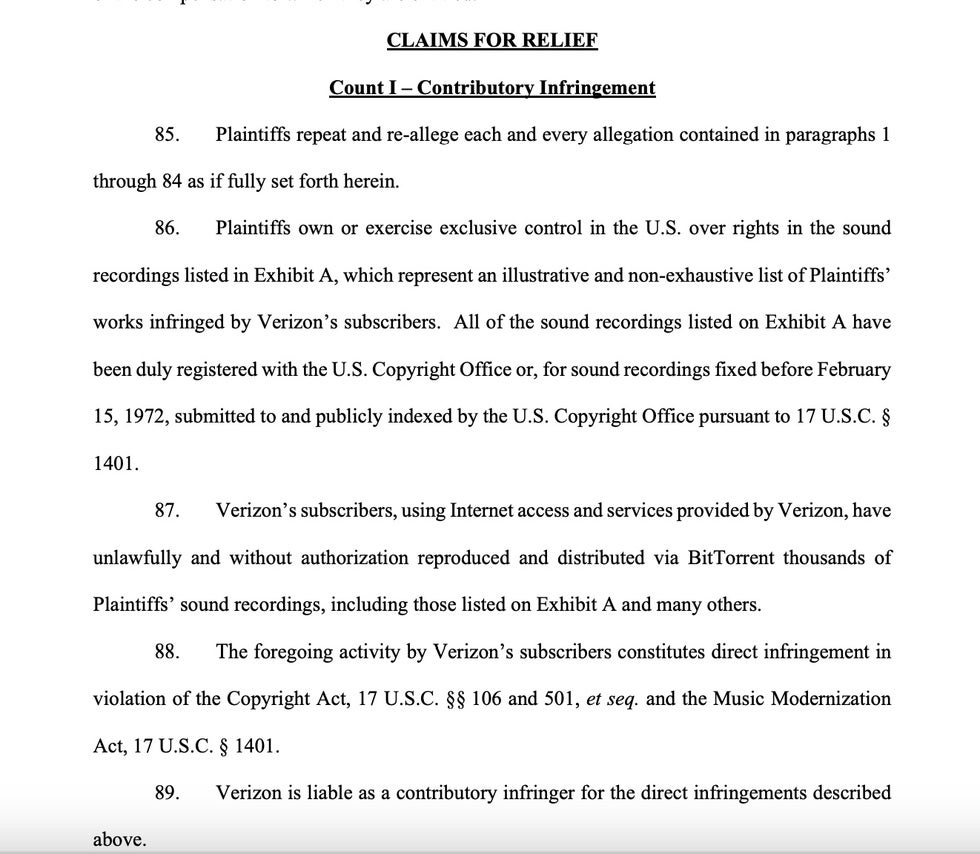
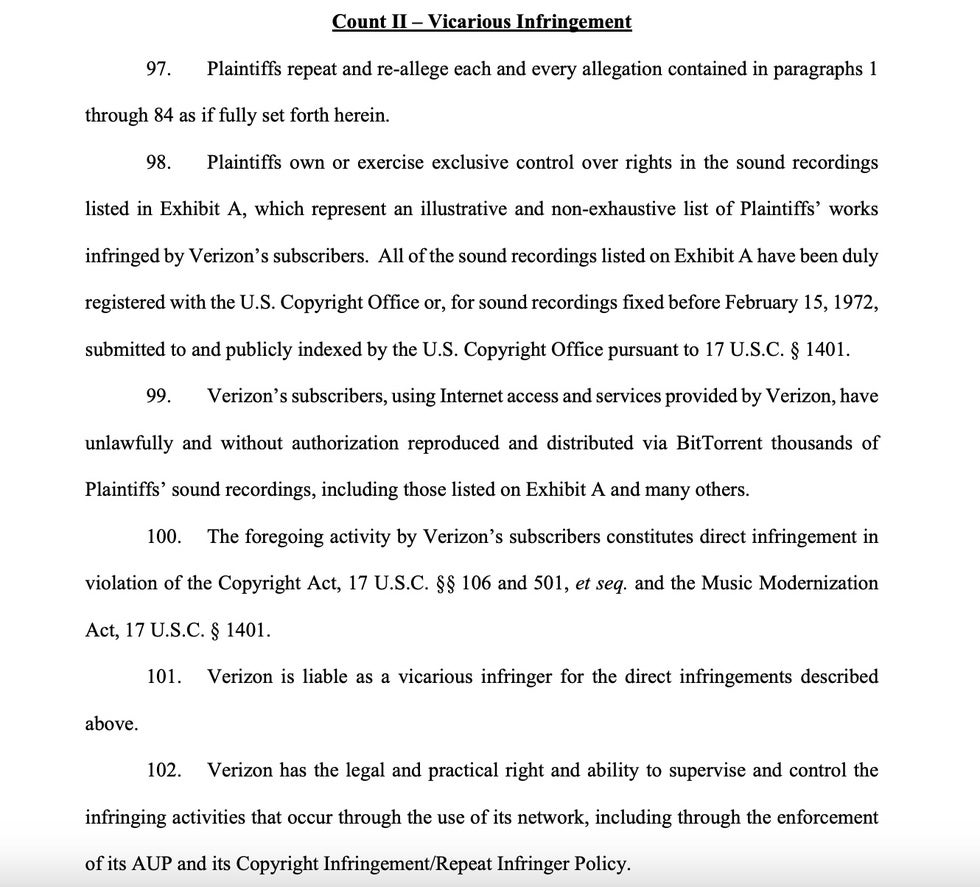
Plaintiffs claim Verizon is liable for both contributory infringement (facilitating infringement by its users) and for vicarious infringement (they are liable vicariously)
The first cause of action for contributory copyright infringement
The second cause of action for vicarious copyright infringement
What is the difference between vicarious and contributory copyright infringment?
DMCA Safe Harbor requirements - 17 U.S.C. 512(i)
In order to have "safe harbor" liability immunity for claims of copyright infringement, an online service provider must adhere to the legal requirements set forth in 17 U.S.C. 512(i) which states:
(i) Conditions for Eligibility.—
(1) Accommodation of technology.—The limitations on liability established by this section shall apply to a service provider only if the service provider—
(A) has adopted and reasonably implemented, and informs subscribers and account holders of the service provider's system or network of, a policy that provides for the termination in appropriate circumstances of subscribers and account holders of the service provider's system or network who are repeat infringers;
and
(B) accommodates and does not interfere with standard technical measures.
If the OSP cannot meet this standard, it can lose its liability shield.
Contact a California DMCA Attorney
If you or your company is involved in a copyright legal dispute involving the DMCA, whether it deals with "safe harbors", takedowns and counter-notifications, or allegations of trafficking or illegal circumvention of access controls, contact us at (877) 276-5084 or drop us a message on our contact form on the right side of this page.
Since 2004, few firms can match our IP experience, including having appeared in over 500 federal court litigation cases. In many, non-litigation cases), we are able to offer predictable flat-rate legal fees.

