
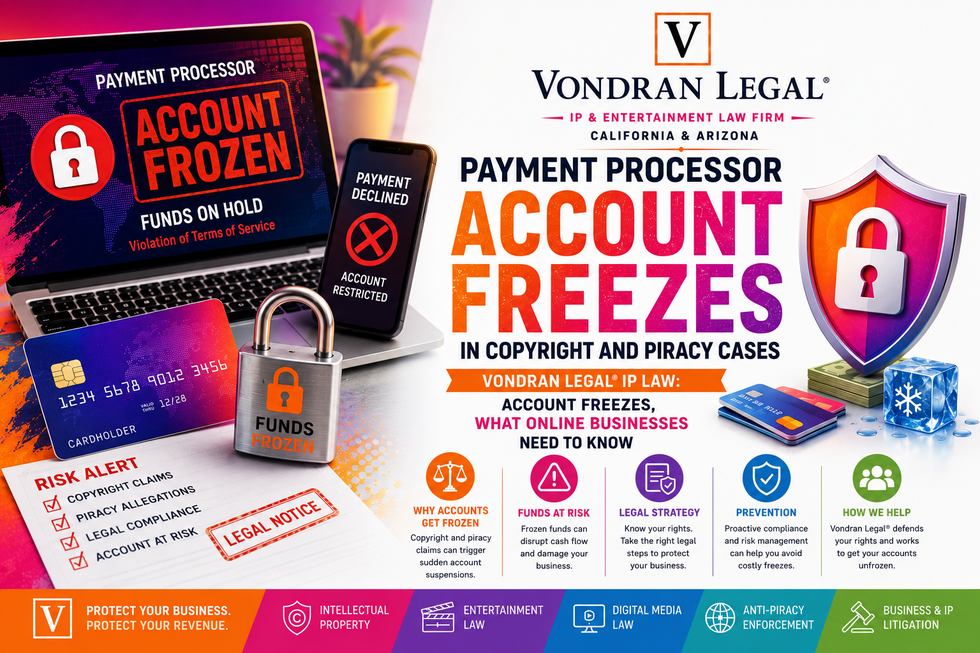
Vondran Legal® IP Law: Account Freezes, What Online Businesses Need to Know
By Attorney Steve® | Vondran Legal®
If you operate an online business, IPTV service, streaming platform, software company, subscription website, digital marketplace, or e-commerce store, one of the most devastating events you can experience is waking up to discover that your PayPal, Stripe, or other payment processing account has been suspended. Overnight, customer payments stop, funds may be placed on hold, and your business can quickly grind to a halt.
In today's digital economy, copyright owners and anti-piracy companies have developed increasingly sophisticated methods for combating alleged infringement. While lawsuits and DMCA takedown notices remain important enforcement tools, many companies now employ what is commonly referred to as payment disruption—a strategy designed to cut off the financial lifeline of an allegedly infringing business.
At Vondran Legal®, we regularly advise businesses, content creators, software companies, and online entrepreneurs regarding copyright disputes, DMCA matters, intellectual property enforcement, and related business litigation. Understanding how payment disruption works—and knowing your legal options—can be critical to protecting your business.
What Is Payment Disruption?
Payment disruption is an enforcement strategy in which a copyright owner or anti-piracy investigator seeks to interfere with the ability of an allegedly infringing business to receive payments.
Instead of immediately filing a federal copyright lawsuit, the rights holder may contact the payment processor or other service provider and present evidence that the merchant is engaged in activities that violate intellectual property rights or the processor's acceptable use policies.
Potential targets include:
-
PayPal
-
Stripe
-
Square
-
Shopify Payments
-
Visa
-
Mastercard
-
Google Pay
-
Apple Pay
-
Cryptocurrency exchanges
-
Affiliate marketing platforms
-
Advertising networks
-
Merchant banks
The objective is straightforward: if a business cannot process payments, it may be forced to shut down long before litigation is concluded.
Why Is Payment Disruption Becoming More Common?
Modern copyright enforcement has evolved dramatically over the past decade.
Sophisticated anti-piracy companies—including organizations such as Irdeto, Friend MTS, Nagra, and others—now combine traditional legal enforcement with advanced technological tools such as forensic watermarking, real-time monitoring, device fingerprinting, IP analysis, and payment disruption strategies.
For live sporting events, subscription television, premium streaming services, software licensing, and other high-value digital content, stopping infringement immediately is often more valuable than obtaining a judgment months or years later.
From the copyright owner's perspective, disrupting the revenue stream often proves far more effective than simply sending another cease-and-desist letter.
Does a Copyright Owner Need a Court Order?
One of the biggest misconceptions is that payment processors can only suspend accounts after receiving a court order.
In most situations, that is simply not the case.
Payment processors are private companies operating under contracts with their merchants. Those contracts—commonly referred to as Merchant Agreements or Terms of Service—typically grant the processor broad authority to investigate suspicious activity, hold funds, suspend accounts, terminate services, or delay payouts whenever the processor believes its policies may have been violated.
Accordingly, many payment disruptions occur entirely outside the courtroom.
The payment processor makes its own business decision after reviewing the information presented to it.
Where Does the Payment Processor's Authority Come From?
The legal authority generally arises from the contractual agreement between the merchant and the processor.
Most payment agreements authorize the processor to:
-
Suspend merchant accounts.
-
Hold funds for investigation.
-
Delay payouts.
-
Establish reserve accounts.
-
Terminate processing privileges.
-
Reverse certain transactions.
-
Request additional documentation.
-
Investigate intellectual property complaints.
When merchants open these accounts, they generally agree to these contractual provisions.
Is This Actually an "Asset Freeze"?
Not usually.
Although many business owners understandably describe the situation as having their assets frozen, the legal terminology is different.
A true asset freeze generally involves a court-issued injunction preventing a defendant from transferring assets. Such relief is typically available only after a lawsuit has been filed and the moving party satisfies the applicable legal standards.
By contrast, a payment processor's decision to temporarily hold payouts or suspend processing is generally based on contractual rights contained in the merchant agreement rather than a judicial order.
The distinction is important because different legal remedies may apply.
Why Would a Payment Processor Suspend an Account?
Payment processors evaluate numerous risk factors.
Some common reasons include:
-
Alleged copyright infringement.
-
Trademark infringement.
-
Counterfeit products.
-
Unauthorized IPTV or streaming services.
-
Pirated software.
-
High chargeback rates.
-
Consumer complaints.
-
Fraud indicators.
-
Suspicious transaction patterns.
-
Requests from law enforcement.
-
Violations of the processor's acceptable use policies.
In copyright matters, payment processors frequently receive complaints from copyright owners, anti-piracy vendors, law firms, or investigators who claim that a merchant is monetizing infringing content.
What Happens to the Money Already in the Account?
The outcome varies depending on the processor and the circumstances.
Funds may be:
-
Temporarily held for 30, 90, or even 180 days.
-
Placed into a rolling reserve.
-
Delayed pending investigation.
-
Released after documentation is provided.
-
Offset against chargebacks or refunds.
-
Returned after the investigation concludes.
Each processor has its own policies, and the specific merchant agreement usually controls.
Can Bank Accounts Be Frozen Too?
Yes, but banks generally operate under a different legal framework.
Banks may freeze accounts because of:
-
Court orders.
-
Garnishments.
-
Attachment orders.
-
Fraud investigations.
-
Anti-money laundering obligations.
-
Suspicious Activity Reports (SARs).
-
OFAC sanctions.
-
Criminal investigations.
Unlike payment processors, banks are heavily regulated financial institutions and often act pursuant to statutory or regulatory obligations.
What About Cryptocurrency?
Cryptocurrency presents unique issues.
If funds are held in a self-custodied wallet, there may be no centralized intermediary capable of freezing the assets.
However, centralized cryptocurrency exchanges frequently reserve contractual authority to suspend withdrawals, freeze accounts, investigate suspicious activity, or comply with legal process and regulatory obligations.
As cryptocurrency enforcement continues to evolve, this area of law is becoming increasingly complex.
Common Copyright and Piracy Scenarios
Payment disruption frequently arises in cases involving:
Unauthorized IPTV services. Subscription-based streaming platforms accused of redistributing live television broadcasts often lose access to payment processors before litigation is filed.
Live sporting events. Companies broadcasting pay-per-view boxing, UFC, soccer, football, or rugby events aggressively pursue payment disruption strategies because the commercial value of the content exists only during the live event.
Software piracy. Businesses accused of distributing unauthorized software licenses or cracked software may find payment processing interrupted while investigations are underway.
Digital media marketplaces. Websites selling unlicensed movies, music, photographs, fonts, e-books, or other copyrighted content may receive complaints that result in suspended merchant accounts.
Subscription streaming platforms. Online video services accused of facilitating copyright infringement may lose payment processing, advertising revenue, affiliate relationships, or cloud hosting services simultaneously.
Counterfeit and gray-market products. Intellectual property owners often pursue payment disruption as part of broader trademark and copyright enforcement campaigns.
What Should You Do If Your Payment Processor Suspends Your Account?
Do not panic, but do act quickly.
Important initial steps may include:
-
Carefully reviewing the suspension notice.
-
Determining whether the action resulted from a copyright complaint, fraud review, or contractual compliance issue.
-
Preserving all communications.
-
Gathering licenses, invoices, contracts, and authorization documents.
-
Responding through the processor's appeal procedures.
-
Consulting experienced intellectual property counsel before making admissions or concessions.
Each case is different, and an early strategic response can significantly affect the outcome.
Can You Challenge the Suspension?
In many situations, yes.
Depending upon the facts, possible avenues may include:
-
Internal appeals.
-
Submission of ownership or licensing documentation.
-
Negotiated resolutions with the complaining party.
-
Requests for reinstatement.
-
Contract-based claims where appropriate.
-
Declaratory judgment actions in certain circumstances.
-
Business tort claims if false allegations caused economic harm.
-
Defending related copyright litigation if a lawsuit follows.
Not every suspension gives rise to a legal claim, but not every suspension is legally justified either. The facts, governing contracts, and applicable law matter.
How Can Vondran Legal® Help?
Our firm represents businesses, software companies, online entrepreneurs, creators, photographers, developers, digital publishers, and technology companies in intellectual property disputes throughout the United States.
We assist clients with matters involving:
-
Copyright infringement defense.
-
DMCA takedown notices and counter-notices.
-
Online platform disputes.
-
Software license audits.
-
Copyright compliance counseling.
-
Anti-piracy investigations.
-
Intellectual property litigation.
-
Contract disputes involving online businesses.
-
Cease-and-desist letter responses.
-
Digital content licensing disputes.
-
Payment processor and online marketplace disputes.
Whether you are defending allegations of infringement or seeking to protect your own copyrighted works, obtaining experienced legal guidance early in the process can often reduce risk and improve your negotiating position.
Final Thoughts
The future of copyright enforcement extends well beyond traditional lawsuits. Today's rights holders increasingly rely on technical investigations, forensic analysis, payment disruption, and coordinated enforcement strategies to combat alleged infringement.
For businesses operating online, understanding these evolving enforcement mechanisms is no longer optional—it is essential. A suspended payment account can have immediate and significant consequences, but merchants are not necessarily without options. Knowing your contractual rights, understanding the allegations, and responding strategically can often make the difference between a temporary disruption and a permanent business interruption.
If your company has received a payment processor suspension, copyright complaint, DMCA notice, or intellectual property enforcement demand, experienced counsel can help evaluate your legal options and develop an appropriate response strategy before the situation escalates.

