
VONDRAN LEGAL® | DUPES, TRADEMARK, TRADE DRESS, DESIGN PATENTS, AND BRAND PROTECTION
INTRODUCTION
Over the past several years, "dupe" products have become one of the hottest trends in retail.
Consumers are increasingly searching for lower priced alternatives to luxury handbags, athletic apparel, cosmetics, fragrances, furniture, and consumer electronics. Social media platforms such as TikTok and Instagram have fueled this trend by encouraging users to share inexpensive products that allegedly offer the same appearance, quality, or performance as well known brands.
While many consumers celebrate dupes as affordable alternatives, brand owners often view them differently.
As companies invest millions of dollars developing innovative products and building valuable brand recognition, they are increasingly turning to trademark law, trade dress, design patents, false advertising, and unfair competition laws to combat copycat products.
Several recent lawsuits illustrate how courts are addressing these issues and provide valuable lessons for businesses seeking to protect their intellectual property.
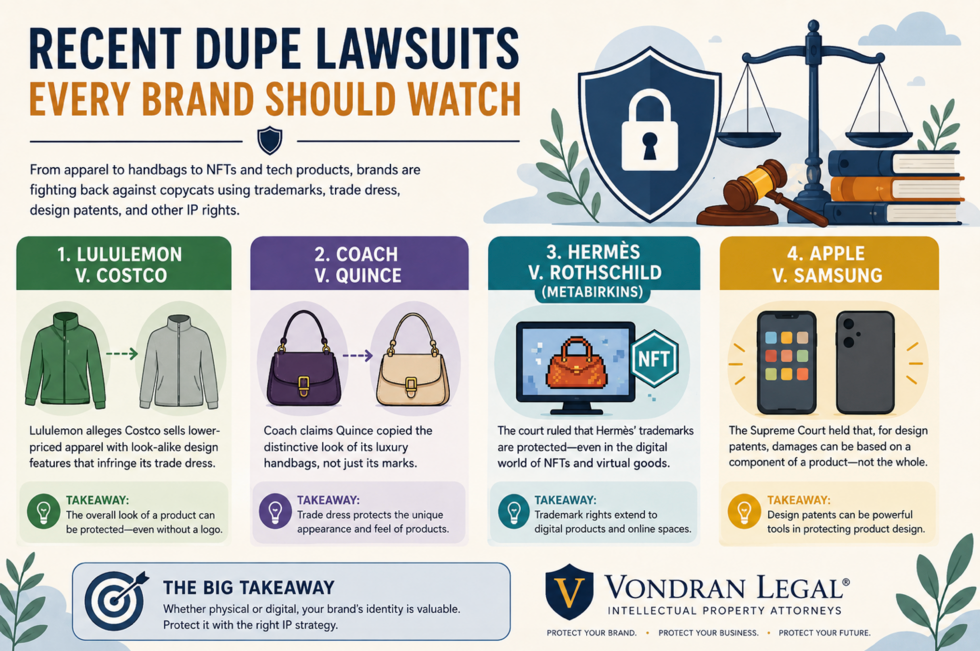
LULULEMON V. COSTCO
Perhaps no lawsuit better illustrates the modern battle over dupes than Lululemon Athletica Canada Inc. v. Costco Wholesale Corp.
Filed in the Central District of California in 2025, Lululemon alleges that Costco sold lower priced apparel products that closely resembled several of Lululemon's best known designs, including jackets, hoodies, and athletic pants. According to the complaint, Costco marketed these products through its private label brands while allegedly copying distinctive design features that consumers associate with Lululemon.
Importantly, Lululemon is not simply alleging that Costco copied its name or logo. Instead, the company argues that Costco unlawfully copied the overall appearance of its products and attempted to capitalize on the goodwill associated with the Lululemon brand. The complaint includes claims for trademark infringement, trade dress infringement, false designation of origin, and unfair competition under the Lanham Act. The litigation remains pending and continues to attract significant attention from both the retail and intellectual property communities.
WHY THIS CASE MATTERS
Many businesses mistakenly believe that avoiding another company's logo eliminates the risk of infringement.
Not necessarily.
If a product's overall appearance functions as a source identifier, it may qualify for trade dress protection. The Lululemon lawsuit demonstrates that companies are increasingly relying on trade dress law to challenge copycat products even where competing products bear completely different brand names.
COACH V. QUINCE
Another closely watched dispute involves luxury fashion brand Coach and online retailer Quince.
Coach filed suit against Quince in the Northern District of California in 2025, alleging that Quince's Italian leather handbags copied the distinctive appearance of Coach's popular Rogue and Soho Flap handbags. Rather than focusing solely on logos or word marks, Coach alleged that Quince had copied the overall visual design and distinctive nonfunctional features that consumers associate with Coach products.
The lawsuit is particularly significant because it reflects a growing trend among luxury brands. Rather than relying exclusively on traditional trademark claims, companies are increasingly asserting trade dress rights to protect the appearance of their products from lower priced lookalikes.
Although the litigation generated significant attention, the parties ultimately agreed to dismiss the lawsuit without prejudice before the court reached the merits. As a result, the court never decided whether Quince's handbags actually infringed Coach's trade dress. Nevertheless, the lawsuit remains an important example of how luxury brands are attempting to use intellectual property law to combat the growing market for "dupes."
WHY THIS CASE MATTERS
The Coach litigation highlights both the power and the limitations of trade dress law.
Even though the lawsuit ended without a judicial decision, it demonstrates that product appearance itself may become the centerpiece of modern intellectual property disputes. Businesses should carefully evaluate not only the names they use, but also the overall look and feel of their products before bringing them to market.
HERMÈS V. ROTHSCHILD
Not every dupe dispute involves physical products.
One of the most significant trademark decisions of the digital era is Hermès International v. Rothschild, commonly known as the MetaBirkins case.
The dispute arose after digital artist Mason Rothschild created and sold a collection of NFTs depicting colorful digital images inspired by Hermès' iconic Birkin handbag. Hermès argued that consumers would mistakenly believe the NFT collection was affiliated with or endorsed by the luxury fashion house, while Rothschild maintained that the collection constituted protected artistic expression under the First Amendment.
Following trial, a federal jury found Rothschild liable for trademark infringement, trademark dilution, and cybersquatting. The court later entered a permanent injunction prohibiting further use of the Birkin marks in connection with the MetaBirkins project and ordered the transfer of the metabirkins.com domain name to Hermès.
The decision represents one of the first major trademark cases addressing NFTs and virtual goods, confirming that traditional trademark principles apply even as commerce expands into digital environments.
WHY THIS CASE MATTERS
Businesses should understand that intellectual property rights extend well beyond physical products.
Whether a product exists in a retail store or a virtual marketplace, trademarks continue to protect consumers from confusion regarding the source, sponsorship, or affiliation of goods and services. As digital commerce continues to evolve, companies should ensure that their brand protection strategies evolve as well.
APPLE V. SAMSUNG
Few intellectual property disputes have had a greater impact on design patent law than Samsung Electronics Co. v. Apple Inc.
Apple alleged that Samsung infringed several of its design patents covering key visual features of the original iPhone, including the rectangular front face with rounded corners, the raised rim surrounding the screen, and the familiar arrangement of colorful application icons. A jury found that Samsung infringed Apple's design patents and awarded Apple approximately $399 million, representing Samsung's total profits from the sale of the accused smartphones.
The dispute eventually reached the United States Supreme Court. Rather than deciding whether Samsung had infringed Apple's patents, the Court considered how damages should be calculated under the Patent Act when a design patent covers only part of a complex product.
In a unanimous opinion authored by Justice Sotomayor, the Supreme Court held that the relevant "article of manufacture" may be an individual component of a multicomponent product rather than the finished product sold to consumers. The Court reversed the Federal Circuit and remanded the case for further proceedings, establishing an important precedent for future design patent litigation.
WHY THIS CASE MATTERS
Apple v. Samsung confirmed that product design itself can represent enormously valuable intellectual property.
The decision also clarified that design patent damages must be tied to the appropriate "article of manufacture," an issue that continues to shape patent litigation involving complex consumer products.
WHAT THESE CASES TEACH BUSINESSES
Although these lawsuits involve different industries and different legal theories, several important themes emerge.
First, businesses are no longer relying solely on trademark infringement claims to combat copycat products.
Instead, successful intellectual property enforcement often involves a combination of trademark law, trade dress protection, design patents, unfair competition, and, in some cases, false advertising claims.
Second, the overall appearance of a product may be just as valuable as the brand name appearing on it. As these cases demonstrate, companies increasingly recognize that consumers often identify products by their visual appearance long before they notice a trademark.
Finally, businesses should remember that intellectual property protection is most effective when implemented proactively. Registering trademarks, pursuing design patents where appropriate, documenting the distinctiveness of product designs, and developing comprehensive brand protection strategies can significantly strengthen a company's legal position should litigation become necessary.
FINAL THOUGHTS
The rapid growth of the dupe economy has transformed the intellectual property landscape.
As consumers continue searching for lower priced alternatives to premium products, businesses should expect increased litigation involving trademarks, trade dress, design patents, false advertising, and unfair competition.
The cases discussed above demonstrate that there is no single legal theory for addressing copycat products. Instead, successful brand protection often requires a thoughtful combination of intellectual property rights tailored to the specific product and marketplace at issue.
At Vondran Legal®, our intellectual property attorneys regularly advise businesses regarding trademark registration, trade dress protection, design patents, copyright law, false advertising, licensing, and intellectual property litigation.
If your company is facing issues involving copycat products, dupe litigation, or brand protection, contact Vondran Legal® to discuss your legal options.
