
ATTORNEY STEVE® – CALL US IF YOU NEED HELP WITH AI DEEPFAKES, TRADEMARK PROTECTION, FALSE ENDORSEMENT CLAIMS, OR BRAND ENFORCEMENT – (877) 276-5084
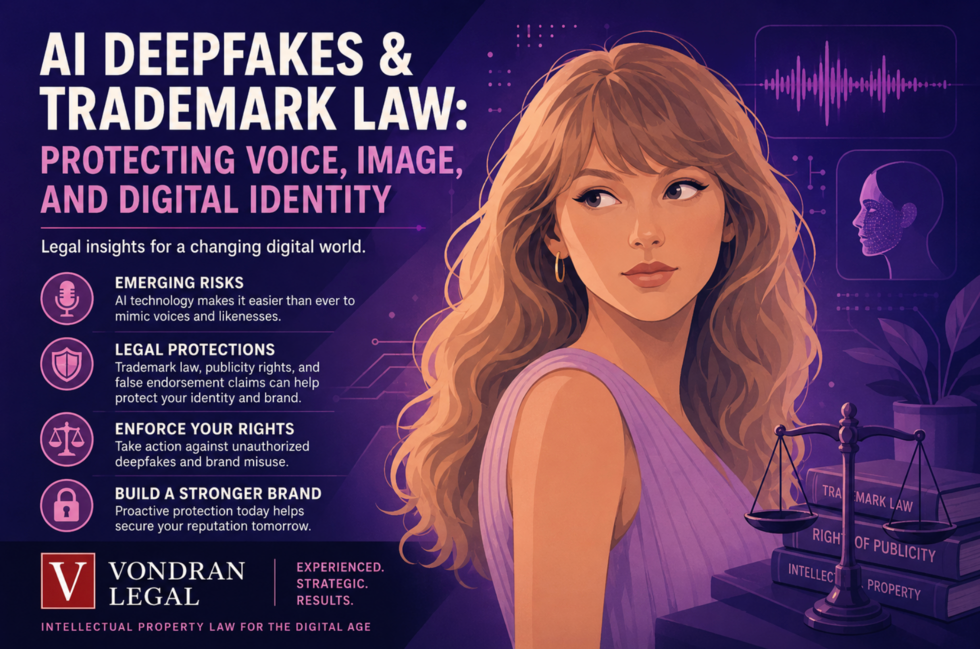
Image used for editorial commentary regarding legal issues involving AI, deepfakes, trademark law, and right of publicity. Taylor Swift is not affiliated with, sponsored by, or endorsing Vondran Legal.
INTRODUCTION
Taylor Swift is once again at the center of a major legal conversation. This time, however, the issue is not music rights or copyright ownership, but whether trademark law, rights of publicity, and false endorsement claims can keep pace with the rise of AI-generated deepfakes and digital impersonation. Recent reports indicate that Swift's company has filed trademark applications connected to her voice and image, highlighting a growing legal battleground for celebrities whose identities can now be digitally copied and commercialized in seconds.
Artificial intelligence is rapidly changing intellectual property enforcement. Deepfake technology can generate entirely new content that imitates a celebrity's voice, appearance, or persona without necessarily copying an existing copyrighted work. According to reports, Swift's filings cover spoken phrases associated with her identity, along with visual imagery tied to her performances, potentially creating an additional layer of trademark protection against AI impersonation and false endorsement uses online.
For intellectual property attorneys, creators, influencers, and entertainment brands, the filings may signal the beginning of a new era of trademark enforcement strategy in the age of generative AI.
WHY COPYRIGHT LAW MAY NOT BE ENOUGH ANYMORE
Traditionally, artists relied heavily on copyright law to combat unauthorized uses of their music and recordings. The problem with AI-generated deepfakes, however, is that many systems are not directly copying existing recordings. Instead, they generate synthetic content that merely sounds like the artist.
That creates a difficult legal issue.
If an AI-generated recording imitates a celebrity voice without reproducing a protected sound recording, copyright claims may become substantially more complicated. Several commentators covering the Swift filings specifically noted that AI voice cloning technologies are creating a legal gap that traditional copyright law may not fully address.
This is where trademark law may become increasingly valuable.
Trademark law focuses on source identification and consumer confusion. In other words, if consumers are likely to believe a particular voice, phrase, image, or digital persona is genuinely associated with a celebrity or brand, trademark theories such as false endorsement, false association, and unfair competition may become powerful enforcement tools.
That is likely one reason why Swift's legal team pursued trademark registrations rather than relying solely on copyright law or state publicity rights.
CAN A HUMAN VOICE FUNCTION AS A TRADEMARK?
Potentially, yes.
Sound trademarks already exist under U.S. trademark law. Famous examples include The NBC chimes, The MGM lion roar, Distinctive startup and notification sounds and certain advertising jingles and audio signatures
What makes the Swift applications particularly notable is the attempt to protect recognizable spoken phrases associated with her identity and public persona.
Some legal commentators have described this as relatively untested territory, especially in the AI context. But if successful, these filings could become highly influential for:
• Musicians
• Actors
• Influencers
• Streamers
• Podcasters
• Virtual creators
• AI-generated personalities
• Entertainment brands
As AI cloning tools become more sophisticated, the commercial value of voice identity is increasing dramatically.
THE GROWING BUSINESS RISK OF AI IMPERSONATION
The legal concerns here are not theoretical.
AI-generated celebrity deepfakes have already been used in:
• Fake advertisements
• Fraudulent investment promotions
• False political endorsements
• Explicit synthetic imagery
• Scam social media campaigns
• Unauthorized endorsement videos
Swift herself has previously been targeted by viral AI-generated content online.
For businesses and creators, the risks extend far beyond embarrassment. Deepfakes can create substantial commercial harm, including reputational damage, consumer confusion, loss of sponsorship opportunities, brand dilution, and false endorsement liability.
This is especially important for influencers and online personalities whose businesses depend heavily on personal branding and audience trust. In many ways, a creator's voice and likeness are now becoming standalone commercial assets that require proactive protection strategies.
TRADEMARK LAW MAY BECOME A KEY AI ENFORCEMENT TOOL
One particularly important aspect of trademark law is that it focuses on “confusingly similar” uses.
That standard may become extremely useful in AI disputes.
A deepfake does not necessarily need to be an exact copy to create liability. If the synthetic content is realistic enough to imply sponsorship, endorsement, affiliation, or association, trademark claims may still become viable.
This could provide plaintiffs with additional causes of action involving:
• False endorsement
• Trademark dilution
• Unfair competition
• False advertising
• Passing off
• Consumer confusion
As generative AI technology evolves, we expect to see increasing attempts to trademark:
• Voice signatures
• Catchphrases
• Distinctive visual identities
• Character likenesses
• AI avatars
• Virtual influencers
• Signature performance aesthetics
The Swift filings may ultimately become one of the first major test cases in this emerging area of law.
THE FUTURE OF AI, LIKENESS RIGHTS, AND DIGITAL IDENTITY
The broader issue here extends well beyond celebrities.
AI voice cloning and synthetic likeness technologies are becoming increasingly accessible to the general public. As a result, businesses, influencers, creators, and even ordinary individuals may soon face growing concerns involving identity misuse and digital impersonation.
Lawmakers are already attempting to respond through proposed legislation such as the NO FAKES Act, which seeks to establish broader protections against unauthorized digital replicas.
At the same time, courts will likely be forced to address entirely new questions involving:
• Ownership of digital identity
• AI-generated endorsements
• Synthetic performance rights
• Voice cloning liability
• Consent requirements
• Platform enforcement obligations
This area of law is developing rapidly, and intellectual property owners should begin evaluating AI-related brand protection strategies now rather than waiting until a deepfake incident occurs.
HOW VONDRAN LEGAL® CAN ASSIST
Our firm represents businesses, creators, influencers, musicians, and entertainment industry professionals in intellectual property and online enforcement matters. We assist clients with:
• Trademark registration strategy
• Copyright registration and enforcement
• AI deepfake and impersonation disputes
• DMCA takedowns and platform enforcement
• False endorsement and unfair competition claims
• Right of publicity issues
• Entertainment and digital media counseling
• Brand protection strategy
As artificial intelligence continues reshaping online content creation, businesses and creators should take proactive steps to protect their intellectual property, likeness, and brand identity. You can contact us at (877) 276-5084 or reach out by email for a free initial consultation to discuss your options.

