
Vondran Legal® - AI Cloning Law By Vondran Legal® – Copyright, Entertainment, AI & Intellectual Property Lawyers
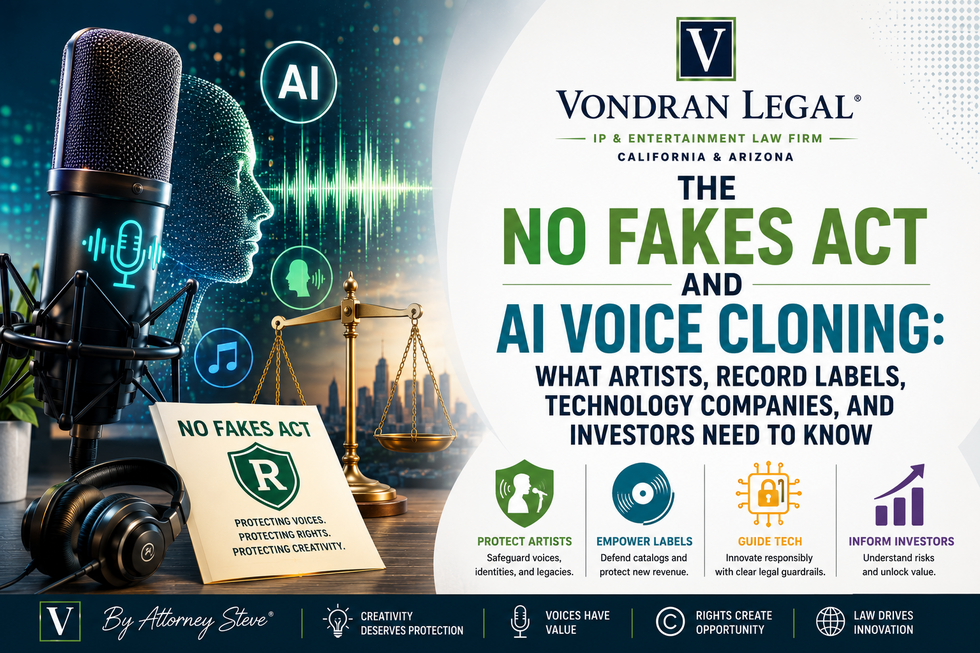
Artificial intelligence is changing the entertainment industry at an unprecedented pace. What once required a recording studio, professional impersonator, or visual effects team can now be accomplished in minutes using generative AI. AI systems are capable of producing realistic singing voices, spoken dialogue, music performances, and digital avatars that closely resemble real people.
This technological revolution has created enormous opportunities—but it has also introduced significant legal uncertainty.
One of the most closely watched legislative proposals designed to address these issues is the NO FAKES Act (Nurture Originals, Foster Art, and Keep Entertainment Safe Act). Although the Act has not yet been enacted into law, it represents one of the most ambitious federal efforts to regulate AI-generated digital replicas of a person's voice and visual likeness.
For artists, musicians, actors, record labels, AI companies, digital platforms, investors, and content creators, the legislation deserves close attention.
At Vondran Legal®, we closely monitor emerging AI legislation because today's legal developments often become tomorrow's litigation. Businesses that understand these issues now will be far better positioned to manage risk as the law evolves.
What Is the NO FAKES Act?
The proposed NO FAKES Act would establish a federal cause of action protecting individuals against the unauthorized creation and commercial exploitation of highly realistic AI-generated replicas of their:
-
Voice
-
Face
-
Appearance
-
Visual likeness
-
Other readily identifiable identity characteristics
Unlike copyright law, which protects creative works such as songs, photographs, books, films, and software, the NO FAKES Act focuses on protecting human identity itself.
That distinction is critically important.
Today, ownership of a copyrighted work does not necessarily include ownership of the performer's identity.
For example:
A record label may own a master recording.
A music publisher may own the musical composition.
Yet neither necessarily owns the artist's voice for purposes of creating an entirely new AI-generated performance.
That legal gap is precisely what Congress is attempting to address.
Why Existing Copyright Law May Not Be Enough
Many people assume copyright law already protects against AI voice cloning.
In reality, copyright law often addresses only part of the problem.
Copyright protects:
-
Musical compositions
-
Sound recordings
-
Books
-
Artwork
-
Software
-
Motion pictures
-
Photographs
It generally does not protect:
-
A person's natural speaking voice
-
Facial identity
-
Personal appearance
-
Vocal style
-
Physical characteristics
Those rights traditionally fall under state right of publicity laws.
The problem is that every state treats publicity rights differently.
Some states provide strong protection.
Others provide relatively little.
Some recognize postmortem rights.
Others do not.
The NO FAKES Act seeks to create a more uniform national framework.
AI Has Changed the Economics of Identity
Historically, entertainment contracts focused primarily on ownership of copyrighted works.
Artificial intelligence changes that equation.
Today, AI systems can generate entirely new performances that never actually occurred.
Imagine:
-
A deceased singer recording a new album.
-
An actor appearing in a movie they never filmed.
-
A celebrity endorsing products without ever agreeing to the endorsement.
-
A famous musician "performing" songs generated entirely by AI.
The commercial value increasingly lies not only in the copyrighted works themselves—but also in the person's identity.
That represents a fundamental shift in intellectual property law.
Digital Replicas Could Become a New Asset Class
One of the most interesting aspects of the proposed legislation is what it suggests about the future.
The Act is not merely about stopping deepfakes.
It may signal the emergence of identity rights as a standalone commercial asset.
Future entertainment transactions may increasingly evaluate:
-
voice rights
-
likeness rights
-
AI licensing rights
-
synthetic performance rights
-
digital avatar rights
-
estate licensing rights
These rights may eventually become just as valuable as:
-
publishing rights
-
master recordings
-
synchronization rights
-
merchandising rights
That possibility could reshape entertainment finance for decades.
How Could the NO FAKES Act Affect the Music Industry?
The music industry is likely to experience some of the largest impacts.
Questions that once seemed theoretical are becoming practical business issues:
Can AI recreate a famous singer's voice?
Who has authority to approve that use?
Can record labels license AI performances?
Can estates authorize new recordings decades after an artist dies?
Must musicians be compensated?
Can AI companies train models using licensed recordings?
The answers remain uncertain.
But these questions increasingly appear in licensing negotiations, recording agreements, investment diligence, and AI partnerships.
How Platforms May Need to Adapt
Major online platforms already operate extensive copyright compliance systems under the Digital Millennium Copyright Act (DMCA).
If enacted, the NO FAKES Act may require similar procedures for digital replica claims.
Companies may need systems for:
-
claimant verification
-
identity verification
-
consent documentation
-
takedown procedures
-
repeat violator policies
-
appeals
-
record retention
-
AI content review
-
moderation procedures
Unlike copyright disputes, however, identity claims often involve much more fact-intensive analysis.
Determining whether a voice is "readily identifiable" can be significantly more subjective than determining who owns a copyright registration.
AI Licensing May Become the Next Major Revenue Stream
History suggests that the entertainment industry usually adapts to new technologies through licensing—not prohibition.
The same pattern occurred with:
-
radio
-
television
-
cable
-
home video
-
streaming
-
synchronization
-
YouTube
-
TikTok
-
user-generated content
Artificial intelligence will likely follow a similar path.
Rather than banning AI entirely, markets are already moving toward licensed AI uses.
Future agreements may include provisions governing:
-
AI voice licensing
-
digital replicas
-
training permissions
-
model restrictions
-
revenue sharing
-
royalty participation
-
audit rights
-
approval rights
-
revocation rights
-
attribution requirements
The legal framework surrounding AI licensing is likely to become increasingly sophisticated.
Why Investors and Catalog Buyers Should Pay Attention
The article also highlights an important issue for investors.
Historically, music acquisitions focused primarily on:
-
master recordings
-
publishing catalogs
-
royalty income
-
licensing revenue
Artificial intelligence introduces an entirely new diligence category.
Future buyers may ask:
Who controls AI rights?
Who owns publicity rights?
Who controls voice rights?
Can those rights be licensed?
Are they assignable?
Do management agreements address AI?
What happens after death?
Are there consent requirements?
Can these rights serve as collateral?
Those questions may become increasingly important in mergers, acquisitions, financing transactions, and catalog sales.
Businesses Should Begin Preparing Now
Although the legislation remains pending, prudent companies should begin reviewing their contracts today.
Areas worth evaluating include:
Artists
-
AI clauses
-
voice cloning permissions
-
publicity rights
-
estate planning
Record Labels
-
AI licensing authority
-
performer approvals
-
future revenue allocation
Publishers
-
AI synchronization provisions
-
licensing language
Technology Companies
-
consent mechanisms
-
moderation systems
-
documentation
-
provenance tracking
Investors
-
diligence procedures
-
ownership verification
-
valuation assumptions
Waiting until litigation begins may prove far more expensive than preparing now.
How Vondran Legal® Can Help
Artificial intelligence is rapidly changing copyright law, entertainment law, publicity rights, trademark law, and commercial licensing.
At Vondran Legal®, we advise creators, technology companies, investors, software developers, entertainment businesses, and intellectual property owners on emerging legal issues involving AI and digital content.
Our services include:
-
AI compliance counseling
-
Copyright litigation
-
Copyright registration strategy
-
Entertainment contract drafting and negotiation
-
Music licensing agreements
-
Software licensing disputes
-
DMCA takedown and counter-notice representation
-
Right of publicity disputes
-
Trademark enforcement
-
Trade secret litigation
-
Digital content licensing
-
AI policy development
-
Platform compliance counseling
-
Intellectual property due diligence
-
Technology transaction support
-
Federal copyright litigation
-
Licensing audits
-
Risk management assessments
-
Pre-litigation strategy and settlement negotiations
Whether you are an artist protecting your identity, a technology company building AI products, a record label negotiating AI licensing rights, or an investor evaluating intellectual property assets, experienced legal guidance can help reduce uncertainty while positioning your business for future opportunities.
Final Thoughts
The NO FAKES Act is about much more than deepfakes.
It reflects a broader transformation occurring across the entertainment and technology industries: human identity is becoming a valuable commercial asset in the age of artificial intelligence.
While copyright law will continue to protect creative works, the next generation of disputes may increasingly focus on who controls a person's voice, likeness, digital identity, and AI-generated performances.
Whether or not the current version of the NO FAKES Act ultimately becomes law, the legal issues it raises are unlikely to disappear. Businesses that proactively address AI rights today will be better positioned to navigate tomorrow's legal landscape.
Frequently Asked Questions (FAQ)
Is the NO FAKES Act currently law?
No. As of this writing, the NO FAKES Act has been introduced in Congress but has not yet been enacted. Businesses should monitor its progress while reviewing their current AI-related practices.
Does copyright law already protect my voice?
Generally, no. Copyright protects creative works such as songs and sound recordings, but a person's natural voice and likeness are typically governed by publicity rights and related laws.
Can AI companies legally clone my voice?
The answer depends on numerous factors, including applicable state law, contractual rights, consent, licensing agreements, and future federal legislation. Because the law is rapidly evolving, legal advice should be tailored to the specific facts.
Why should entertainment companies review their contracts now?
Many existing agreements were drafted before generative AI became widespread. Reviewing contracts now can help identify whether AI uses, digital replicas, publicity rights, and consent provisions are adequately addressed before disputes arise.
Contact Vondran Legal®
If your business is navigating issues involving artificial intelligence, copyright, entertainment law, software licensing, digital content, publicity rights, or emerging AI regulations, Vondran Legal® can help evaluate your legal risks and develop practical strategies tailored to your business objectives.
Disclaimer: This article is for educational and informational purposes only and does not constitute legal advice. Reading this article does not create an attorney-client relationship. Laws continue to evolve, and readers should consult qualified legal counsel regarding their specific circumstances.

