
Vondran Legal® AI Lawyers - Protecting yourself online!
By Attorney Steve® | Vondran Legal®
Artificial Intelligence Is Amazing—But Is It Really Private?
Millions of people now use artificial intelligence every day.
Whether you're chatting with ChatGPT, Claude, Grok, Gemini, Copilot, Perplexity, or another AI platform, it's easy to become comfortable sharing information that you might never tell another person. Many users ask deeply personal questions, upload confidential documents, brainstorm business ideas, seek legal or medical guidance, discuss relationship problems, or even confess mistakes.
After all, it feels like you're simply talking to a computer.
But here's an important legal question that very few people are asking:
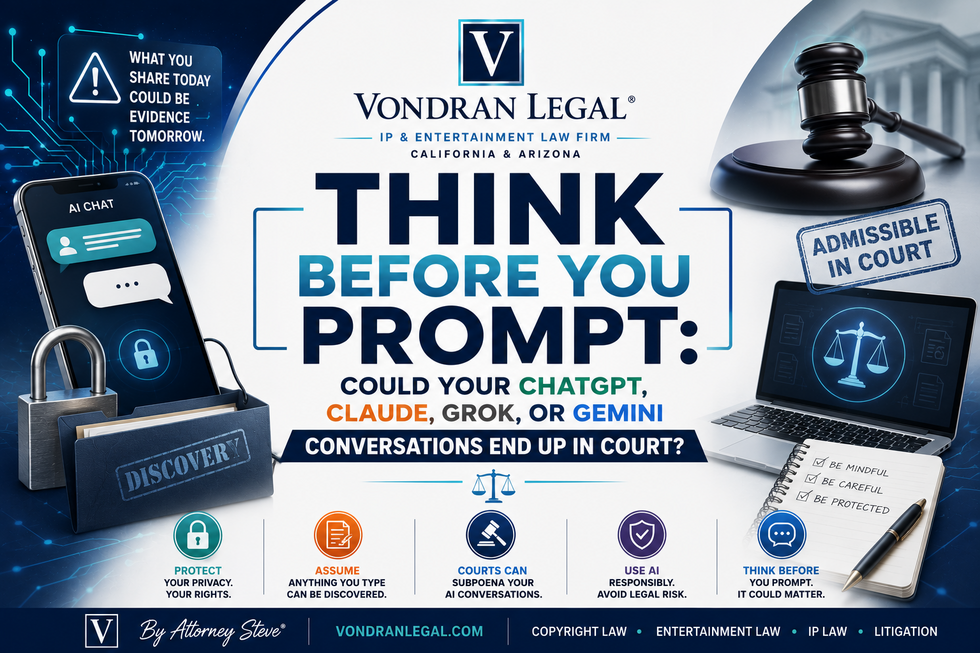
Could your AI conversations someday become evidence in court?
The answer is becoming increasingly important.
While the law is still developing, recent court decisions demonstrate that AI prompt histories may, under certain circumstances, become the subject of discovery requests during litigation.
As both a lawyer and someone who regularly studies emerging technology, I believe this is an issue everyone—not just attorneys—should understand.
AI Chats Are Not Necessarily Your Private Diary
Many people think of AI as a digital notebook.
They assume they can safely write things like:
-
"Here's my invention. Is it patentable?"
-
"Can you help me hide assets?"
-
"How do I get around this copyright?"
-
"My spouse doesn't know about this account..."
-
"Here's my medical history..."
-
"Here's my company's confidential financial statements."
-
"Can you tell me if this competitor is violating my patent?"
The problem?
Those conversations may be stored.
Depending on the platform, your settings, enterprise agreements, applicable privacy policies, and evolving law, those conversations may exist somewhere beyond your own computer.
That doesn't automatically mean someone else can obtain them.
But it does mean that, if litigation arises, someone may try.
Courts Have Already Begun Addressing This Issue
Although the law remains in its infancy, two recent U.S. cases illustrate how courts are beginning to analyze AI-generated conversations.
1. Assini v. Hayward (New York Supreme Court)
In Assini v. Hayward, a litigant used ChatGPT while preparing legal filings and litigation strategy.
The opposing party subpoenaed OpenAI seeking the user's prompt history.
The New York court rejected the request.
The court concluded that the ChatGPT prompts and responses were part of the attorney's litigation preparation and constituted protected work product.
In other words, merely using AI as part of legal strategy did not automatically destroy work-product protection.
Why This Matters
This decision is encouraging for lawyers and clients who use AI responsibly during litigation.
However, it does not mean every AI conversation will always be protected.
The ruling turned heavily on the fact that the communications reflected litigation strategy and attorney work product.
2. Concord Music Group, Inc. v. Anthropic PBC
A different federal court reached a more nuanced conclusion.
In the copyright lawsuit between Concord Music Group and Anthropic, the parties disputed whether certain AI prompts and outputs should be produced during discovery.
Rather than announcing a broad rule, the court carefully analyzed which materials were relevant to the issues in dispute and which reflected protected attorney thought processes.
Some AI-generated materials were ordered produced under structured discovery procedures, while other materials remained protected.
The Lesson
Context matters.
Some AI conversations may be discoverable.
Others may not.
There is currently no universal rule.
Why Intellectual Property Lawyers Should Pay Attention
As an intellectual property attorney, this issue immediately caught my attention.
Imagine someone developing a new software program.
Instead of keeping handwritten engineering notes, they ask an AI:
"Here's my competitor's source code. How can I rewrite mine without infringing?"
Or perhaps:
"How can I design around Patent No. X?"
Or:
"Can you improve this copyrighted article so I won't get sued?"
Those prompts could become highly relevant evidence concerning:
-
knowledge
-
intent
-
willfulness
-
copying
-
access
-
patent design-around efforts
-
trade secret disclosures
-
copyright infringement
-
business strategy
In some cases, those prompts could support a plaintiff's claims.
In other cases, they may help establish a defendant's good-faith efforts to avoid infringement.
Either way, they may become important evidence.
It's Not Just Businesses
This issue affects ordinary people as well.
Many individuals ask AI questions they would never ask another human being.
Examples include:
-
marriage problems
-
divorce strategy
-
child custody issues
-
depression
-
addiction
-
gambling
-
criminal investigations
-
employment disputes
-
workplace complaints
-
medical conditions
-
tax issues
-
immigration concerns
People often feel unusually comfortable talking with AI because it appears judgment-free.
That comfort can lead to oversharing.
Civil Lawsuits
Imagine someone files a lawsuit involving:
-
wrongful termination
-
divorce
-
child custody
-
business fraud
-
copyright infringement
-
patent infringement
-
partnership disputes
-
breach of fiduciary duty
-
employment discrimination
If your AI conversations discuss the very issues being litigated, an opposing party may attempt to obtain them.
Whether they succeed depends on many factors, including relevance, privilege, work-product protection, privacy interests, and the governing procedural rules.
But discovery disputes over AI records are no longer hypothetical.
Criminal Investigations
The same caution applies in criminal matters.
Although constitutional protections and evidentiary rules differ significantly from civil litigation, people should never assume that anything they type into an online service can never become relevant.
Statements made voluntarily—even to an AI platform—may raise legal questions depending on the circumstances.
If someone is under criminal investigation, they should seek qualified legal counsel rather than attempting to use AI as a substitute for legal advice.
Medical Information
Many users upload:
-
lab reports
-
MRI results
-
X-rays
-
prescriptions
-
psychiatric records
-
therapy notes
AI can often provide helpful educational information.
However, before uploading sensitive health information, users should understand:
-
where the information is stored;
-
whether conversations are retained;
-
what privacy settings are available;
-
what the provider's terms of service say; and
-
whether the platform offers enterprise or health-specific privacy protections.
Business Secrets
Business owners increasingly upload:
-
source code
-
customer lists
-
contracts
-
licensing agreements
-
financial projections
-
investor decks
-
product roadmaps
-
engineering drawings
-
unpublished manuscripts
These materials may contain confidential or proprietary information.
Before uploading sensitive business materials, carefully review your company's policies, confidentiality obligations, and the AI provider's terms governing data use and retention.
Best Practices for Using AI Responsibly
Here are several practical tips.
1. Treat AI Like Sending an Email
Before typing something, ask yourself:
"Would I be comfortable if this email were someday reviewed in litigation?"
If the answer is no, pause before submitting it.
2. Avoid Uploading Trade Secrets
Think carefully before uploading:
-
confidential algorithms
-
proprietary software
-
engineering drawings
-
manufacturing methods
-
unpublished books
-
confidential photographs
-
customer databases
3. Don't Use AI as a Confession Booth
AI is a remarkable educational tool.
It is not a substitute for confidential communications with your attorney, physician, accountant, or therapist.
4. Read the Platform's Privacy Policies
Different AI companies have different approaches to:
-
conversation retention
-
training usage
-
enterprise privacy
-
deletion requests
-
user controls
Understand the platform you're using before sharing sensitive information.
5. Talk to Your Lawyer
If litigation is pending—or reasonably anticipated—consult with your attorney before uploading documents or discussing the dispute with an AI platform.
Legal advice should come from a licensed attorney familiar with the facts of your case.
The Law Will Continue to Evolve
Artificial intelligence is changing faster than the legal system.
Over the next several years, courts will likely address numerous questions, including:
-
Are AI prompts discoverable?
-
Are prompts protected by attorney-client privilege?
-
Does using AI waive work-product protection?
-
Can AI conversations establish intent?
-
Can prompt histories prove willfulness?
-
How should courts balance relevance against privacy?
These questions will shape the future of litigation.
Final Thoughts
Artificial intelligence has become one of the most powerful productivity tools ever created.
I use AI regularly in my legal practice to help organize ideas, analyze issues, and improve efficiency.
But like every powerful technology, it should be used thoughtfully.
The safest approach is simple:
Never assume your AI conversations are the equivalent of a locked personal diary.
Instead, assume that anything you type could someday become relevant in a legal dispute, especially if it concerns litigation, intellectual property, confidential business information, or other sensitive matters.
Use AI wisely.
Ask great questions.
But think before you prompt.
Need Legal Advice About AI, Intellectual Property, or Discovery Issues?
Vondran Legal® represents businesses, creators, software companies, authors, photographers, entrepreneurs, and individuals in matters involving:
-
Copyright infringement
-
Trademark disputes
-
Patent-related issues
-
Trade secret protection
-
Software licensing disputes
-
DMCA claims
-
Online platform disputes
-
Business litigation
-
Discovery and electronic evidence
If you have questions about how AI-generated materials may affect your legal rights or obligations, contact an experienced intellectual property attorney before problems arise.
This article is for general educational purposes only and is not legal advice. Every case is different, and you should consult qualified legal counsel regarding your specific circumstances.
References
-
Assini v. Hayward, 2026 N.Y. Slip Op. 26086 (N.Y. Sup. Ct. 2026).
-
Concord Music Group, Inc. v. Anthropic PBC, No. 5:24-cv-03811, U.S. District Court for the Northern District of California (discovery orders addressing AI-related materials).

