
WHY LOSING AN EMPLOYEE COULD MEAN LOSING YOUR WEBSITE, SOCIAL MEDIA, OR EVEN YOUR CUSTOMERS
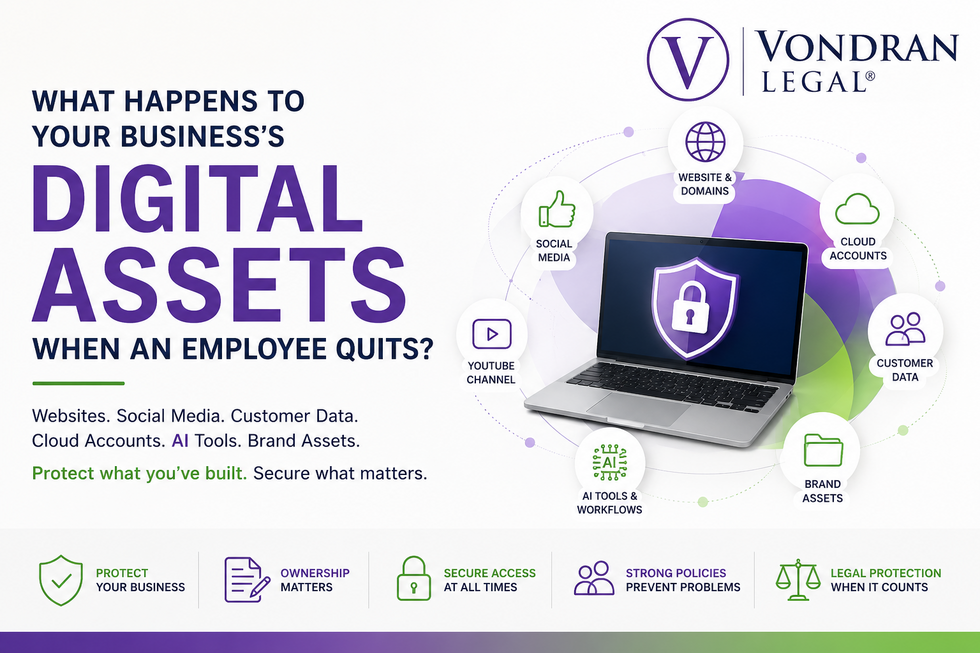
A long-time marketing employee gives two weeks' notice. Everyone wishes them well; the exit interview goes smoothly; the laptop is returned; and the final paycheck is processed. It seems like a routine departure.
Then someone tries to log in to the company's Instagram account, and the password doesn't work. The recovery email belongs to the former employee. As the company digs deeper, it discovers the YouTube channel, Canva account, domain registration, Google Business Profile, Facebook Business Manager, and several other key digital assets were all created years earlier using the employee's personal email address.
What should have been a smooth transition has suddenly become a legal and operational nightmare.
As businesses become increasingly digital, many of their most valuable assets no longer sit in filing cabinets or warehouses. They exist online—in websites, cloud software, customer databases, AI platforms, social media accounts, digital marketing libraries, and even email marketing platforms. Yet surprisingly few companies ever stop to ask one critical question: Who owns these digital assets?
For many businesses, that question isn't answered until an employee walks out the door. By then, recovering access to critical accounts can be time-consuming, expensive, and, in some cases, the subject of legal disputes.
DIGITAL ASSETS ARE OFTEN MORE VALUABLE THAN PHYSICAL PROPERTY
For many companies, digital assets now represent the heart of the business.
A website may generate thousands of leads every month. An Instagram account could represent years of audience growth. A YouTube channel may have hundreds of videos that continue attracting customers long after they're published. Even something as simple as a Canva brand library can contain years of marketing materials and institutional knowledge.
Unlike office furniture or company vehicles, however, ownership of these assets isn't always obvious.
If an employee created an account using a personal Gmail address, paid for a subscription with a personal credit card before being reimbursed, or maintained sole administrative control for years, untangling ownership later can become surprisingly complicated.
THE LEGAL QUESTION ISN'T ALWAYS"WHO CREATED IT?"
One of the biggest misconceptions businesses have is assuming that because an employee built something while working for the company, the company automatically owns it.
Sometimes that's true, but sometimes it isn't.
Ownership often depends on a combination of employment agreements, intellectual property assignment provisions, company policies, copyright law, and the specific facts surrounding how the asset was created and maintained.
Courts may consider questions such as:
- Was the employee acting within the scope of their employment?
- Did the company pay for the account or subscription?
- Was there a written agreement assigning intellectual property rights?
- Who controls the login credentials?
- Was the account presented publicly as belonging to the business?
The answers can vary from one dispute to another, which is why proactive planning is far less expensive than reconstructing ownership after an employee leaves.
SOCIAL MEDIA OWNERSHIP HAS BECOME A GROWING SOURCE OF LITIGATION
Social media accounts have become some of the most contested business assets in modern employment disputes.
Imagine a marketing director who spends five years growing a company's TikTok account to hundreds of thousands of followers. They create every post, respond to comments, and become closely associated with the brand.
When they resign, can they take the account with them?
Can they change the password?
Can they continue using the followers they built?
These questions have led to lawsuits across multiple industries because social media accounts often blur the line between personal identity and corporate property.
The safest approach is to establish ownership before any content is posted. Company accounts should be created using business-controlled email addresses, multiple administrators should be designated, and employment agreements should clearly address ownership and control of digital platforms.
AI HAS INTRODUCED AN ENTIRELY NEW CATEGORY OF BUSINESS ASSETS
Artificial intelligence has added another layer of complexity.
Employees are increasingly developing custom GPTs, prompt libraries, automated workflows, AI-assisted marketing campaigns, and internal knowledge bases that become deeply integrated into day-to-day business operations.
But what happens if all those tools are housed inside the employee's personal ChatGPT account?
Or if the company's most effective AI prompts disappear the day an employee leaves?
Many businesses have not yet updated their employment agreements or technology policies to address ownership of AI-generated work product or internally developed AI systems.
As AI adoption accelerates, these issues are likely to become far more common.
SOMETIMES THE GREATEST RISK ISN'T INTELLECTUAL PROPERTY—IT'S ACCESS
Ownership means very little if a company cannot access its own systems.
Many businesses discover, upon an employee's departure, that critical passwords are stored only in a personal password manager or browser.
The departing employee may have been the only administrator on the company's Google Business Profile, website hosting account, or advertising platforms.
Even if everyone agrees the company owns the accounts, regaining access can take weeks or even months.
For businesses that rely on online sales or digital marketing, even a brief interruption can have significant financial consequences.
CUSTOMER INFORMATION CAN RAISE TRADE SECRET ISSUES
Another common area of conflict involves customer data.
When an employee leaves, businesses often discover that large amounts of client information have been downloaded or transferred before departure.
Whether those customer lists qualify as legally protectable trade secrets depends on several factors, including the nature of the information and whether the company took reasonable steps to maintain their confidentiality.
Simply labeling something "confidential" may not be enough.
Courts often examine how the business protected the information through access controls, confidentiality agreements, employee policies, and security practices.
A STRONG OFFBOARDING PROCESS IS ONE OF THE BEST INVESTMENTS A BUSINESS CAN MAKE
Most companies have detailed procedures for onboarding new employees.
Far fewer have equally detailed procedures when employees leave.
A comprehensive offboarding process should include much more than collecting laptops and key cards. Companies should verify administrative access to every significant digital platform, rotate passwords where appropriate, remove unnecessary permissions, preserve important business records, and confirm that ownership of critical accounts remains with the business—not the departing employee.
These steps often take only a few hours but can prevent months of disruption later.
THE BEST TIME TO SOLVE THESE PROBLEMS IS BEFORE THEY EXIST
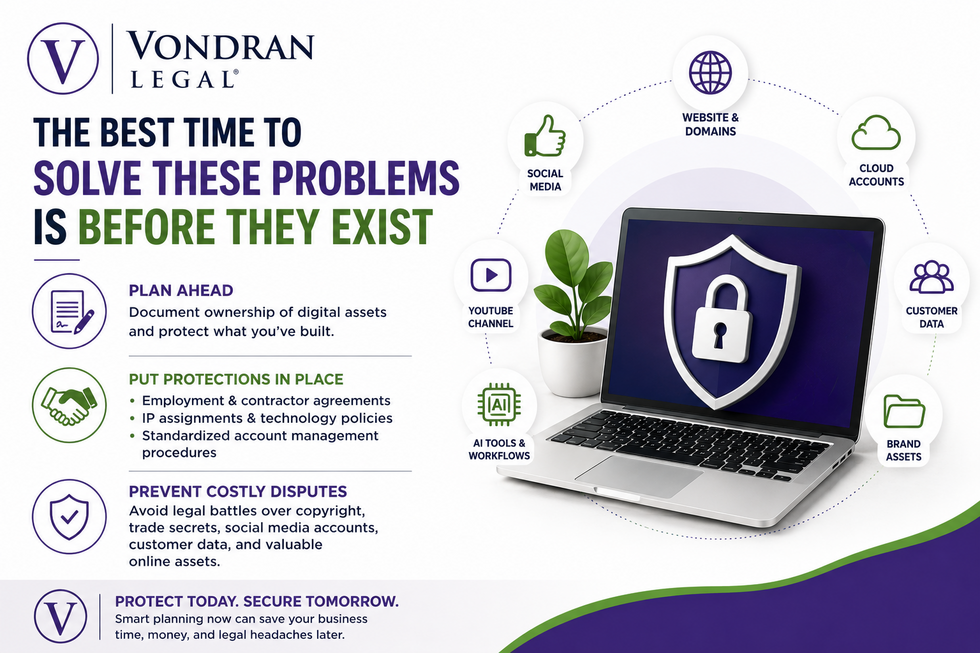
Businesses spend enormous amounts of time building their online presence, yet many never formally document ownership of the digital assets that support it.
Employment agreements, independent contractor agreements, intellectual property assignments, technology policies, and standardized account management procedures all play an important role in protecting those investments.
When these documents are overlooked, what appears to be a simple employee resignation can quickly evolve into a dispute involving copyright ownership, trade secrets, social media accounts, customer relationships, or valuable online business assets.
FINAL THOUGHTS
Today's businesses are built on far more than office space and equipment. Their value increasingly resides in websites, customer databases, cloud software, AI systems, digital content, and online communities.
The question every business owner should ask is not whether these assets are valuable; it is whether the company has taken the legal and practical steps necessary to ensure they remain company property when an employee leaves, and whether the business is prepared for that day.
At Vondran Legal®, we regularly counsel businesses on intellectual property ownership, digital asset disputes, trade secret protection, technology agreements, and employment-related IP issues. Taking a proactive approach today may help avoid costly disputes tomorrow and help ensure that the digital assets you've spent years building remain exactly where they belong, with your business.
