
Frequently Asked Questions (FAQ): Understanding Thin Copyright Protection
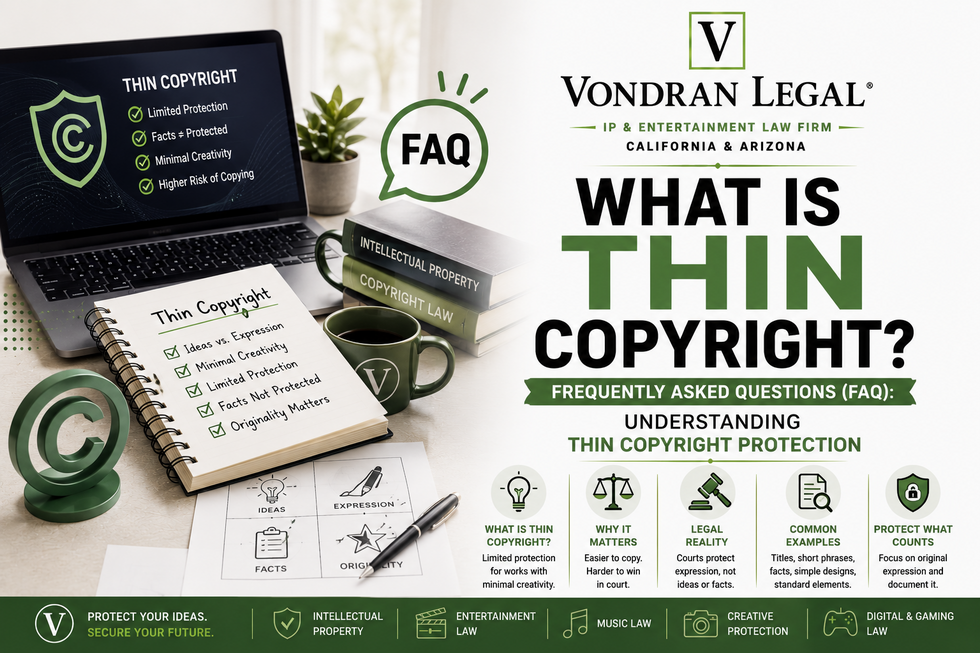
What is "thin copyright" protection?
Thin copyright is a legal doctrine that provides limited copyright protection to works containing only a modest amount of original creative expression. While these works may qualify for copyright protection, the scope of that protection is much narrower than for highly creative works like novels, movies, paintings, or original music.
Why is it called "thin" copyright?
The term "thin" refers to the narrow scope of legal protection. The copyright owner can prevent others from copying the original expressive elements of the work, but cannot stop others from using the underlying facts, ideas, concepts, systems, or public-domain material contained within it.
What Supreme Court case established the basis for thin copyright?
The leading case is Feist Publications, Inc. v. Rural Telephone Service Co. (1991). The U.S. Supreme Court held that facts themselves cannot be copyrighted and that copyright protects only original expression. The Court explained that originality—even a small amount—is the constitutional requirement for copyright protection.
Does thin copyright mean there is no copyright protection?
No. Thin copyright still provides legal protection. However, proving infringement is usually more difficult because the copyright owner must show that the defendant copied the original expressive elements rather than merely using ideas, facts, or other unprotectable material.
What kinds of works often receive thin copyright protection?
Examples include:
-
Factual compilations
-
Directories and databases
-
Maps
-
Educational materials
-
Public-domain works with original annotations
-
Certain software interfaces
-
AI-assisted works
-
Some choreography
-
Social media content
-
Certain translations and edited versions of historical texts
Are public-domain works protected by copyright?
The underlying public-domain work is not protected. Anyone may copy, reproduce, or distribute it.
However, new creative contributions added to a public-domain work—such as commentary, annotations, original translations, formatting, illustrations, or editorial organization—may receive copyright protection.
Can someone copyright the Torah or other ancient religious texts?
No. Ancient religious texts such as the Torah, Bible, or other historical works generally reside in the public domain.
However, publishers may obtain copyright protection for their own original contributions, including:
-
Original translations
-
Editorial commentary
-
Study notes
-
Footnotes
-
Original formatting
-
Search tools
-
Creative organization
The copyright protects only those additions—not the underlying religious text itself.
Can a translation of a public-domain work be copyrighted?
Yes.
Translation requires numerous creative and linguistic decisions. Courts have consistently recognized that original translations generally qualify for copyright protection, even when the original work is in the public domain.
Can formatting or page layout be copyrighted?
Sometimes.
While simple formatting usually is not protected, courts have found that sufficiently original organizational choices, pagination, and editorial arrangement may qualify for copyright protection if they reflect creative judgment.
Can functional software features be copyrighted?
Generally, no.
Copyright protects creative expression—not functionality. Features designed solely to improve searching, indexing, or other utilitarian purposes are generally not protected by copyright, although they may qualify for protection under patent law or trade secret law in some circumstances.
Can comedians copyright jokes?
Comedians cannot copyright ideas or general comedic premises.
For example, no one owns jokes about:
-
Lawyers
-
Dating
-
Marriage
-
Air travel
-
Family life
However, the specific wording, structure, timing, sequencing, and expression of a joke may receive copyright protection.
Can someone copy Jeff Foxworthy's "You might be a redneck if..." jokes?
Not verbatim.
Courts have recognized that while the overall joke format is not protected, closely copying or paraphrasing Foxworthy's specific jokes may constitute copyright infringement.
Why is Abbott and Costello's "Who's on First?" more strongly protected?
Unlike short jokes, "Who's on First?" is a fully scripted dramatic performance with substantial original expression.
Because of its extensive creative authorship, courts have afforded it broader copyright protection than isolated jokes or comedic premises.
Can AI-generated works receive copyright protection?
Generally, purely AI-generated content is not eligible for copyright protection under current U.S. law because copyright requires human authorship.
Can humans obtain copyright in AI-assisted works?
Yes.
If a human meaningfully contributes original creativity—such as selecting, arranging, editing, or organizing AI-generated material—that human contribution may qualify for copyright protection.
The protection, however, generally extends only to the human-created elements.
What is the "Zarya of the Dawn" Copyright Office decision?
The Copyright Office concluded that while the AI-generated artwork itself was not copyrightable, the author's creative selection and arrangement of the images within the graphic novel qualified for copyright protection.
It has become one of the leading examples of thin copyright in AI-generated works.
Can maps be copyrighted?
The underlying geographic facts cannot.
However, original creative choices involving:
-
Selection
-
Organization
-
Labeling
-
Color choices
-
Graphic presentation
-
Visual design
may receive copyright protection.
What are "trap streets" on maps?
Trap streets are fictitious streets intentionally inserted into maps to help prove copying.
Although they may help demonstrate infringement, they generally are not independently copyrightable.
Can influencers copyright their "look" or aesthetic?
Usually not.
Copyright generally does not protect:
-
Overall style
-
Mood
-
Color palette
-
Vibe
-
General aesthetic
-
Visual trends
Instead, copyright protects specific original expressive elements such as:
-
Original scripts
-
Narration
-
Dialogue
-
Creative editing
-
Camera angles
-
Unique sequencing
-
Original graphics
Can TikTok dances be copyrighted?
Sometimes—but often not.
Many viral dances consist of short sequences of commonplace movements that may not satisfy copyright's originality requirements.
Longer, more elaborate choreographic works may receive copyright protection if they contain sufficient creative expression.
Why were the Fortnite dance lawsuits difficult?
Many courts concluded that individual dance moves or short dance sequences are not sufficiently original to qualify as protected choreography under copyright law.
Can creators still make money even without strong copyright protection?
Absolutely.
Many influencers and creators monetize their work through:
-
Brand sponsorships
-
Licensing agreements
-
Advertising
-
Merchandise
-
Affiliate marketing
-
Live appearances
-
Endorsement deals
Commercial success often depends on audience recognition rather than copyright ownership alone.
Why is understanding thin copyright important?
Many modern disputes involve works that contain both protected and unprotected elements.
Understanding thin copyright helps creators, businesses, publishers, software developers, artists, and content creators evaluate:
-
Whether a work is protected
-
How broad that protection is
-
Whether infringement has occurred
-
What defenses may be available
-
How courts separate ideas from expression
What is the key takeaway?
Copyright does not protect everything that is valuable or popular.
It protects original expression—not ideas, facts, systems, methods, or concepts. When originality is limited, copyright protection becomes correspondingly narrow. Determining exactly where that line falls is one of the most important—and frequently litigated—issues in modern copyright law.

