
Getty Images v. Stability AI: Vondran Legal AI Copyright Law Firm
By Attorney Steve® | Vondran Legal®
Artificial intelligence has transformed how digital content is created. Today, users can generate realistic photographs, illustrations, logos, and artwork in a matter of seconds using generative AI platforms such as Stable Diffusion, Midjourney, DALL·E, Flux, and others.
Much of the legal discussion surrounding AI has focused on copyright law. Questions about whether AI companies can train on copyrighted works, whether AI-generated images are substantially similar to protected works, and whether outputs infringe copyright have dominated headlines.
But another area of intellectual property law is quietly emerging as an equally important battleground:
Trademark law.
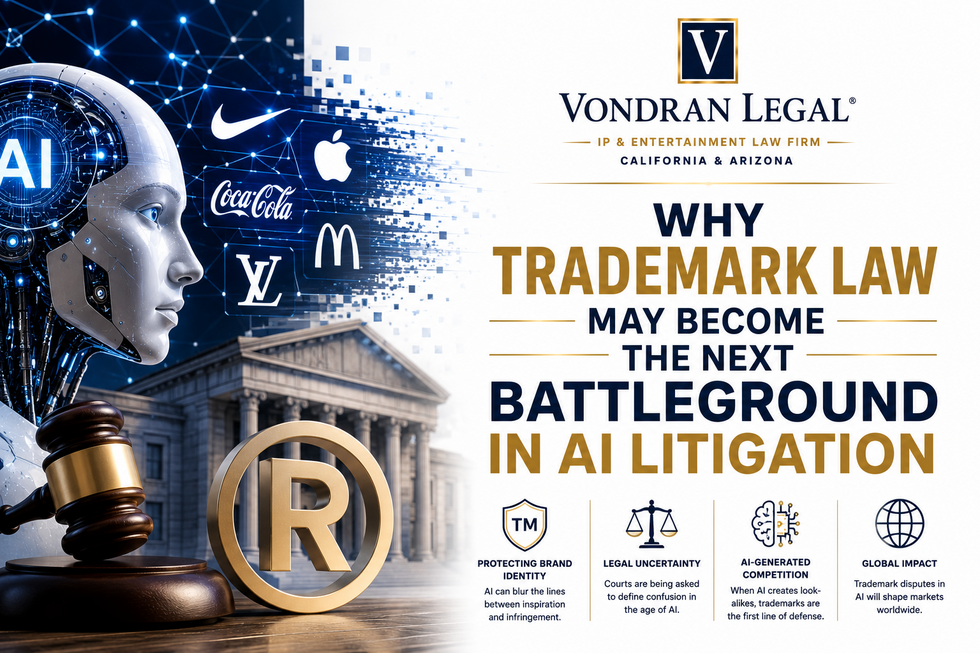
The ongoing litigation between Getty Images and Stability AI demonstrates why businesses, AI developers, artists, photographers, and technology companies should pay close attention. Even if copyright claims ultimately face significant legal hurdles, recognizable branding—such as logos, company names, and watermarks—may expose AI companies to entirely different legal risks under the Lanham Act.
This article explains why.
What Is the Getty Images v. Stability AI Lawsuit About?
Getty Images filed lawsuits in both the United States and the United Kingdom against Stability AI, the developer of the popular image-generation model Stable Diffusion.
Getty alleges that Stability AI copied millions of Getty-owned photographs during the training of its AI models without obtaining licenses.
According to Getty, the company's extensive image library—including professionally licensed photographs available through Getty Images and iStock—was allegedly scraped and incorporated into AI training datasets.
The lawsuits have become one of the most closely watched AI intellectual property cases in the world because they present fundamental questions regarding:
- AI training datasets
- Machine learning
- Copyright infringement
- Fair use
- Database rights (UK)
- Trademark infringement
- Digital Millennium Copyright Act (DMCA)
- False designation of origin
- Trademark dilution
The outcome could significantly influence how AI developers build future models.
Copyright and Trademark Protect Different Things
One of the biggest misconceptions in AI litigation is that copyright and trademark law accomplish the same objective.
They do not.
Copyright Protects Creative Expression
Copyright protects original works of authorship, including:
- photographs
- illustrations
- paintings
- books
- software
- music
- movies
- architectural works
Copyright generally protects the creative expression embodied in the work—not the underlying ideas.
Trademark Protects Brand Identity
Trademark law serves an entirely different purpose.
Rather than protecting creativity itself, trademark law protects consumers from confusion regarding the source of goods or services.
Examples include:
- company names
- logos
- slogans
- product packaging
- service marks
- distinctive branding
- trade dress
For Getty Images, the famous Getty Images watermark is more than simply text appearing on a photograph.
It functions as a source identifier, telling consumers where the image originated and who controls licensing rights.
That distinction becomes critically important in AI litigation.
Why Getty's Trademark Claims Matter
One of Getty's more interesting allegations is not simply that AI models were trained on copyrighted photographs.
Getty also alleges that some AI-generated images contain distorted or partial versions of Getty's recognizable watermarks.
Anyone who has experimented with image generators has likely seen examples where AI occasionally produces:
- garbled logos
- partially formed text
- incomplete watermarks
- distorted branding
- nonsensical trademarks
Getty argues that these outputs are not merely random artifacts.
Instead, they allegedly reflect that the AI model learned recognizable Getty branding during training.
Because trademark law focuses on consumer perception, Getty contends that these outputs could falsely imply:
- sponsorship
- affiliation
- endorsement
- licensing
- origin
Those are classic trademark concerns.
The Lanham Act: A Powerful Tool Beyond Copyright
Getty's U.S. trademark claims primarily arise under the Lanham Act, the principal federal trademark statute in the United States.
The Lanham Act provides several potential causes of action that may be relevant in AI litigation.
Trademark Infringement
Trademark infringement occurs when another party uses a protected mark in a manner that is likely to confuse consumers about:
- source
- sponsorship
- affiliation
- approval
The key question is likelihood of confusion.
Unlike copyright law, courts are not primarily asking whether expression was copied.
Instead, they ask whether consumers might mistakenly believe the product comes from—or is associated with—the trademark owner.
False Designation of Origin
Section 43(a) of the Lanham Act also prohibits false designation of origin.
This provision addresses situations where marketing or presentation falsely suggests a connection between parties.
Getty alleges that AI-generated images displaying distorted Getty branding may create precisely this type of confusion.
Trademark Dilution
Getty also alleges trademark dilution.
Dilution differs from ordinary trademark infringement.
Unlike infringement, dilution generally does not require proof of consumer confusion.
Instead, owners of famous marks may claim that unauthorized uses weaken the distinctiveness of their brand or harm its reputation.
For companies with globally recognized brands, dilution can become an important litigation tool.
What Did the U.S. Court Decide?
In April 2026, the U.S. District Court for the Northern District of California largely denied Stability AI's motion to dismiss Getty's complaint.
Importantly, the court did not decide that Stability AI infringed Getty's rights.
Instead, the court concluded that Getty had plausibly alleged several claims sufficient to proceed into discovery, including:
- trademark infringement
- false designation of origin
- trademark dilution
- copyright infringement
- related California unfair competition claims
The ruling simply allowed Getty to continue litigating these issues.
As is typical at the motion-to-dismiss stage, the court assumed Getty's factual allegations were true solely for purposes of determining whether the complaint stated legally viable claims.
Discovery, expert testimony, summary judgment, and possibly trial remain ahead.
What About the DMCA Claim?
Getty also asserted claims under the Digital Millennium Copyright Act (DMCA).
One claim involving copyright management information was dismissed without prejudice because the court found Getty had not adequately alleged the specific intent required under that statutory provision.
Importantly, dismissal without prejudice does not necessarily end the claim.
Getty may be permitted to amend its allegations if additional facts supporting the required scienter can be pleaded.
This procedural ruling also illustrates an important point:
Different intellectual property claims contain different legal elements.
A weakness in one statutory claim does not necessarily defeat others.
What Happened in the United Kingdom?
Getty also pursued litigation against Stability AI in the High Court of England and Wales.
The UK proceedings produced another important distinction.
The High Court rejected Getty's argument that the Stable Diffusion model itself constituted an infringing copy of Getty's photographs.
The court concluded that the model does not literally store or reproduce copyrighted images in the manner Getty alleged.
However, the court recognized limited trademark-related issues involving certain AI-generated outputs displaying Getty- or iStock-style branding.
The court emphasized that these findings were narrow and fact-specific.
They did not establish that every AI-generated image containing distorted branding automatically violates trademark law.
Nevertheless, the UK proceedings reinforced the growing importance of trademark theories in AI litigation.
Why Watermarks Matter
Many people think of watermarks as simply copyright notices.
Legally, they often serve a much broader function.
A watermark may simultaneously represent:
- copyright ownership
- branding
- licensing information
- source identification
- commercial goodwill
When AI reproduces recognizable portions of those identifiers, plaintiffs may argue that trademark law—not just copyright—has been implicated.
That dual function makes watermark cases particularly interesting.
Why AI Developers Should Pay Attention
The Getty litigation sends an important message to AI companies.
Risk management now extends beyond simply evaluating copyright exposure.
Developers should consider whether models generate:
- recognizable logos
- brand names
- corporate symbols
- watermarks
- trade dress
- source identifiers
If AI outputs repeatedly include protected branding, trademark claims may become increasingly common.
Practical Compliance Strategies for AI Companies
Companies developing generative AI systems should consider implementing comprehensive intellectual property compliance programs.
These may include:
Licensed Training Data
Whenever feasible, developers should obtain licensed datasets from reputable providers.
Dataset Audits
Organizations should periodically review datasets for branded materials, logos, and copyrighted works.
Output Filtering
Modern AI systems increasingly employ safeguards designed to reduce reproduction of:
- trademarks
- logos
- copyrighted characters
- watermarks
Prompt Restrictions
Some AI systems block prompts requesting well-known brands or copyrighted works.
Although imperfect, these controls may reduce litigation risk.
Governance Policies
Companies should maintain documented procedures regarding:
- data sourcing
- licensing
- content moderation
- intellectual property review
- legal compliance
Strong governance may become important evidence in future litigation.
Practical Lessons for Businesses
Businesses using AI-generated content should also remain cautious.
Before publishing AI-generated images commercially, ask:
- Does the image contain recognizable branding?
- Are there distorted logos?
- Does the image include partial watermarks?
- Could consumers mistakenly believe another company sponsored this image?
- Was the image generated using properly licensed AI tools?
- Are additional human edits necessary before publication?
Simple review procedures can avoid expensive disputes.
Lessons for Photographers and Content Creators
Professional creators should also consider strengthening their intellectual property strategies.
Recommendations include:
- Register copyrights promptly with the U.S. Copyright Office.
- Maintain consistent branding across licensed content.
- Use recognizable watermarks where appropriate.
- Preserve metadata whenever possible.
- Monitor unauthorized online uses.
- Document licensing histories.
- Consider trademark protection for distinctive brand identifiers.
Copyright and trademark protection often work best together.
Frequently Asked Questions
Can AI-generated images infringe trademarks?
Yes. If an AI-generated image contains recognizable logos, watermarks, or branding that is likely to cause consumer confusion regarding source, sponsorship, affiliation, or endorsement, trademark law may be implicated.
Are watermarks protected by trademark law?
Sometimes. A watermark may serve as both a copyright management tool and a trademark if it identifies the source of goods or services and functions as a brand identifier.
Is every distorted logo automatically trademark infringement?
No. Trademark liability is highly fact-specific. Courts generally examine issues such as likelihood of confusion, the nature of the mark, how the mark is used, and the overall commercial context.
Does Getty's lawsuit mean AI training is illegal?
No. The Getty litigation remains ongoing, and many of the central legal questions regarding AI training, copyright, and fair use have not yet been finally resolved. The procedural rulings to date do not establish that all AI training practices are unlawful.
The Bigger Picture
Getty Images v. Stability AI illustrates an important evolution in artificial intelligence litigation.
For years, most discussions focused almost exclusively on copyright law.
Today, however, trademark law has emerged as another powerful avenue for protecting valuable intellectual property.
As AI technology becomes more sophisticated, future lawsuits may increasingly involve multiple legal theories at once, including:
- copyright infringement
- trademark infringement
- trademark dilution
- false designation of origin
- unfair competition
- breach of contract
- right of publicity
- trade secret misappropriation
- violations of the Digital Millennium Copyright Act
Businesses developing or deploying AI technologies should evaluate intellectual property risks comprehensively rather than focusing on any single legal doctrine.
How Vondran Legal® Can Help
Generative AI presents exciting opportunities—but it also raises complex legal questions that many businesses have never faced before. Whether you are an AI developer, software company, content creator, photographer, marketing agency, or business integrating AI into your operations, proactive legal guidance can help reduce risk before disputes arise.
Attorney Steve® and Vondran Legal® represent clients in intellectual property and technology matters involving:
- AI and generative AI legal compliance
- Copyright infringement claims and litigation
- Trademark infringement and brand protection
- DMCA takedown notices and counter-notices
- Software licensing and audit defense
- Content licensing and digital media agreements
- Technology contracts and SaaS licensing
- Unfair competition and Lanham Act litigation
- Intellectual property due diligence for AI products
- Website, social media, and online content disputes
If your business has received a cease-and-desist letter, been accused of AI-related infringement, or is developing AI tools that may implicate intellectual property rights, obtaining experienced legal advice early can help preserve defenses and minimize costly litigation.
This article is provided for informational purposes only and does not constitute legal advice. Reading this article does not create an attorney-client relationship. Laws governing artificial intelligence and intellectual property continue to evolve, and outcomes depend on the specific facts of each case.

