
IS YOUR WEBSITE LEGALLY PROTECTED? THE TRUTH ABOUT TERMS OF SERVICE AGREEMENTS
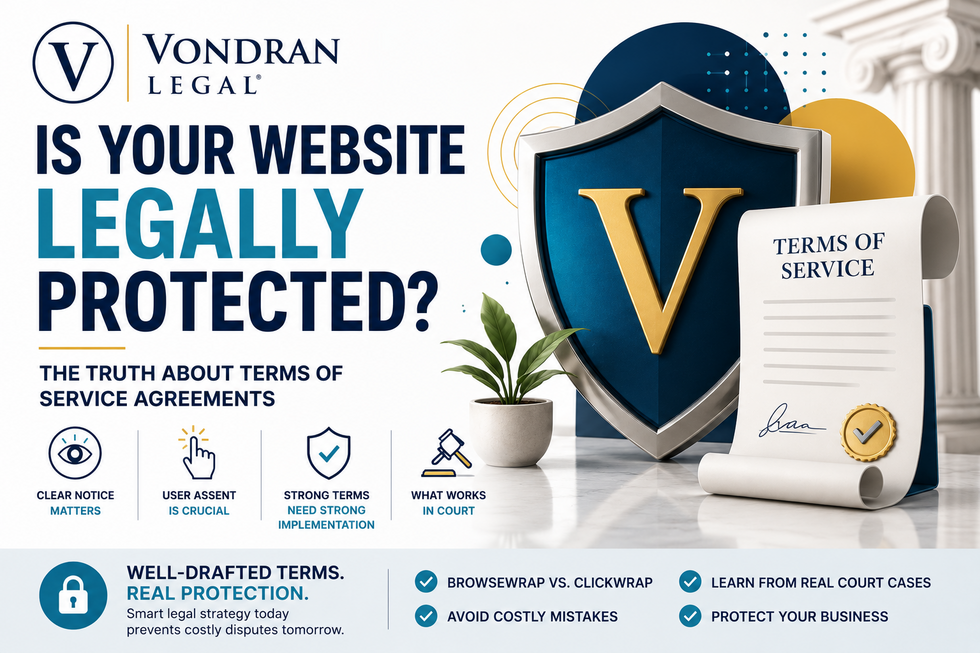
For many businesses, a website's Terms of Service page is little more than an afterthought.
It gets copied from another company, generated by an online template, or drafted years ago and forgotten. A link is placed in the website footer, and business owners assume they are legally protected if a dispute ever arises.
Unfortunately, that assumption can become a costly mistake—and the problem often begins when a dispute arises.
When litigation begins, one of the first questions a court may ask is surprisingly simple: Did the customer actually agree to your terms?
If the answer is no, or even 'we're not sure,' your carefully written Terms of Service may provide little protection at all—and that leads to a larger issue.
A TERMS OF SERVICE AGREEMENT IS ONLY AS STRONG AS THE WAY IT'S PRESENTED
Many business owners focus almost entirely on what their Terms of Service say. But just as important is how users encounter and accept those terms.
Courts generally look for evidence that users had reasonable notice of the agreement and took an affirmative action showing they agreed to be bound.
Without those elements, even well-written provisions addressing arbitration, limitation of liability, intellectual property ownership, payment disputes, or governing law may become difficult or impossible to enforce.
In other words, the problem often isn't the legal language. It's the user experience that shapes whether those terms hold up.
It's the user experience.
THE DIFFERENCE BETWEEN BROWSEWRAP AND CLICKWRAP
One of the most important distinctions courts examine is the type of online agreement being used.
Browsewrap Agreements
Browsewrap agreements typically place a hyperlink to the Terms of Service somewhere on the website, often in the footer.
Users are never asked to click "I Agree."
Instead, the website attempts to state that merely using the site constitutes acceptance of the terms.
While this approach is convenient, it can create significant enforcement challenges because many users never see the agreement.
A footer link that blends into dozens of others may not provide sufficient notice that legal rights are affected.
Clickwrap Agreements
Clickwrap agreements require users to take an affirmative action, such as clicking "I Agree," before proceeding.
Common examples include:
- Clicking the "I Agree" checkbox before creating an account.
- Accepting terms before completing a purchase
- Confirming agreement before downloading software
- Accepting updated terms before logging in
Because users actively take an affirmative action to indicate agreement, courts have generally been more willing to enforce properly implemented clickwrap agreements. That difference matters when litigation later arises.
That single click can make a substantial difference if litigation later arises.
WHEN A FOOTER LINK WASN'T ENOUGH: THE BARNES & NOBLE CASE
One of the most influential decisions involving online Terms of Service came from a dispute involving Barnes & Noble.
In Nguyen v. Barnes & Noble, Inc., a customer attempted to purchase discounted HP TouchPad tablets through the company's website. After Barnes & Noble canceled the order, the customer filed suit. Barnes & Noble argued that the dispute was subject to arbitration because its website's Terms of Use contained a mandatory arbitration clause.
But there was one problem.
The Terms of Use were available only through a hyperlink at the bottom of the website. Customers were never required to click "I Agree," check a box, or otherwise take any action to acknowledge acceptance before making a purchase.
The Ninth Circuit refused to enforce the arbitration clause.
The court explained that simply placing a hyperlink in the website footer—even one visible on every page—did not, by itself, mean users had reasonable notice of the agreement. Without clear notice and some affirmative indication that the customer agreed to the terms, there was no enforceable contract. That is why the footer link alone was not enough.
The decision became one of the most frequently cited opinions involving browsewrap agreements and continues to influence how businesses design their websites today.
For business owners, the takeaway is clear: if your website relies solely on a footer link stating that visitors are bound by your Terms of Service, you may discover—only after litigation begins—that those terms provide far less protection than you expected.
THE PROBLEM OF MISSING ASSENT
One of the biggest weaknesses in many online agreements is the absence of meaningful user assent.
Imagine a customer later claims:
"I never saw those terms."
If the business cannot demonstrate that the customer had clear notice and took affirmative action to accept the agreement, enforcing provisions such as arbitration requirements, attorney fee clauses, forum selection clauses, or liability limitations becomes much more difficult. That is where the analysis turns next.
Courts frequently examine questions such as:
- Was the hyperlink obvious?
- Was the text readable?
- Was the agreement presented before the transaction?
- Was acceptance optional or mandatory?
- Did the website record when the user accepted?
These seemingly minor design choices can become central issues in litigation, which is why the website experience matters so much.
BAS DRAFTING CREATES PROBLEMS EVEN WHEN USERS AGREE
Even if your website uses a strong clickwrap process, poorly drafted Terms of Service can still create unnecessary legal risk. The next concern is the quality of the draft itself.
Common issues include:
- Internal inconsistencies
- Outdated legal references
- Overly broad disclaimers
- Ambiguous language
- Missing intellectual property provisions
- Weak dispute resolution clauses
- Conflicting state law provisions
- Generic templates copied from unrelated businesses
Many online templates are designed to fit virtually any website. But the problem is that no two businesses operate the same way.
An e-commerce retailer, SaaS platform, content creator, law firm, mobile app developer, and marketplace each face very different legal risks.
Your Terms of Service should reflect your actual business—not someone else's.
WEBSITE DESIGN CAN INFLUENCE LEGAL OUTCOMES
Many people assume courts evaluate only the legal document itself. In practice, judges often review screenshots of the website, registration pages, checkout flow, account creation process, and even button placement.
Questions may include:
- Was the Terms of Service hyperlink easy to find?
- Did users need to scroll past the agreement?
- Was the checkbox pre-selected?
- Could users continue without accepting?
- Was the language hidden behind multiple pages?
These design decisions may determine whether the agreement is enforceable.
In other words, website design and legal drafting often work hand in hand, so both deserve attention.
RECENT COURT DECISIONS CONTINUE TO FOCUS ON NOTICE AND ASSENT
Although every dispute depends on its own facts, courts across the country have repeatedly emphasized two fundamental principles: first, users generally need reasonable notice that contractual terms exist; second, there must be evidence showing the user manifested assent to those terms. Together, those points frame the analysis.
First, users generally need reasonable notice that contractual terms exist and require an action to accept them.
Second, there must be evidence showing the user took an affirmative action manifesting assent to those terms.
Businesses relying solely on inconspicuous footer links or passive website use have faced greater challenges enforcing online agreements than those implementing clear acceptance mechanisms during account creation or checkout. That pattern continues across recent decisions.
The law surrounding online contracts continues to evolve alongside technology, making periodic review of website agreements increasingly important.
A WEBSITE IS OFTEN ONE OF YOUR MOST IMPORTANT CONTRACTS
Every day, customers may interact with your website hundreds—or even thousands—of times, and each interaction creates potential legal issues involving:
Each interaction creates potential legal issues involving:
- Purchases
- Intellectual property
- User-generated content
- Subscription services
- Privacy
- Refunds
- Account suspensions
- Payment disputes
- Software licensing
For many businesses, their Terms of Service govern more customer relationships than any other contract, which is why the details matter.
Treating those terms as a simple template can leave significant gaps when disputes arise.
PRACTICAL TAKEAWAYS FOR BUSINESS OWNERS
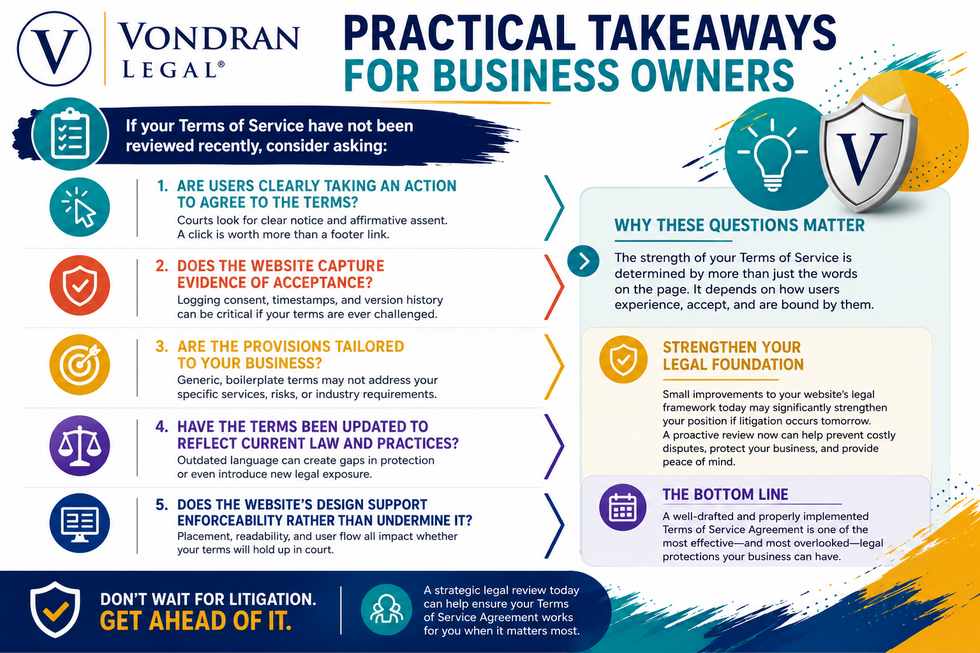
If your Terms of Service have not been reviewed recently, consider asking: Are users clearly taking an action to agree to the terms?
- Does the website capture evidence of acceptance?
- Are the provisions tailored to your business?
- Have the terms been updated to reflect current law and business practices?
- Does the website's design support enforceability rather than undermine it?
Small improvements to your website's legal framework today may significantly strengthen your position if litigation occurs tomorrow, so the review should not wait.
HOW WE CAN HELP
Online contracts have become increasingly important as businesses move more transactions, customer relationships, and intellectual property to digital platforms. Yet many companies continue relying on outdated templates or website designs that may not provide the legal protections they expect.
At Vondran Legal®, we assist businesses with drafting, reviewing, and strengthening website Terms of Service, intellectual property provisions, online contracting strategies, technology agreements, and other business contracts. We also represent clients in disputes involving contract enforcement, intellectual property, technology law, and business litigation.
A well-drafted Terms of Service is only part of the equation. Make sure users actually agree to it—and that the agreement is presented in a legally defensible manner—so your position is stronger when a dispute reaches the courtroom.
