
AI SEARCH IS CHANGING COPYRIGHT LAW, BRAND VISIBILITY, ONLINE REPUTATION, AND EVEN WHO CONTROLS THE TRUTH ABOUT YOUR BUSINESS.
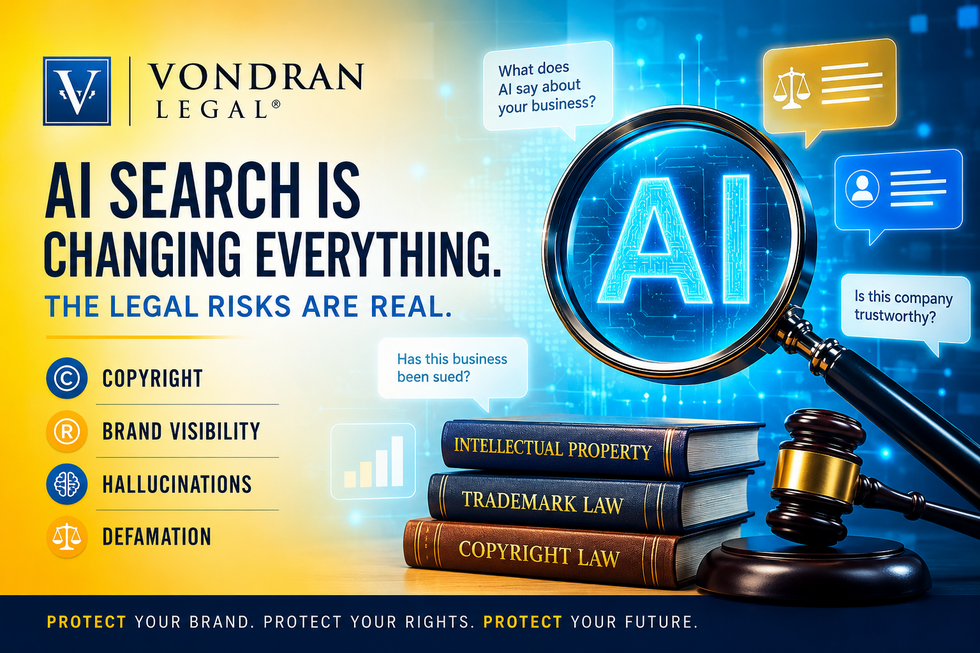
For nearly thirty years, businesses have asked one question:
"How do we rank higher on Google?"
Today, the question is changing.
Instead, companies should be asking:
"What does AI say about us?"
That may sound like a marketing question.
It isn't.
It is becoming a legal question.
Every day, millions of people are asking ChatGPT, Gemini, Claude, Perplexity, Microsoft's Copilot, and Google's AI search features questions that previously would have gone to Google.
Instead of receiving ten links, they receive one answer.
That answer could determine:
- whether someone hires your company
- buys your product
- trusts your expertise
- believes negative information
- ever visits your website
Your first impression may no longer come from your homepage.
It may come from artificial intelligence.
And that changes everything.
AI DOESN'T SEND CUSTOMERS TO YOUR WEBSITE
It Replaces It.
Google rewarded websites.
AI rewards answers.
For years, businesses spent thousands—or millions—of dollars creating:
- blogs
- FAQs
- videos
- educational articles
- SEO pages
The goal was simple: Get someone to click.
AI changes that equation. Now the user may never click at all. AI summarizes information from dozens of sources and delivers a finished answer. This is convenient for users, but for businesses, it raises a difficult question:
If AI gives away your expertise without sending anyone to your website, who owns the value you created?
That question is already making its way into courtrooms.
AI IS BECOMING YOUR BRAND'S SPOKESPERSON
Here's something most businesses haven't considered.
Every AI answer is effectively speaking about your company, sometimes accurately, sometimes not.
Imagine a potential client asking:
- · "Is XYZ Company trustworthy?"
- · "Has this law firm won important cases?"
- · "Is this business involved in a lawsuit?"
- · "Is this product safe?"
If AI gets any of those answers wrong, the damage can happen before anyone visits your website. That's a completely different risk than traditional search engines. Google linked to information. AI interprets information. Interpretation creates legal risk.
HALUSANATIONS ARE POTENTIALLY EXPENSIVE
AI systems occasionally generate false information.
These so-called "hallucinations" may include:
- lawsuits that never happened
- executives who never worked for a company
- products that don't exist
- fabricated quotations
- inaccurate legal conclusions
- false descriptions of businesses
Imagine losing a six-figure client because an AI confidently stated something completely false.
That's no longer science fiction.
It's happening.
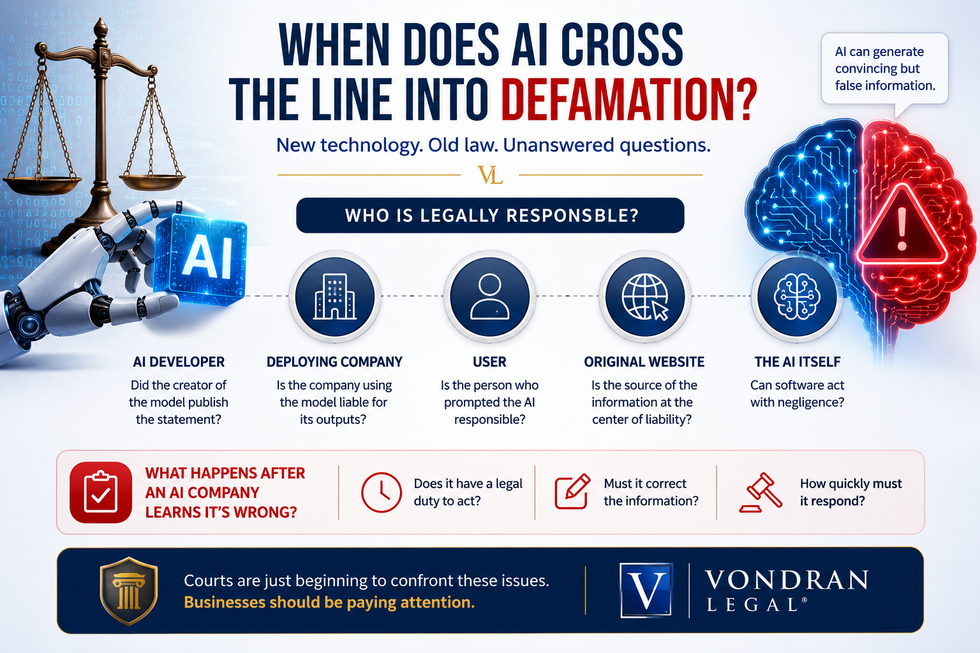
WHEN DOES AI CROSS THE LINE INTO DEFAMATION?
Defamation law was not written with large language models in mind, making the application of traditional legal principles to AI-generated content far from straightforward.
Historically, courts have examined whether a person or entity published a false statement that harmed another person's or business's reputation. With generative AI, however, those questions become significantly more complex.
If an AI system generates a defamatory statement, who is legally responsible? Is liability attributed to the AI developer, the company deploying the model, the user who prompted the response, or the website that originally contained the underlying information?
Additional questions arise when an AI company becomes aware that its system is repeatedly generating false information. Does it have a legal duty to correct the error, and if so, how quickly must it act?
As courts begin addressing these novel issues, businesses should pay close attention, as the answers could shape the future of online reputation management and AI liability.
COPYRIGHT IS ABOUT MORE THAN AI TRAINING
The headlines often focus on whether AI companies trained their models on copyrighted works.
That's only part of the story.
Businesses should also ask:
- · Can AI summarize an article so completely that no one needs to visit the original?
- · Can AI reproduce creative expression?
- · Can it compete with the very publishers whose work helped create the answer?
Those issues sit at the center of ongoing copyright litigation.
The decisions could reshape online publishing for years to come.
Your Trademark May Matter More Than Ever
A strong trademark and consistent brand identity may become even more valuable in the age of AI-powered search. Well-established brands are generally easier for AI systems to recognize and distinguish from competitors, but that advantage can quickly disappear if an AI model confuses your company with another business.
Trademark law has long been centered on preventing consumer confusion, and generative AI introduces an entirely new environment in which that confusion can occur.
Similar company names, overlapping product offerings, or inaccurate AI-generated responses could cause consumers to associate your business with the wrong entity. The consequences may include lost customers, reputational harm, and, in some cases, legal disputes over trademark infringement, false advertising, or unfair competition.
As AI increasingly serves as an intermediary between businesses and consumers, investing in strong trademark protection and maintaining consistent branding across digital platforms may be more important than ever.
AI REWARDS TRUSTWORTHY BUSINESSES
As AI systems increasingly determine which sources to rely on when generating answers, the quality and credibility of a company's online presence may become just as important as its products or services.
Businesses that consistently publish accurate, original, and trustworthy content are more likely to be viewed as reliable sources of information, thereby reducing the risk that AI will rely on outdated, misleading, or inaccurate third-party content.
In that sense, building an authoritative digital presence is no longer simply a marketing objective—it is part of a broader strategy for protecting a company's reputation, brand, and legal interests in an AI-driven marketplace.
FIVE QUESTIONS EVERY BUSINESS SHOULD BE ASKING
Instead of obsessing over Google rankings, consider asking:
- 1. What does AI currently say about my business?
- 2. Would I know if AI were spreading false information about my company?
- 3. Are my trademarks strong enough to prevent confusion?
- 4. Is my original content being used in ways I never intended?
- 5. Who owns the legal risk when AI gets the answer wrong?
If those questions don't have clear answers, now is the time to start looking.
THE BIGGER PICTURE
The internet is quietly changing.
Google organized websites.
AI organizes knowledge.
That's a much bigger shift than most businesses realize.
The legal questions aren't limited to copyright.
They include:
- trademark law
- false advertising
- defamation
- unfair competition
- right of publicity
- licensing
- data ownership
- consumer protection
- reputational harm
Over the next decade, some of the most important business litigation may not involve websites at all.
It may involve what artificial intelligence says about them.
FINAL TAKEAWAY
Artificial intelligence is not replacing lawyers, but it is creating legal questions that barely existed just a few years ago. Businesses that understand how AI represents their brand—and the legal implications that come with AI-generated information—will be better positioned than those that assume AI is simply another search engine. In this new environment, protecting valuable intellectual property is more important than ever. Strong trademark rights can help distinguish your business from competitors and reduce the risk of consumer confusion, while copyright protection remains an essential tool for safeguarding the original content, creative works, and educational resources that define your brand. As AI continues to reshape how consumers discover information, businesses should view their intellectual property as a strategic asset rather than an afterthought.
The companies that thrive in the AI era may not be those with the largest advertising budgets, but those that proactively protect their brands, monitor their online reputation, and adapt their legal strategies as the technology evolves. Whether you are facing issues involving copyright, trademarks, AI-generated content, online defamation, false advertising, or other emerging technology disputes, the attorneys at Vondran Legal® can help evaluate your rights and develop practical strategies to protect your business in an increasingly AI-driven marketplace.
