
VondranLegal.com—FACTORS SUPPORTING A FINDING OF WILLFUL COPYRIGHT INFRINGEMENT. Nationwide Copyright Infringement Law Firm. Call us at (877) 276-5084.
INTRODUCTION
This blog is written by copyright litigation attorney Steve Vondran, Esq. This is general legal information only and not legal advice.
In copyright litigation, identifying the facts that may support a finding of willful infringement can be critical in any case, whether you are on the plaintiff or defense side. A willfulness finding may significantly increase the defendant's financial exposure, including the potential for enhanced statutory damagesdamages ($30,000-150,000), attorneys' fees, and injunctive relief. Just as important, where the infringement is carried out through a corporation, courts may examine whether company officers, directors, owners, or managers personally participated in, directed, authorized, or financially benefited from the infringing activity. For this reason, copyright plaintiffs should carefully evaluate evidence such as prior notice, cease-and-desist letters, continued use after warning, concealment, removal of copyright management information (17 U.S.C. 1202 claims), repeated infringement, and decision-maker involvement. These facts can help establish not only infringement but also whether the conduct was knowing, reckless, or intentional, which could lead to broader liability against the individuals behind the business. This is what we refer to as "officer and director copyright liability," which allows plaintiffs to name both individuals and their corporations notwithstanding the corporate veil!
Federal courts do not apply a single universal test for "willful infringement" in copyright cases. However, courts repeatedly identify certain facts and circumstances that support a finding that infringement was knowing, intentional, reckless, or undertaken with willful blindness. This blog provides some general concepts to consider in your next infringement matter.
I. ACTUAL KNOWLEDGE OF COPYRIGHT OWNERSHIP
Here are some factors that can tend to show the infringer was aware of the infringement and thus acted willfully or with willful disregard of the copyright holders rights.
-
Receipt of a cease-and-desist letter prior to continuing the infringement.
-
Receipt of DMCA takedown notices or infringement notices.
-
Receipt of demand letters from copyright counsel.
-
Prior settlement agreements involving the same copyrighted works. (repeat offenders)
-
Prior litigation involving the same copyrighted works. (didn't learn your lesson the first time around)
-
Admissions by defendants that they knew the works belonged to another. (think discovery)
-
Internal emails acknowledging copyright ownership. (demand letters should require preservation of all evidence)
-
Contractual provisions recognizing another party's ownership rights.
-
Copyright registrations provided to defendants before infringement continued. (actual notice)
-
Written warnings from distributors, licensors, vendors, or business partners.
Attorney Steve® Tip: These factors tend to show you were aware of the potential for copyright infringement but were willing to proceed forward anyway by posting or using copyrighted content such as film, videos, music, and other content.
II. CONTINUED INFRINGEMENT AFTER NOTICE
This is the failure-to-stop situation after notice of a rights holder's rights and claims.
-
Continuing sales after receipt of infringement complaints.
-
Continuing the online display of copyrighted works after notice.
-
Failure to remove infringing content after receiving warnings.
-
Republishing copyrighted material after takedown requests.
-
Re-uploading content after prior removals.
-
Expanding the infringement after receiving notice.
-
Continuing to manufacture infringing products after notice.
-
Continuing advertising campaigns using copyrighted works after notice.
Attorney Steve® Tip: If a person or company receives a cease and desist notice, it is important to document (preserve the evidence) but to also immediately take down the infringing content. Unless, of course, you plan to challenge the allegations with a license or fair use defense or some other recognized defense.
III. DELIBERATE COPYING
In some cases, there is clear evidence that creative works of authorship were copied, scrapped, downloaded and used (for example, content for a video).
-
Direct copying from the plaintiff's website. (cut and paste)
-
Copying source files, images, videos, music, software, or text.
-
Evidence of downloading copyrighted content from plaintiff sources. (for example, on YouTube)
-
Near-identical duplication inconsistent with independent creation. (sometimes called "striking similarities")
-
Internal discussions describing a plan to copy plaintiff's content. (again, find this out in discovery.)
-
Use of the plaintiff's copyrighted materials as templates. (or use in a commercial brochure or advertisement)
-
Intentional reproduction of entire works rather than small excerpts. (wholescale copying)
-
Systematic copying across multiple works. (for example downloading 30+ movies from Strike 3 Holdings)
-
Removal of identifying information before republication.
Attorney Steve® Tip: Clear evidence of copying should be accumulated and preserved and cited to in the event a federal copyright lawsuit must be filed. NOTE: a copyright registration certificate from the United States Copyright Office (USCO) is a pre-requisute to filing a federal court action.
IV. CONCEALMENT OR DECEPTIVE CONDUCT
Another way to try to show facts alleging willful misconduct is to show deceptive conduct by the infringer. Here are but a few examples.
-
Removal of copyright management information (CMI). (This is a "1202 copyright claim")
-
Removal of watermarks. (intentional conduct)
-
Cropping attribution notices. (attempts to deceive as to ownership)
-
Altering metadata to conceal origin.
-
Using aliases or shell entities to hide involvement.
-
Concealing the source of copied material.
-
Destroying evidence after litigation begins. (spoliation is never a good thing in federal court)
-
Spoliation of records relating to infringement.
-
False statements regarding ownership rights.
-
Backdating licenses or permissions.
-
Fabricating authorization documents.
Attorney Steve® Tip: An accused infringer sometimes goes on a lying and evidence destruction campaign once confronted with a cease and desist letter, trying to delete and cover their tracks for all uses of third-party content on their websites and social media platforms (ex. Facebook, Instagram, and TikTok) and in their videos that use other party's content with permission, sometimes believing there is a fair use defense. Document all these instances, and these can become part of your allegations in your complaint if the case cannot be settled.
V. RECKLESS DISREGARD FOR COPYRIGHT RIGHTS
These next potential willful factors deal with the "who cares no one will find out, I am a small fish" routine in my experience.
-
Failing to investigate ownership despite obvious copyright indicators. (why not just seek permission)
-
Ignoring copyright notices appearing on the work. (blatant disregard of the rights holder)
-
Ignoring website terms of use. (for example, in Creative Commons cases, not providing the proper attribution)
-
Ignoring licensing requirements. (not reading your terms and conditions can bite you since typically people "agree" to these and courts often hold such persons liable)
-
Proceeding despite uncertainty about ownership.
-
Taking no steps to determine whether a license was required. (many things you see online are subject to copyright, and every is PRESUMED to know the law)
-
Relying on assumptions rather than confirming rights. (lack of due diligence)
-
Failure to consult counsel where infringement risks were obvious.
-
Failure to conduct customary rights-clearance procedures. (not following common standards of care, for example in the film, music and creative industries)
-
Deliberate avoidance of information concerning ownership.
Attorney Steve® Tip: Many people mistakenly believe that copyright infringement is only "willful" when someone knowingly copies protected content. Not so. Courts have consistently held that reckless disregard of a copyright owner's rights—or even willful blindness to the possibility of infringement—can also constitute willful copyright infringement. In other words, intentionally ignoring warning signs, failing to investigate ownership issues, disregarding cease-and-desist letters, or choosing not to seek legal advice may expose an infringer to a finding of willfulness. See In re Aimster Copyright Litigation, 334 F.3d 643, 650 (7th Cir. 2003) ("willful blindness is knowledge, in copyright law"), and Int'l Korwin Corp. v. Kowalczyk, 855 F.2d 375, 380-81 (7th Cir. 1988), where the court noted that a defendant's disregard of copyright notices and failure to consult counsel may support a finding of willfulness. Likewise, the Second Circuit has held that a plaintiff need not prove actual knowledge of infringement; it is enough to show that the defendant recklessly disregarded the possibility that its conduct infringed another's copyright. Yurman Design, Inc. v. PAJ, Inc., 262 F.3d 101, 112 (2d Cir. 2001). A finding of willful infringement can have serious consequences, including personal liability and enhanced statutory damages ranging from $30,000 to $150,000 per infringed work, provided the copyright was timely registered with the U.S. Copyright Office.
VI. WILLFUL BLINDNESS
This is similar to the factors above, but perhaps more egregious. This is what we call "putting your head in the sand."
-
Purposefully avoiding confirmation of ownership.
-
Deliberately declining to review copyright notices.
-
Refusing to investigate complaints.
-
Instructing employees not to inquire into licensing.
-
Turning a blind eye to obvious infringement by subordinates.
-
Deliberately avoiding legal review of suspect conduct.
-
Ignoring repeated reports of infringement.
VII. BUSINESS SOPHISTICATION OF THE DEFENDANT
Federal courts may look to the relative sophistication of the defendant or infringer in determining if infringement conduct was willful.
-
Defendant is a sophisticated commercial enterprise. (more likely to be willful)
-
Defendant regularly licenses copyrighted materials. (for example, creators who know better)
-
Defendant operates in a copyright-intensive industry. (media, film, YouTubers, music, e-books, podcasting)
-
Defendant employs legal counsel familiar with IP issues. (for example, ignoring a fair use opinion letter)
-
Defendant has prior copyright compliance programs.
-
Defendant previously obtained licenses for similar works.
-
Defendant has extensive experience in publishing, media, software, entertainment, advertising, or content distribution.
-
Defendant holds itself out as knowledgeable regarding intellectual property.
Attorney Steve® Tip: You will sometimes see this scenario where the infringer's own website has a copyright notice that seems to be claiming third-party infringing content as their own. Then, they claim, "We know nothing about copyright law." Look for these facts.
VIII. PROFIT MOTIVE
Most things nowadays are monetized. People use third-party content largely for profit. Even "non-profits" have "donation" buttons on their websites and pay their board a salary. A profit motive can tend to show it was not worth the time and trouble to inquire about a license or to seek permission. Look for these facts.
-
Intentional use of copyrighted works to generate revenue.
-
Use of copyrighted works to attract customers.
-
Increased sales attributable to infringing content.
-
Commercial exploitation of copyrighted works.
-
Monetization through advertising revenue. (typical on sites like YouTube, Distrokid, etc.)
-
Subscription revenues tied to infringing content.
-
Licensing revenues derived from copied works.
-
Deliberate use of copyrighted content to gain competitive advantage.
Attorney Steve® Tip: It is always wise to look at all potential revenue streams the infringer has resorted to. How are the monetizing, and on which platforms? Sometimes we seen third party content being used behind paywalls, such as Patreon. This scenario raises potential concealment, profit motive, and hopes they would never be caught. Some IP firms even look to the Internet Archive/Wayback Machine to see how the content was being used in prior times. This can be a very valuable tool.
IX. REPEAT OR SYSTEMATIC INFRINGEMENT
Naturally, repeat infringement tells its own story.
-
Multiple infringements involving numerous works.
-
Repeated infringement over an extended period.
-
Prior warnings ignored.
-
Prior judgments for infringement.
-
Prior settlements involving copyright claims.
-
Company-wide infringement practices.
-
Recurring infringement by multiple employees.
-
Large-scale unauthorized distribution.
-
Institutionalized infringement policies.
X. FAILURE TO MAINTAIN COPYRIGHT COMPLIANCE
Every company should have at least basic training on copyright laws in our modern digital society. Failure to do so can lead to alot of problems.
-
No copyright compliance procedures.
-
No training regarding copyright laws.
-
No licensing review process.
-
No approval procedures before publication.
-
Failure to implement takedown procedures.
-
Failure to supervise content acquisition.
-
Failure to verify ownership before publication.
-
Failure to maintain licensing records.
Attorney Steve® Tip: We see this often in the real estate business. Many sales agents and realtors have their own personal or "team" websites. Under California law, a real estate BROKER has the duty to oversee all licensed activity, and this includes advertising such as an agent's social media and website advertising and, increasingly, video and podcast marketing. Where this does not happen and infringement is shown, a review of the brokerage's policies and procedures and training may indicate a lack of concern about IP rights. This can lead to the real estate company being sued along with the brokerage for a breakdown of training and policy and having no review process whatsoever for their employees.
XI. FACTORS SUPPORTING PERSONAL LIABILITY OF OFFICERS AND DIRECTORS
Here are other elements that can establish willful or reckless infringement and lead to officers and directors having their personal assets exposed and at risk.
-
Officer personally directed the infringement.
-
Officer authorized the infringement.
-
Officer approved use of copyrighted works.
-
Officer supervised employees engaged in infringement.
-
Officer participated in the copying process.
-
Officer selected the copyrighted works for use.
-
Officer controlled company operations giving rise to infringement.
-
Officer had the right and ability to stop the infringement.
-
Officer knowingly permitted infringement to continue.
-
Officer ignored complaints regarding infringement.
-
Officer personally benefited financially from infringement.
-
Officer was the moving force behind the infringing conduct.
-
Officer exercised substantial control over the infringing activity.
-
Officer instructed others to engage in infringement.
-
Officer ratified infringing conduct after learning of it.
-
Officer participated in decisions regarding publication, distribution, manufacturing, marketing, or sales involving the infringing works.
-
Officer was directly involved in obtaining, reproducing, distributing, or exploiting the copyrighted works.
-
Officer used the corporate entity as the vehicle through which infringement occurred.
-
Officer knowingly failed to stop infringement despite having authority to do so.
-
Officer personally negotiated transactions involving infringing content.
-
Officer received direct economic benefit from the infringement.
-
Officer was the primary decision-maker responsible for the infringing business practice.
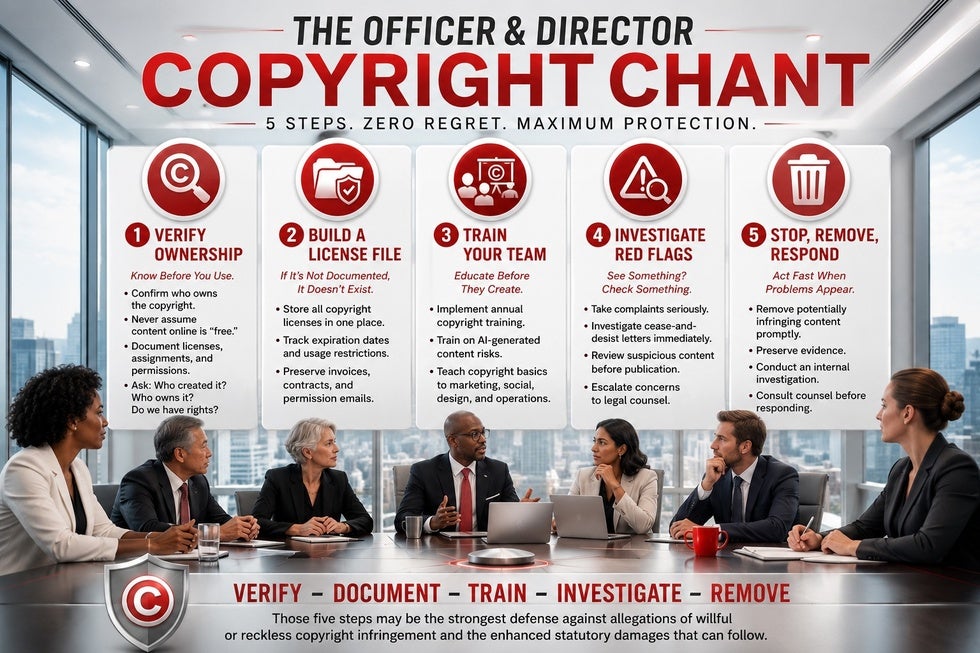
Attorney Steve® Tip: Here is a graphic I generated. These are the things your boardroom should be talking about as part of its sales, marketing and advertising efforts to seek to document good policy, training and education company-wide.
In closing
Always look at all the potential factors that can show willful infringement in a copyright case; there may be others not listed herein, as this document is not an exclusive list. Hope this has been helpful. Remember, you DO NOT need to see a copyright symbol for someone to have a copyright claim against you. Copyright protection is automatic upon fixation of a creative work of authorship in a tangible medium of expression. Be safe out there! - Steve Vondran, Esq. -
Involved in a copyright dispute, arbitration, mediation, or litigation?
For more information, contact us at (877) 276-5084 or fill out the contact form on the right side of this page. We can help with a wide-variety of copyright, internet and entertainment law matters. From fair use opinion letters, copyright employee training, educational seminars, cease and desist letters, copyright subpoenas, clearance and chain of title issues and dispute resolution. Since 2004, Vondran Legal® has been The First Name in Legal Services®.

