
Van Leeuwen Ice Cream v. Rebel Creamery: Trade Dress IP Updates.
In today's crowded marketplace, consumers often make purchasing decisions in a matter of seconds. Before they read a product name or compare ingredients, they are influenced by something much more immediate—the product's overall appearance.
That is precisely why trade dress law exists.
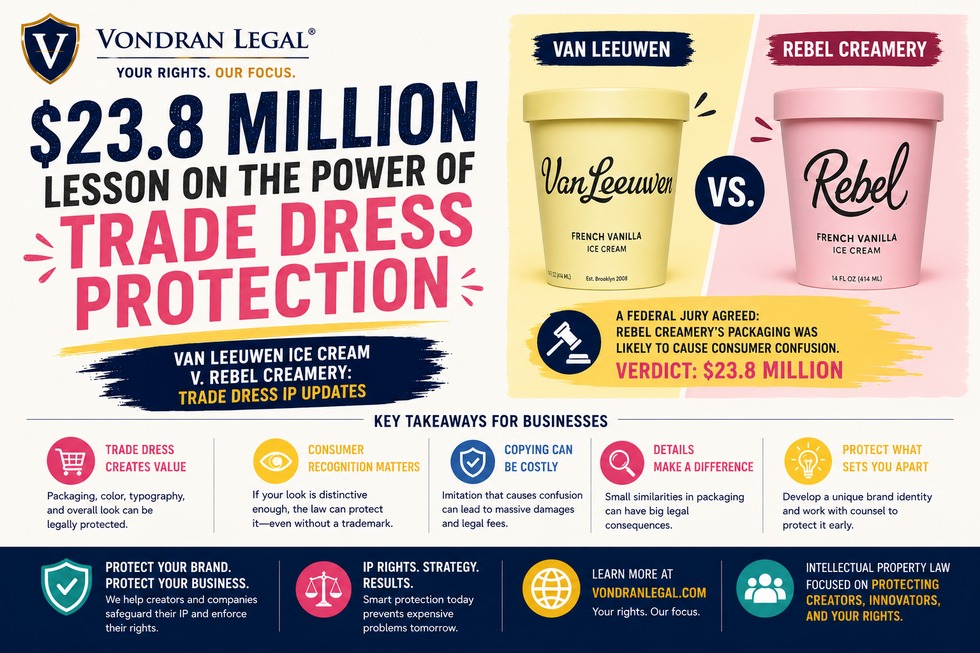
A recent federal court decision involving Van Leeuwen Ice Cream and Rebel Creamery demonstrates just how valuable trade dress can be as an intellectual property asset. The court awarded Van Leeuwen approximately $23.8 million in Rebel's profits, permanently enjoined Rebel from continuing to use its packaging, and ordered the company to redesign its products after finding that the overall appearance of Rebel's ice cream pints infringed Van Leeuwen's protectable trade dress.
The case serves as a powerful reminder that businesses do not need to copy a company's name or logo to commit trademark infringement. Copying the overall commercial look and feel of product packaging may be enough.
The Facts
Van Leeuwen has developed a distinctive appearance for its premium ice cream pints.
According to the court, the company's trade dress consisted of the overall combination of visual elements appearing on its packaging, including:
- monochromatic pint containers
- matching lids
- pastel color palettes
- minimalist presentation
- black script lettering
- descriptive product text
- the overall visual arrangement of these features
Rather than claiming that Rebel copied its name or logo, Van Leeuwen alleged that Rebel intentionally designed its own packaging to create an overall commercial impression that closely resembled Van Leeuwen's products.
The lawsuit alleged that consumers shopping in grocery stores could easily mistake Rebel's products for Van Leeuwen's because the packaging looked substantially similar.
Following a bench trial, the court agreed.
The Legal Issue
The primary issue before the court was:
Did Rebel's packaging create a likelihood of consumer confusion by copying the overall commercial impression of Van Leeuwen's protected trade dress?
If so, the court also had to determine:
- whether Rebel had any valid defenses,
- whether Van Leeuwen was entitled to Rebel's profits,
- whether injunctive relief was appropriate.
Understanding Trade Dress
Trade dress is a form of trademark protection.
Unlike an ordinary trademark—which protects words, names, logos, or slogans—trade dress protects the overall visual appearance of a product or its packaging when that appearance identifies the source of the goods.
Examples include:
- product packaging
- restaurant décor
- store layouts
- product configuration
- color combinations
- graphics
- design themes
The key question is whether consumers associate the overall appearance with a single company.
Rebel's Main Defense
Rebel argued that Van Leeuwen could not monopolize ordinary design elements because many of those elements were common within the food industry.
For example:
- pastel colors are common
- script fonts are common
- simple layouts are common
- descriptive product wording is common
According to Rebel, none of those individual components were unique.
The Court's Response
The court rejected that argument.
One of the most important principles reaffirmed by this decision is:
Trade dress protects the overall combination of design elements—not merely the individual components viewed separately.
Individual design elements may be commonplace.
But when those elements are combined in a distinctive way that consumers recognize as identifying a particular source, the overall appearance may receive trade dress protection.
This is an important principle because businesses often mistakenly believe that copying "a little bit of everything" avoids infringement.
The law frequently looks at the opposite question:
What overall commercial impression does the package create?
Likelihood of Confusion
Rebel next argued that consumers would not be confused because:
- the products had different names;
- Rebel sold keto products;
- Van Leeuwen sold premium traditional ice cream.
Again, the court disagreed.
The court found that:
- both products were sold through the same retail channels;
- grocery shoppers often rely upon visual impressions;
- packaging influences purchasing decisions;
- differences in names did not eliminate confusion created by similar overall appearances.
In other words, consumers may initially assume products originate from the same source or are somehow affiliated before carefully reading the labels.
Actual Confusion Evidence
The court also relied upon evidence supporting consumer confusion, including:
- testimony from industry participants;
- survey evidence;
- consumer perception evidence.
Actual confusion is not always required in trademark cases, but when it exists it can become highly persuasive evidence.
Good Faith Was Rejected
Rebel argued that any similarities were accidental.
The court rejected this defense after reviewing:
- Rebel's design process;
- documentary evidence;
- witness testimony.
The court concluded that Rebel did not independently arrive at its packaging design in good faith.
Those findings became significant not only on liability but also on remedies.
The Remote User Defense
The decision also discusses an often-overlooked Lanham Act defense:
The Good Faith Remote User Defense
This defense generally protects businesses that:
- independently adopt a mark or trade dress;
- in good faith;
- in a geographically remote market;
- before learning of another user's rights.
To prevail, a defendant generally must establish both:
- good-faith adoption; and
- geographically remote use.
The court found that Rebel failed on both elements.
Why the Court Awarded $23.8 Million
Perhaps the most significant aspect of the decision is the damages award.
Instead of merely issuing an injunction, the court ordered Rebel to disgorge approximately $23.8 million in profits.
Disgorgement of Profits
Trademark law provides remedies beyond compensating the plaintiff.
One of the most powerful remedies is:
disgorgement of the infringer's profits.
Unlike traditional damages, which compensate the trademark owner for its losses, disgorgement focuses on removing the profits the infringer earned through wrongful conduct.
Burden-Shifting Under the Lanham Act
The Lanham Act establishes an important burden-shifting framework.
First:
The plaintiff must establish the defendant's gross revenues attributable to the infringing products.
Then:
The burden shifts to the defendant to prove:
- deductible expenses;
- what portion of profits resulted from factors other than infringement.
This burden-shifting rule is often overlooked but can significantly affect damages.
Rebel's Apportionment Argument
Rebel argued that consumers purchased its products because they were:
- keto-friendly;
- low-carb;
- sugar-conscious.
Therefore, Rebel argued, not all profits were attributable to packaging.
Van Leeuwen argued otherwise.
The company contended that:
- the infringing packaging substantially drove sales;
- any uncertainty should be resolved against the infringer.
The court ultimately agreed with Van Leeuwen.
Because Rebel failed to adequately prove apportionment, the court awarded the profits.
Permanent Injunction
The court also permanently enjoined Rebel from continuing to use the infringing packaging and required it to redesign its products.
This illustrates that trade dress litigation can dramatically affect an entire product line.
Important Legal Principles Established or Reinforced
The case reinforces several important rules:
1. Trade dress protects the overall commercial impression.
Courts examine the packaging as a whole rather than isolating individual design elements.
2. Individual common elements may collectively become protectable.
Colors.
Fonts.
Layouts.
Packaging.
Graphics.
None must be unique individually.
The combination may still be distinctive.
3. Different names do not necessarily eliminate confusion.
Consumers frequently make purchasing decisions based upon appearance.
4. Good faith matters.
Evidence concerning the design process may influence:
- liability,
- defenses,
- remedies.
5. The remote user defense is narrow.
A defendant generally must establish both:
- independent good-faith adoption, and
- geographically remote use.
6. Defendant profits remain available.
Courts may order disgorgement when equity warrants.
Practical Lessons for Businesses
Companies launching new products should perform more than a traditional trademark search.
They should also evaluate:
- competing packaging;
- product presentation;
- shelf appearance;
- overall commercial impression.
Businesses should document:
- why design choices were made;
- independent design development;
- marketing research;
- creative process.
Those documents may later become powerful evidence of independent creation.
Why Trade Dress Is Such a Valuable IP Asset
Many companies spend millions developing brand recognition without realizing that much of that value resides in trade dress.
Trade dress may protect:
- food packaging;
- beverage containers;
- cosmetics;
- consumer electronics;
- apparel packaging;
- restaurant interiors;
- website interfaces (in some circumstances);
- retail store layouts;
- product shapes.
Unlike patents, trade dress protection can potentially last indefinitely so long as it remains distinctive and continues to identify source.
For many businesses, trade dress becomes one of their most valuable intellectual property assets.
How Vondran Legal Can Help
At Vondran Legal®, we represent businesses nationwide in intellectual property disputes involving trademarks, trade dress, copyrights, unfair competition, and brand protection.
Our trade dress services include:
- Trade dress clearance and risk assessments
- Packaging review before product launch
- Cease-and-desist letters
- Federal trademark and trade dress litigation
- Lanham Act claims and defenses
- Likelihood of confusion analysis
- Product packaging disputes
- Injunction proceedings
- Counterfeit and knockoff investigations
- Brand enforcement strategies
Whether you are developing a new consumer product or defending your existing brand identity, early legal review can prevent costly litigation and help preserve one of your company's most valuable competitive advantages.
Key Takeaways
- Trade dress protects the overall appearance of a product or packaging—not just names and logos.
- Common design elements can become legally protectable when combined into a distinctive overall commercial impression.
- Similar packaging may create trademark liability even if the products bear different brand names.
- Evidence of intentional copying can significantly influence liability and available remedies.
- The Lanham Act's burden-shifting framework makes disgorgement of profits a potent remedy when infringement is proven.
- Companies should evaluate both trademark clearance and trade dress risks before launching new packaging.
- Proper documentation of an independent design process can be critical in defending against trade dress claims.
- Strong trade dress rights can become a significant business asset, helping companies distinguish their products, deter competitors, and preserve brand value over the long term.

