
Vondran Legal® AI Music Law Firm: What Every Musician, Producer, Record Label, and Entertainment Lawyer Needs to Know
By Attorney Steve® | Vondran Legal®
Artificial intelligence is rapidly transforming the music business. What started as experimental software capable of generating melodies has evolved into sophisticated systems that can write lyrics, imitate famous singers, compose orchestral arrangements, produce entire albums, and even create realistic performances that many listeners cannot distinguish from human artists.
The technology is moving faster than the law.
As courts continue wrestling with copyright ownership, right of publicity claims, training-data lawsuits, and AI licensing disputes, the music industry has taken an important first step toward greater transparency.
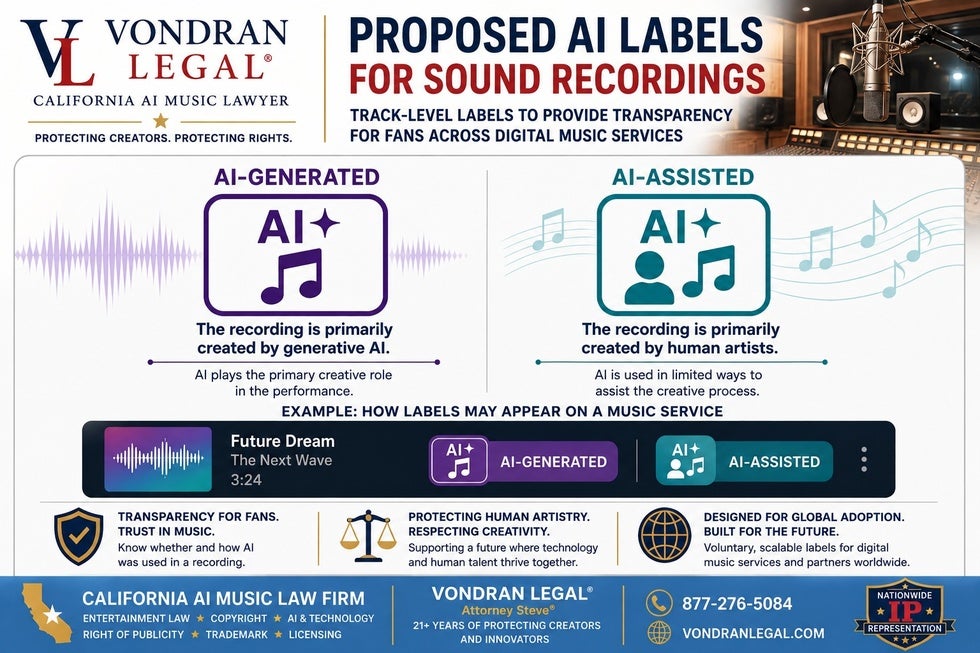
In July 2026, some of the largest organizations in the global music industry—including the Recording Industry Association of America (RIAA), the International Federation of the Phonographic Industry (IFPI), the Recording Academy (The Grammys), SAG-AFTRA, the American Association of Independent Music (A2IM), the Worldwide Independent Network (WIN), IMPALA, and the Human Artistry Campaign—announced a new voluntary labeling initiative designed to inform listeners about how generative AI was used in creating a recording.
Although these labels are voluntary rather than mandatory, they may ultimately become the industry standard across Spotify, Apple Music, Amazon Music, YouTube Music, Deezer, Tidal, and other digital music services.
That makes this announcement one of the most important AI developments the music business has seen to date.
Why Is This Happening Now?
The answer is simple:
AI-generated music is exploding.
According to the organizations behind the proposal, Deezer recently reported that approximately 44% of all newly uploaded tracks on its platform were AI-generated. Apple Music has similarly indicated that more than one-third of uploaded tracks are entirely AI-created.
Those numbers illustrate a dramatic shift in the music ecosystem.
Only a few years ago, AI-assisted music was considered experimental.
Today, millions of AI-created songs are entering streaming platforms.
Without some type of disclosure, consumers may have no idea whether they are listening to:
- a real singer,
- an AI voice clone,
- a synthetic orchestra,
- a human performance enhanced with AI, or
- an entirely computer-generated recording.
The industry believes consumers deserve greater transparency.
The Two New Labels
The proposal introduces two separate categories.
AI-Generated
This label is reserved for recordings where generative AI creates the primary creative expression.
Examples include:
- AI-generated lead vocals
- AI-generated instrumental performances
- Entire songs produced primarily from prompts
- Recordings where AI performs the principal artistic role
In other words, the computer—not a human performer—is creating the heart of the recording.
AI-Assisted
This label covers a very different situation.
Here, humans remain the artists.
Humans perform the lead vocals.
Humans play the primary instruments.
AI simply assists portions of the creative process.
For example:
- harmony suggestions
- orchestration assistance
- arrangement ideas
- production enhancements
- certain expressive musical elements
The recording remains fundamentally human-created.
Notice What Is NOT Covered
Many people assume these labels apply to every use of AI.
They do not.
At least for now, the proposal only applies to sound recordings.
It specifically does not address:
- songwriting
- lyrics
- musical compositions
- music videos
- album artwork
- cover art
Those issues remain open for future consideration.
Why Labels Matter
Some people dismiss these labels as merely informational.
I think they could become much more significant.
They could influence:
- consumer purchasing decisions
- playlist inclusion
- Grammy eligibility
- chart rankings
- licensing negotiations
- synchronization deals
- advertising partnerships
- artist branding
Many fans specifically seek authentic human performances.
Others may actively seek AI-generated music.
Transparency benefits everyone.
The Legal Questions Have Only Begun
From an intellectual property perspective, these labels solve almost none of the difficult legal questions.
Those include:
Copyright Ownership
Can an AI-generated recording even receive copyright protection?
If a person merely types a prompt into an AI platform, who owns the resulting music?
The user?
The software company?
Nobody?
These questions remain unresolved in many jurisdictions.
Voice Cloning
What happens when AI perfectly recreates:
- Taylor Swift
- Morgan Wallen
- Drake
- Frank Sinatra
- Elvis Presley
Without permission?
That raises serious right of publicity concerns.
Copyright Training Lawsuits
Numerous lawsuits already challenge whether AI companies unlawfully trained their models using copyrighted recordings without licenses.
Those cases could reshape the economics of AI music for decades.
Trademark Issues
Consumers may mistakenly believe an AI-generated recording was endorsed by a famous artist.
That creates possible:
- trademark infringement
- false endorsement
- unfair competition
- consumer deception claims
False Advertising
Suppose a streaming platform advertises:
"Performed by John Smith"
when the vocals are actually synthetic.
Could that constitute deceptive advertising?
Potentially.
Contract Issues
Record labels will increasingly need contracts addressing:
- AI permissions
- voice cloning rights
- digital replica rights
- future AI exploitation
- royalty allocation
- ownership of AI-assisted recordings
Expect AI clauses to become standard in recording agreements.
Why This Matters for Independent Artists
Independent musicians may be affected even more than major labels.
Imagine you're an independent artist using AI to help generate:
- backing vocals
- drum grooves
- orchestration
- guitar solos
Will your recordings receive the "AI-Assisted" label?
Probably.
But what if AI generated the lead vocal?
Now you may fall into the "AI-Generated" category.
Those distinctions may become increasingly important as streaming platforms, listeners, and advertisers decide what content they wish to promote.
What About Spotify and Apple Music?
The organizations intend to work directly with:
- digital streaming platforms
- distributors
- aggregators
- metadata providers
- standards organizations
to implement these labels across the music ecosystem. Adoption will likely occur over time, and individual services may choose their own implementation schedules.
My Legal Take
I believe this initiative is less about policing AI and more about preserving consumer trust.
The organizations behind the proposal recognize that AI is not going away. Instead of trying to prohibit it, they are attempting to distinguish between music that is principally the product of human creativity and music where generative AI supplied the core artistic expression.
That distinction may eventually influence everything from streaming recommendations and chart eligibility to licensing negotiations, collective bargaining agreements, and future copyright legislation. Indeed, recent proposals from major record companies suggest that chart eligibility itself could become tied to whether music is "substantially human made" and whether AI use is disclosed.
For lawyers practicing entertainment, copyright, and intellectual property law, this is another reminder that AI governance is shifting from theory to industry practice. Today's voluntary labels could become tomorrow's contractual obligations—or even regulatory requirements.
Frequently Asked Questions
Are these labels required by law?
No. They are currently a voluntary industry initiative supported by major music organizations.
Will Spotify and Apple Music be required to use them?
No. The organizations intend to encourage adoption across streaming platforms, but each service will determine its own implementation timeline.
Do these labels determine copyright ownership?
No. They are intended to provide transparency about AI usage, not to decide legal ownership or authorship.
Will AI-assisted music still qualify for Grammy Awards?
The announcement does not address awards eligibility. Separate Grammy rules and policies would govern those questions.
Do the labels apply to lyrics or album artwork?
No. At present, they are limited to sound recordings.

