
Vondran Legal®—Software Piracy and Infringement Defense - Ansys mass copyright lawsuits in Texas. If you received a notice or were served a summons and complaint, call us for a free initial consultation. We can be reached at (877) 276-5084. We are a clear leader in software infringement defense in the United States.

Introduction
We have been working hard to settle lawsuits in an earlier case filed by Ansys in the Texas federal district court. They had previously filed a lawsuit against 359 John Does back in July, 2024. This lawsuit appeared to be stalled, and there may have been a reassignment of one of the judges. Now, they appear to have revived the case and are back on track with residents and business owners across the United States getting ISP notices informing them that Ansys is seeking to uncover the identity and address of the internet subscriber. Then, they can move forward to add your name to the complaint. Here is the copyright law firm handling the case:
Daniels & Tredennick, PLLC
6363 Woodway Dr. Suite 700
Houston, TX 77057
USA
713-917-0024
Sample allegations in complaint
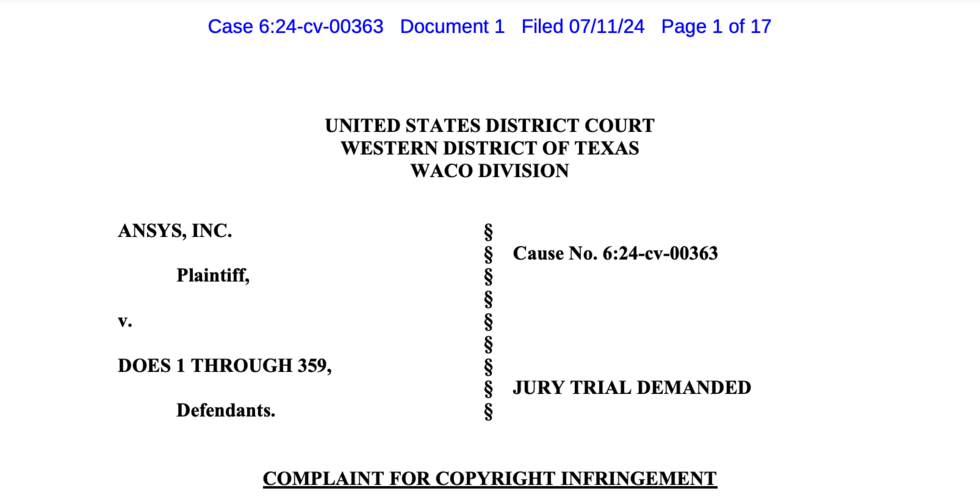
Here are the general allegations of the complaint (Case#6:24-cv-00363).
This is a civil action seeking damages and injunctive relief arising out of the violation of Ansys' intellectual property rights by Defendants, currently known only by an Internet Protocol address (“IP address”).
2. Ansys is a global leader in engineering simulation software. With its portfolio of engineering simulation software, Ansys helps its customers solve complex design challenges and engineer products. Ansys provides services in a wide range of industries, including aerospace and defense, automotive, construction, consumer goods, and energy.
3. Ansys' flagship products include Ansys Electronics Enterprise, Ansys Fluent, and Ansys Mechanical software programs (collectively with all other Ansys software products, “Ansys Software”), which are protected by U.S. Copyright Registrations. See Exhibits 1-20. Ansys Electronics Enterprise is a comprehensive platform for simulating various electrical components, devices, and systems and includes several simulation solutions including Ansys Electronics Premium Maxwell (“Ansys Maxwell”), Ansys Electronics Premium HFSS ("Ansys HFSS”), Ansys Electronics Premium SIwave (“Ansys SIwave”), among others. Ansys CFD Enterprise software is the industry leading fluid simulation software known for its advanced physics modeling capabilities and accuracy. Ansys Mechanical Enterprise software is a best-in-class finite element solver with structural, thermal, acoustic, and piezoelectric simulation capabilities.
4. Ansys licenses its highly valuable Ansys Software to its customers. Customers may purchase single-use licenses or multi-user licenses. Ansys prevents unauthorized access of the Ansys Software through the use of technological measures. Ansys' license agreement, which all users see on their computer screens and to which all users must agree to in order to use the Ansys Software, states the Ansys Software may collect information to determine if modifications to certain code files have been made or if there is suspected or confirmed unauthorized access to or use of the Ansys Software.
5. Despite the fact that Ansys Software includes technological measures to control access to it, and users are put on notice of the same by agreeing to the license agreement, Defendants obtained, installed on their computer systems, and used pirated Ansys Software. Defendants committed willful copyright infringement and DMCA violations when they downloaded pirated Ansys Software, circumvented Ansys' technological measures protecting the software, and used the unlicensed Ansys Software to solve complex design problems and to engineer products and solutions for themselves, their employers, and others.
6. Although Defendants attempted to hide their theft by anonymously infringing Ansys Software, Defendants' Internet Service Provider (“ISP”) can identify Defendants through his or her IP address. Ansys will seek the identity of Defendants from the ISP. Once known to Ansys, Ansys will amend this Complaint to identify the infringing individuals.
B. Piracy of Ansys Software
18. Piracy of software occurs when users access software for which they have not purchased a valid license. The ease of digital replication of software lends itself to illegal copying of software, where users may make multiple copies of a software program, and then distribute the copies to users who have not made a legal purchase of a license to the software (i.e., either distributing copies of the software for free or selling the copies of the software at deeply discounted prices).
19. To reduce the use of illegally copied software, software providers, including Ansys, implement license verification technology that will prevent the software from functioning unless the user has legally purchased a license. This license verification technology may be a software mechanism or a physical mechanism attached to a single computer. The license verification technology may be in the form of either a license key (i.e., a series of numbers and letters sometimes stored in a computer file) that a user types in or that the software reads from a file during the software installation process, or a hardwire device, where the software will only operate correctly when the hardware device is attached to the computer executing the software. The license verification technology and the license key are provided by the software provider to the buyer when the software is purchased legally. Users who have not made a legitimate purchase of a software license will not have access to the license key or hardware device provided by the software provider, and therefore the software will not function properly.
20. Software hackers reverse engineer the technological measures used to control access to the software and then provide processes and utilities to bypass the license verification technology thus allowing unauthorized use of the software. The hackers' processes and utilities mimic the license verification technology (e.g., keys, hardware devices, etc.) and allow pirated software to function as fully as legally purchased software. Software utilities that mimic the license verification technology are often referred to as “cracked” licenses. Software hackers may also create hacked versions of the software such that a license is not needed during installation.
21. Sophisticated websites exist where illegally obtained software, the software utilities that mimic the license verification technology, and hacked versions of the software may be downloaded and installed by those who do not want to pay for properly licensed software. Each hacked version of the software represents a lost sale and/or license for the company that owns the software and for resellers of the software (who may provide hardware installation and support, and software configuration, customization, and maintenance). A study by the Business Software Alliance reported that properly licensed software has a positive impact on national economic activity that is more than three times the impact of pirated software.
22. Software that has been hacked or modified to use a cracked license may also contain malware that can damage computer systems, and/or infiltrate the computer network and the data on the network. In a study conducted by the Technology Policy Institute, the more times users visited piracy sites, the more likely their machines were infected with malware. Software that has been hacked also may not operate properly, negatively impacting the reputation of the software company that now has no oversight or control over the quality of the hacked versions of its software in use or the products produced by that software. C. Piracy Detection and Reporting Security Software.
23. Piracy Detection and Reporting Security Software (“PDRSS”) exists to identify instances of pirated software in use and provides the identity and location of organizations utilizing the pirated software to the software providers. Identification of pirated software allows the software providers to take legal action against intentional software piracy, notifying organizations and individuals of the illegal use of the software (and the potential malware problems that can accompany pirated software), and sell valid software licenses in the place of the previously illegally obtained software programs to recoup lost sale. Ansys identifies pirated software in use through PDRSS which, along with the license verification technology, is a component of the technological measures used to control access to the software.
24. PDRSS also identifies the means by which software hackers have thwarted the license verification technology (i.e., the above-mentioned cracked license) for a particular software program. For example, PDRSS may accomplish this by downloading pirated software from the above-mentioned websites and determining how the software hackers were able to bypass the license verification technology. Once the software hackers' methods are identified, Ansys can map out a plan for PDRSS to determine when pirated software is in use. This includes identifying when the pirated software is using a cracked license. 25. The plan may include a variety of means for identifying software piracy. The plan may also include defining software use patterns that are indicative of software piracy. PDRSS can determine various patterns that are indicative of pirated software use, and thresholds at which the PDRSS software should begin to gather and report data on the computer using the pirated software. 26. Software providers, such as Ansys, embed the PDRSS within their software, validate that the patterns and thresholds will trigger on pirated software (and will not trigger on validly purchased software), and then release the software. 27. The serial number of the license is a unique identifier and helps in identifying unauthorized versions of the software. Multiple versions of software using the same serial number are indicative of unauthorized versions of software using a cracked license. In some cases, illegal license generators create license files having serial numbers that are inconsistent with the serial numbers generated by the software providers, which is also indicative of a cracked license. 28. The IP address is a unique address used to identify computers on the global network of the internet. An IP address is the numerical sequence by which a computer on the public internet can identify another computer on the public internet. IP addresses are in the form: xxx.xxx.xxx.xxx where each xxx must be a number between 0 – 255.
29. A Media Access Control (“MAC”) address is a unique hardware identifier assigned to network interfaces. Every device that makes a physical connection to the network, where it is an Ethernet card or port or wireless connection, has a unique and specific address. Thus, a computer with both an Ethernet connection and a wireless connection has two unique MAC addresses. A MAC address is a series of numbers and letters. When a network device is manufactured, it is assigned a MAC address at the factory. The first six digits of a MAC address represent the device manufacturer, which can be looked up on the Internet.
30. Data reported from the embedded PDRSS generates a report that identifies the software that has been pirated and the organizations utilizing the pirated software, such as the version of the software being used, the license serial number, the IP address of the organization where the pirated software is running, the identifying name of the computer, and a MAC address. Through the technological measures used to control access to the software, Ansys collects this identifying information to determine when pirated and unlicensed versions of its Ansys software are being utilized.
31. Ansys collects a large volume of data through the use of PDRSS that must be reviewed, analyzed, and investigated to determine and confirm the source of the infringement. Through review, analysis, and investigation of the PDRSS data, Ansys discovered that Defendants used unlicensed and pirated Ansys Software, which included a list of specific IP addresses for each unauthorized installation.
32. Ansys cannot independently identify the user that installed and used the unlicensed software from this information. However, with an Internet Service Provider (“ISP”) it is possible to determine an individual subscriber from an IP address. When a subscriber accesses the Internet through its ISP, it is automatically assigned an IP address, which is a unique numerical identifier.
33. The IP address assigned to a particular subscriber is typically tracked by the ISP, which retains “user logs” of information for a certain period of time. The ISP can then identify users from their logs by reference to their IP address ISPs are assigned blocks of IP addresses.
34. The blocks that are assigned to specific ISPs are publicly available on Internet databases. Accordingly, once an IP address is known it is fairly simple to determine which ISP assigned the IP address.
35. Pirated versions of the Ansys software cannot be downloaded and installed accidentally or innocently. Rather, downloading and installing pirated Ansys Software is a multistep process that requires willful and deliberate action to circumvent technological measures that are put in place to deter and detect such conduct.
36. As a direct and proximate result of Defendants' acts of infringement, Ansys has suffered damages and will continue to suffer damages through loss of substantial licensing revenue, and diminishment of the exclusivity, inherent value, and marketability of the Ansys Software.
37. As a direct and proximate result of Defendants' acts of infringement, Ansys has suffered and continues to suffer irreparable harm for which there is no adequate remedy at law.
The Copyright Software at Issue
In software infringement law, each product is separately copyrighted as can be noted below. Plaintiff's will typically seek separate infringement fees for each product installed (even if you "made no money" which is NOT a defense to software piracy). Here are the registered titles at issue:
THE INFRINGED COPYRIGHTS
38. Ansys Software is protected by numerous U.S. copyright registrations, including those identified in the following paragraphs 39 to 58 (“Ansys Copyrighted Software”).
39. Ansys owns U.S. Copyright Registration No. TX0009377352, registered on March 3, 2024, to ANSYS, Inc. and titled “Ansys 2024 R1.” Attached as Exhibit 1 is a true and correct printout from the U.S. Copyright Catalog for Ansys' U.S. Copyright Reg. No. TX0009377352.
40. Ansys owns U.S. Copyright Registration No. TX0009377393, registered on March 26, 2024, to ANSYS, Inc. and titled “Ansys Electromagnetics Suite 2024 R1.” Attached as Exhibit 2 is a true and correct printout from the U.S. Copyright Catalog for Ansys' U.S. Copyright Reg. No. TX0009377393.
41. Ansys owns U.S. Copyright Registration No. TX0009279546, registered on April 12, 2023, to ANSYS, Inc. and titled “Ansys 2023 R1.” Attached as Exhibit 3 is a true and correct printout from the U.S. Copyright Catalog for Ansys' U.S. Copyright Reg. No. TX0009279546.
42. Ansys owns U.S. Copyright Registration No. TX0009308524, registered on August 4, 2023, to ANSYS, Inc. and titled “Ansys 2023 R2.” Attached as Exhibit 4 is a true and correct printout from the U.S. Copyright Catalog for Ansys' U.S. Copyright Reg. No. TX0009308524.
43. Ansys owns U.S. Copyright Registration No. TX0009325087, registered on August 4, 2023, to ANSYS, Inc. and titled “Ansys Electromagnetics Suite 2023 R2.” Attached as Exhibit 5 is a true and correct printout from the U.S. Copyright Catalog for Ansys' U.S. Copyright Reg. No. TX0009325087.
44. Ansys owns U.S. Copyright Registration No. TX0009104363, registered on March 24, 2022, to ANSYS, Inc. and titled “Ansys 2022 R1.” Attached as Exhibit 6 is a true and correct printout from the U.S. Copyright Catalog for Ansys' U.S. Copyright Reg. No. TX0009104363. 45. Ansys owns U.S. Copyright Registration No. TX0009175204, registered on September 7, 2022, to ANSYS, Inc. and titled “Ansys 2022 R2.” Attached as Exhibit 7 is a true and correct printout from the U.S. Copyright Catalog for Ansys' U.S. Copyright Reg. No. TX0009175204
46. Ansys owns U.S. Copyright Registration No. TX0009104430, registered on March 24, 2022, to ANSYS, Inc. and titled “Ansys Electromagnetics Suite 2022 R1.” Attached as Exhibit 8 is a true and correct printout from the U.S. Copyright Catalog for Ansys' U.S. Copyright Reg. No. TX0009104430.
47. Ansys owns U.S. Copyright Registration No. TX0009179826, registered on September 7, 2022, to ANSYS, Inc. and titled “Ansys Electromagnetics Suite 2022 R2.” Attached as Exhibit 9 is a true and correct printout from the U.S. Copyright Catalog for Ansys' U.S. Copyright Reg. No. TX0009179826.
48. Ansys owns U.S. Copyright Registration No. TX0009005702, registered on March 23, 2021, to ANSYS, Inc. and titled “Ansys 2021 R1.” Attached as Exhibit 10 is a true and correct printout from the U.S. Copyright Catalog for Ansys' U.S. Copyright Reg. No. TX0009005702.
49. Ansys owns U.S. Copyright Registration No. TX0009009247, registered on August 20, 2021, to ANSYS, Inc. and titled “Ansys 2021 R2.” Attached as Exhibit 11 is a true and correct printout from the U.S. Copyright Catalog for Ansys' U.S. Copyright Reg. No. TX0009009247.
50. Ansys owns U.S. Copyright Registration No. TX0009005711, registered on March 23, 2021, to ANSYS, Inc. and titled “Ansys Electromagnetics Suite 2021 R1.” Attached as Exhibit 12 is a true and correct printout from the U.S. Copyright Catalog for Ansys' U.S. Copyright Reg. No. TX0009005711. 51. Ansys owns U.S. Copyright Registration No. TX0009002716, registered on August 20, 2021, to ANSYS, Inc. and titled “Ansys Electromagnetics Suite 2021 R2.” Attached as Exhibit 13 is a true and correct printout from the U.S. Copyright Catalog for Ansys' U.S. Copyright Reg. No. TX0009002716. 52. Ansys owns U.S. Copyright Registration No. TX0008932920, registered on March 23, 2021, to ANSYS, Inc. and titled “Ansys 2020 R1.” Attached as Exhibit 14 is a true and correct printout from the U.S. Copyright Catalog for Ansys' U.S. Copyright Reg. No. TX0008973232,
53. Ansys owns U.S. Copyright Registration No. TX0008973265, registered on March 23, 2021, to ANSYS, Inc. and titled “Ansys 2020 R2.” Attached as Exhibit 15 is a true and correct printout from the U.S. Copyright Catalog for Ansys' U.S. Copyright Reg. No. TX0008973265.
54. Ansys owns U.S. Copyright Registration No. TX0008975337, registered on March 23, 2021, to ANSYS, Inc. and titled “Ansys Electromagnetics Suite 2020 R1.” Attached as Exhibit 16 is a true and correct printout from the U.S. Copyright Catalog for Ansys' U.S. Copyright Reg. No. TX0008975337.
55. Ansys owns U.S. Copyright Registration No. TX0009005706, registered on March 23, 2021, to ANSYS, Inc. and titled “Ansys Electromagnetics Suite 2020 R2.” Attached as Exhibit 17 is a true and correct printout from the U.S. Copyright Catalog for Ansys' U.S. Copyright Reg. No. TX0009005706.
56. Ansys owns U.S. Copyright Registration No. TX0008932920, registered on October 16, 2019, to ANSYS, Inc. and titled “Ansys 2019 R2.” Attached as Exhibit 18 is a true and correct printout from the U.S. Copyright Catalog for Ansys' U.S. Copyright Reg. No. TX0008932920.
57. Ansys owns U.S. Copyright Registration No. TX0008932919, registered on October 16, 2019, to ANSYS, Inc. and titled “Ansys 2019 R3.” Attached as Exhibit 19 is a true and correct printout from the U.S. Copyright Catalog for Ansys' U.S. Copyright Reg. No. TX0008932919. 58. Ansys owns U
58. Ansys owns U.S. Copyright Registration No. TX0008923202, registered on October 30, 2019, to ANSYS, Inc. and titled “Ansys Electromagnetics Suite 2019 R3.” Attached as Exhibit 20 is a true and correct printout from the U.S. Copyright Catalog for Ansys' U.S. Copyright Reg. No. TX0008923202.
To learn more about copyright infringement potential damages and penalties watch my video.
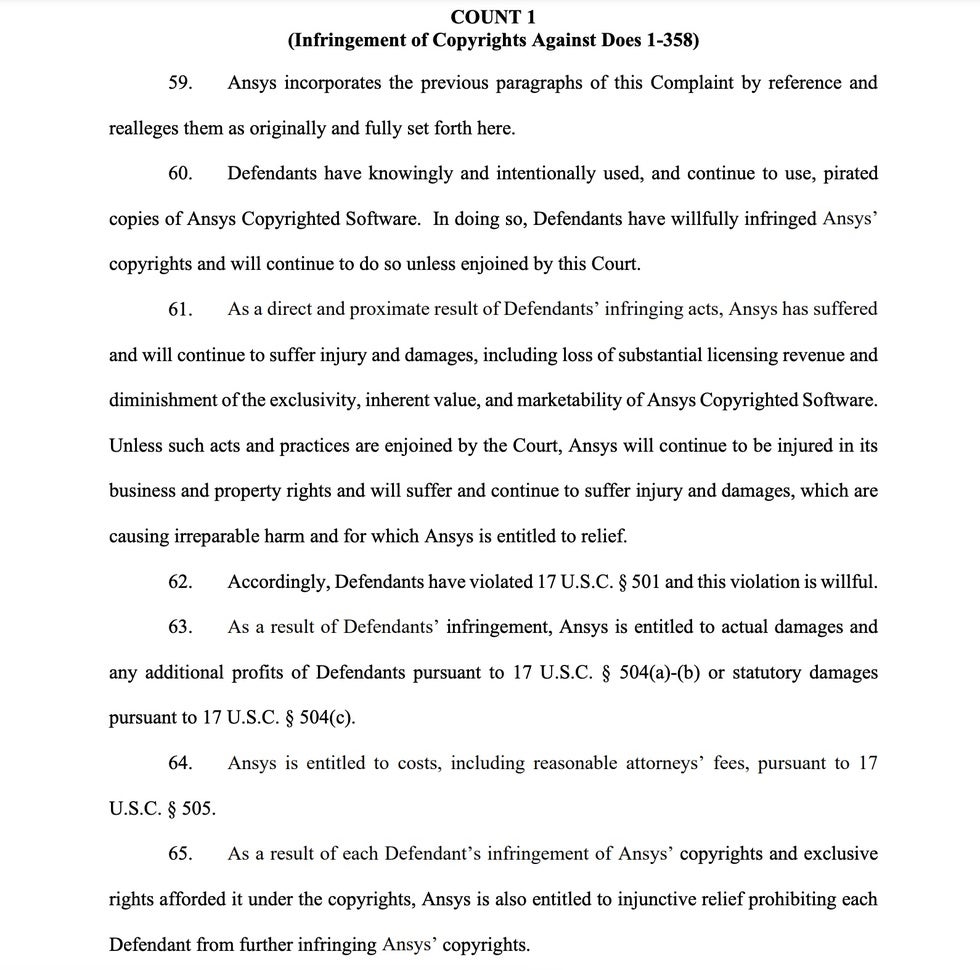
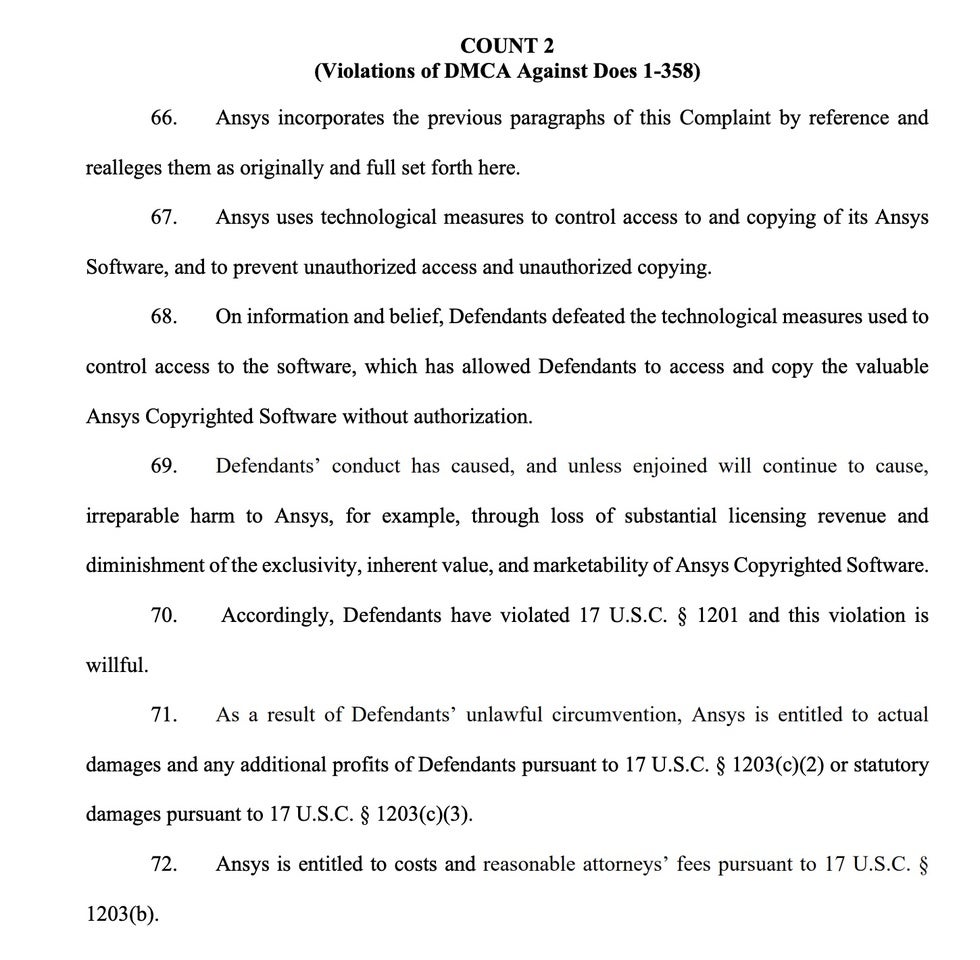
The Ansys lawsuit contains two causes of action
The complaint seeks a wide variety of penalties including statutory damages and lost profits as well as profits realized by the individual defendants. Attorney fees and an injunction are also sought.
Copyright Infringement
Circumvention under 17 U.S.C. 1201
What IS ANSYS up to as of April 2025 with regard to this case?
Currently, Ansys has started serving subpoenas on the alleged infringers ISP. The court has allowed them to serve this (known as "early discovery") so that they can identify the name and address of the alleged infringer. The subscriber is not always the torrent downloader.
How do these cases typically resolve?
Most cases resolve by way of settlement. This can vary depending upon whether the infringer is a business or an individual and a student. Some cases can be dismissed, while others may be looking at several hundreds of thousands of dollars in settlement fees. Every case is different. Hardship settlements are possible (where the defendant turns over tax returns and bank statements) and where they can prove a bona fide financial hardship.
Contact Vondran Legal® Intellectual Property Litigation
Vondran Legal® has handled nearly 1,000 software audit disputes, which makes us, perhaps, the top software piracy defense law firm in the United States. If you are facing a lawsuit with Ansys, call us at (877) 276-5084 to discuss your case. We offer low, flat-rate legal fees to handle most of these cases. You may also fill out the contact form on the right side of this page, and we will contact you. Also, be sure to check out our past client reviews, as they have literally performed the due diligence for you!

