
Vondran Legal® Key IP Case Law: What Every AI Company Needs to Learn About Fair Use, Pirated Training Data, and Copyright Compliance
By Attorney Steve® – Artificial Intelligence & Copyright Lawyer
The artificial intelligence copyright wars just entered a new chapter.
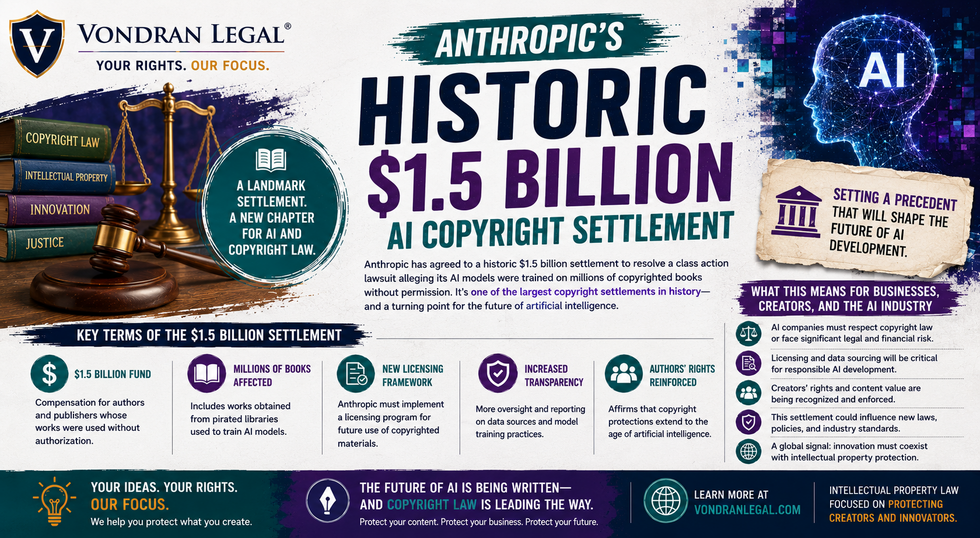
A federal court has granted final approval to Anthropic's landmark $1.5 billion copyright settlement, resolving claims that the company copied hundreds of thousands of copyrighted books without permission to create a massive digital library used in connection with training its Claude large language models. The settlement is believed to be the largest copyright class action settlement in U.S. history and sends a powerful message to AI developers: how you obtain your training data matters just as much as how you use it.
For AI companies, publishers, software developers, and copyright owners, this case may ultimately prove to be one of the defining decisions of the generative AI era.
Breaking News
A federal judge in the Northern District of California granted final approval of a $1.5 billion settlement resolving claims brought by a nationwide class of authors and publishers who alleged that Anthropic unlawfully copied their books to build a centralized digital library used for AI development.
According to court filings:
- Approximately 482,000 copyrighted books were involved.
- More than 91% of eligible rights holders submitted claims for compensation.
- Payments are expected to average roughly $3,000 per qualifying work.
- The court also reduced the attorneys' fee request to preserve more money for authors and publishers.
The Factual Background
Anthropic, developer of the Claude family of AI models, allegedly assembled an enormous internal library containing millions of digital books.
According to the plaintiffs, many of those books were downloaded from well-known piracy repositories rather than obtained through lawful purchase or licensing.
The authors alleged that Anthropic copied the books without permission and stored them in a permanent centralized repository before using them in connection with developing its large language models.
Anthropic disputed many of the allegations and asserted that training generative AI models on books constitutes transformative fair use under copyright law.
That dispute ultimately produced one of the most important copyright rulings yet involving generative AI.
The Plaintiffs' Key Allegations
The lawsuit alleged that Anthropic:
- copied copyrighted books without authorization;
- downloaded books from piracy websites;
- created a permanent digital library of infringing works;
- reproduced copyrighted works on a massive scale;
- violated the exclusive rights of copyright owners under the Copyright Act; and
- benefited commercially from those copies by using them in developing Claude AI.
Unlike many AI lawsuits focusing solely on model training, this case placed significant emphasis on the acquisition and storage of copyrighted works.
Procedural Background
The litigation followed an unusual procedural path.
Early in the case, the court addressed whether AI training itself constituted copyright infringement.
Judge William Alsup issued a highly anticipated ruling distinguishing between:
- lawfully acquired books, and
- pirated books.
The court held that training an AI model using books that had been lawfully purchased could qualify as fair use because the training process was "transformative."
However, the court reached a very different conclusion regarding the alleged pirated library.
The judge ruled that maintaining a massive library of pirated digital books presented an independent copyright problem that was not excused simply because the books were later used for AI training.
That ruling dramatically narrowed the remaining issues and ultimately led to the record-breaking settlement.
Final approval was later entered by Judge Araceli Martínez-Olguín after reviewing objections and confirming that the settlement provided meaningful relief to the class.
The Central Legal Issues
The Anthropic litigation raised several groundbreaking copyright questions.
Among them:
- Can AI companies train on copyrighted books?
- Is AI training itself fair use?
- Does downloading pirated books create separate copyright liability?
- Does building an internal digital library infringe copyright even if the ultimate AI training is transformative?
- Can massive digital copying be excused by later transformative use?
These questions are now at the center of virtually every major AI copyright lawsuit pending in the United States.
The Rules Emerging From the Case
Although the case settled before a final merits trial, several important legal principles have emerged.
1. AI Training May Be Transformative
The court indicated that using lawfully acquired books to train a large language model can constitute transformative fair use under Section 107 of the Copyright Act.
This represents one of the strongest judicial endorsements yet for AI developers on the fair use issue.
2. Lawful Acquisition Matters
The court drew a sharp distinction between:
- buying books and digitizing them for training purposes; and
- downloading pirated copies from unauthorized sources.
That distinction may become one of the defining rules governing AI copyright litigation going forward.
3. Piracy Cannot Be "Cleansed" Through AI Training
Perhaps the most significant lesson from the case is this:
A potentially transformative downstream use does not necessarily erase liability arising from unlawful copying at the front end.
In other words:
Fair use may protect certain AI training activities, but it does not automatically immunize the unlawful acquisition of copyrighted works.
That distinction may become one of the most cited principles in future AI litigation.
Why This Case Is So Important
For nearly two years, many observers assumed the central legal issue in AI copyright cases would be whether AI training itself was lawful.
The Anthropic case changed that discussion.
Instead of asking only:
"Was the training fair use?"
courts are increasingly asking:
"Where did the training data come from?"
That subtle shift may reshape the entire AI industry.
Data provenance—the ability to prove that datasets were lawfully obtained—may become just as important as the architecture of the model itself.
My Legal Analysis
From an attorney's perspective, the Anthropic litigation demonstrates that AI copyright disputes are becoming increasingly sophisticated.
Early lawsuits often focused broadly on the allegation that AI systems copied copyrighted works.
The courts are now separating the AI development pipeline into distinct legal stages:
- acquisition;
- copying;
- storage;
- preprocessing;
- training;
- outputs; and
- commercialization.
Each stage presents different copyright questions.
This case suggests that an AI company could potentially prevail on the training issue while still facing enormous liability arising from how the training corpus was assembled.
That distinction could influence virtually every pending lawsuit involving OpenAI, Meta, Google, Microsoft, Stability AI, Midjourney, and other AI developers.
What This Means for AI Companies
Companies developing AI systems should pay careful attention to several emerging compliance lessons.
Conduct Data Provenance Audits
Know exactly where every dataset originated.
Maintain documentation showing:
- purchase records;
- licenses;
- permissions;
- public-domain status; and
- open-source terms.
Avoid Pirated Datasets
Downloading copyrighted works from piracy repositories creates significant legal risk regardless of later AI use.
Shortcuts taken during dataset collection can become billion-dollar problems years later.
Develop Copyright Governance Policies
Organizations should establish internal policies governing:
- dataset acquisition;
- copyright review;
- licensing;
- record retention;
- vendor due diligence; and
- AI compliance.
Separate Fair Use From Acquisition
Do not assume that a fair use argument resolves every copyright issue.
Fair use addresses one legal question.
Unauthorized copying addresses another.
Both require independent legal analysis.
Document Your AI Development Process
Maintaining detailed documentation of:
- dataset sources;
- preprocessing methods;
- filtering procedures;
- licensing decisions; and
- compliance reviews
may prove invaluable if litigation arises.
What This Means for Copyright Owners
Authors, publishers, photographers, filmmakers, musicians, and software companies should recognize that courts continue to take copyright ownership seriously in the AI era.
While AI training may receive significant fair use protection under certain circumstances, unauthorized mass copying of copyrighted works remains a viable basis for infringement claims.
The Anthropic settlement demonstrates that copyright enforcement continues to have meaningful economic value—even in cases involving cutting-edge artificial intelligence.
Key Takeaways
- Anthropic agreed to a record-breaking $1.5 billion settlement resolving claims involving unauthorized copying of hundreds of thousands of books.
- The case draws a critical distinction between AI training and the acquisition of copyrighted materials.
- The court indicated that training on lawfully acquired books may qualify as transformative fair use, while the creation of a library from pirated books may independently infringe copyright.
- More than 91% of eligible authors and publishers submitted claims, with average payments expected to be about $3,000 per qualifying work.
- AI developers should prioritize data provenance, licensing, copyright governance, and documentation to reduce legal risk.
- Copyright owners should continue monitoring how their works are collected and used in AI training datasets, as the legality of acquisition is becoming a central battleground.
- This decision is likely to influence numerous pending AI copyright cases and may become one of the foundational precedents shaping the future relationship between generative AI and U.S. copyright law.
Need Help With AI Copyright Compliance?
Whether you are building a generative AI platform, licensing training data, defending against copyright claims, or developing internal AI governance policies, experienced legal counsel can help reduce risk before disputes arise.
Attorney Steve® (Steven C. Vondran, P.C.) represents AI companies, software developers, technology startups, copyright owners, publishers, and creators nationwide in matters involving AI compliance, copyright litigation, fair use, software licensing, and intellectual property law. As the legal landscape surrounding artificial intelligence continues to evolve, proactive legal guidance has never been more important.

