
EVERYONE IS CREATING AI AVATARS… BUT WHO ACTUALLY OWNS YOUR FACE?
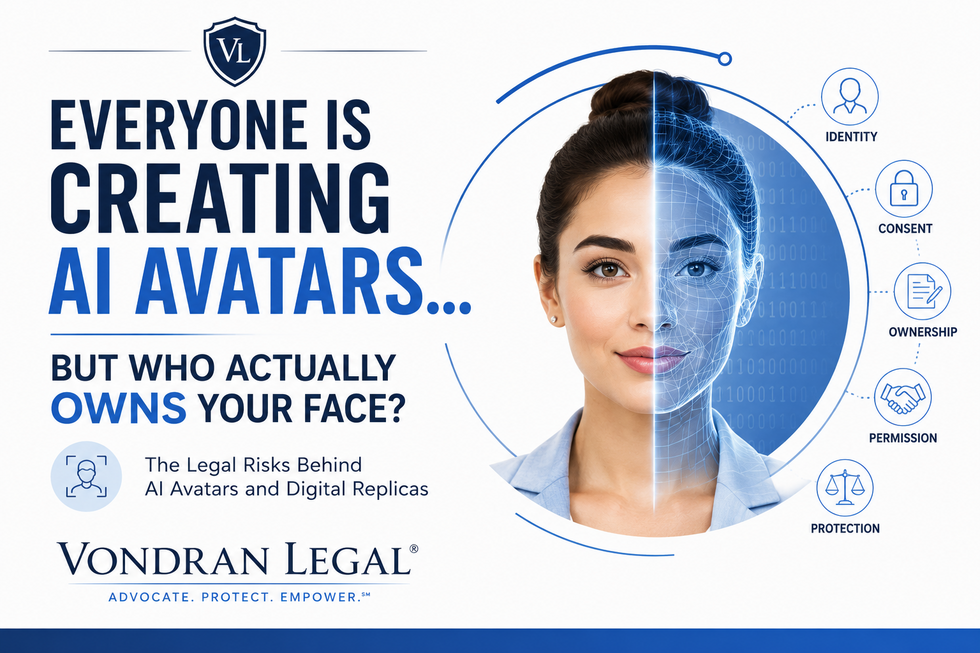
Artificial intelligence is no longer just generating text, images, or marketing captions. It is now generating people.
With a few photos, a voice sample, or a short video clip, AI tools can create realistic digital versions of real individuals. These “AI avatars” can speak, advertise products, appear in training videos, answer questions, and even imitate a person's voice, facial expressions, and personality.
For businesses, creators, influencers, actors, models, and public figures, this technology opens the door to exciting new opportunities. It also creates serious legal risks.
The central question is simple:
Who owns the digital version of you?
AI AVATARS ARE CREATING A NEW IDENTITY ECONOMY
A person's face, voice, name, image, and likeness are becoming valuable business assets. Influencers may use AI avatars to scale content. Companies may use digital spokespeople to reduce production costs. Brands may want to create synthetic models rather than hire real ones. Entertainment companies may want to recreate performers, living or deceased.
But once a person's likeness can be copied, modified, reused, or licensed indefinitely, the legal stakes change dramatically.
This issue is already showing up in real disputes. A New York model reportedly sued a clothing retailer after alleging that the company used an AI-generated clone of her in ads she never agreed to, including after the original modeling agreement had expired. The dispute highlighted a major concern in fashion and advertising: a contract allowing “minor edits” may not authorize a company to generate entirely new AI images of a model.
That is the new legal battlefield.
THE RIGHT OF PUBLICITY: YOUR IDENTITY HAS COMMERCIAL VALUE
In California and many other states, the right of publicity protects people from the unauthorized commercial use of their identity. This can include a person's name, image, likeness, voice, signature, or other recognizable traits.
This is different from copyright. Copyright protects creative works, such as photos, videos, music, and writing. The right of publicity protects the commercial value of a person's identity.
That distinction matters. A company may own the photo it took, but that does not automatically mean it owns unlimited rights to use the person's likeness in new AI-generated content.
For example, a business may have permission to use a model's image in one campaign. That does not necessarily mean it has permission to create an AI clone of that model, place the clone in new ads, use the clone after the contract expires, or make the clone endorse unrelated products.
CALIFORNIA IS ALREADY MOVING TO REGULATE AI REPLICAS
California has taken major steps to address this problem.
AB 2602 is aimed at protecting performers from contract terms that allow companies to create or use AI-generated digital replicas without clear consent. One important takeaway is that broad contract language, such as “all media now known or later developed,” may not be sufficient when dealing with AI replicas. Businesses may need specific language addressing digital replicas, AI use, and consent.
AB 1836 expands protections for deceased individuals by restricting unauthorized AI replicas of their voices or likenesses. This matters for entertainment companies, estates, music labels, film studios, advertisers, and brands that may want to recreate deceased performers or public figures.
These laws signal a major shift: AI likeness rights are becoming their own category of contract and publicity rights concerns.
THE FEDERAL GOVERNMENT MAY BE NEXT
At the federal level, lawmakers have continued discussing the proposed NO FAKES Act, which would create a federal right to control AI-generated digital replicas of a person's voice or visual likeness. The goal is to replace the current patchwork of state laws with more consistent nationwide protection.
In June 2026, the Senate Judiciary Committee advanced legislation to protect a person's name, image, likeness, voice, and visual likeness from unauthorized AI-generated digital replicas. The bill would treat these rights as licensable property rights, allowing individuals to control and potentially monetize authorized uses of their digital identities.
If passed, this could reshape how businesses use AI avatars in advertising, entertainment, influencer marketing, and online content.
THE FTC IS WATCHING AI IMPERSONATION
AI avatar issues are not only about intellectual property. They can also involve consumer deception.
If an AI avatar makes it appear that a real person endorsed a product, gave a testimonial, or appeared in an advertisement, that may raise concerns about false endorsement, advertising, and unfair competition.
The FTC has already proposed expanding its impersonation rules to cover impersonation of individuals, not just businesses and government entities. The proposal also contemplates liability for companies that provide tools or services when they know, or have reason to know, that those tools will be used for unlawful impersonation.
That means businesses cannot assume the legal risk falls only on the person who clicked “generate.” Platforms, agencies, advertisers, and vendors may all face scrutiny depending on their role.
THE COPYRIGHT PROBLEM: YOUR VOICE MAY NOT BE COPYRIGHTED, BUT IT MAY STILL BE PROTECTED
One of the most misunderstood issues is whether a person “owns” their voice under copyright law.
Courts have generally been cautious about treating a voice itself as copyrightable. A 2025 New York case involving AI voice cloning dismissed certain copyright and trademark claims but left open the possibility of state-law right-of-publicity claims. The court recognized an important distinction: copyright may protect a sound recording, but it does not necessarily protect the abstract qualities of a person's voice.
In practical terms, this means a person may not always have a strong copyright claim against a voice clone. But they may still have claims for publicity rights, unfair competition, false endorsement, breach of contract, or consumer deception.
That is why businesses should not view AI voice cloning as a “copyright loophole.” The legal risk may simply come from another direction.
REAL IMPLICATIONS FOR BUSINESSES
For companies, AI avatars may seem like a cheaper, faster alternative to traditional content production. But the risks can be significant.
A business using AI avatars should ask:
- Did the person give written consent to create a digital replica?
- Does the agreement clearly allow AI-generated uses?
- Can the avatar be used after the contract ends?
- Can the avatar be modified, aged, translated, or placed in new contexts?
- Can the avatar endorse products or services?
- Is the audience being misled into thinking a real person appeared in the ad?
- Does the business have the right to use the training data, images, voice samples, or video footage?
Without clear answers, the company may be exposed to claims involving right of publicity, breach of contract, false endorsement, privacy violations, unfair competition, or deceptive advertising.
REAL IMPRESSIONS FOR INFLUENCERS AND CREATORS
For creators, AI avatars can be powerful. An influencer could license an AI version of themselves to appear in ads, answer fan messages, create multilingual videos, or produce content at scale.
But creators should be careful before signing away broad rights.
The most dangerous contract language may be language that gives a company the right to use a creator's likeness “in all media, now known or later developed,” without specifically limiting AI uses.
Creators should look for terms covering:
- Whether an AI replica may be created
- Who owns the AI model or avatar?
- How long can it be used?
- What products can it promote?
- Whether the creator has approval rights
- Whether the avatar can be altered
- Whether the company can train future AI systems on the creator's likeness
- Whether use continues after termination
- Whether the creator receives additional compensation
Your AI clone could become more valuable than a single sponsored post. Treat it that way.
REAL IMPLECTIONS FOR ACTORS, MODELS, AND PERFORMERS
For actors, models, and performers, the issue is even more serious. AI replicas could reduce future work opportunities if companies can reuse a digital version of a performer instead of hiring them again.
This is why unions, state lawmakers, and entertainment attorneys are paying close attention. California's AI replica laws were closely linked to concerns among performers about losing control over their likenesses in film, television, advertising, gaming, and digital media.
A performer may agree to appear in one project. That should not automatically give a studio, agency, or brand permission to create an endless digital substitute.
REAL IMPLICATIONS FOR ESTATES AND DECEASED CELEBRITIES
AI also raises major questions for estates.
Can a company bring back a deceased actor, singer, comedian, or public figure using AI? Who gives permission? Who gets paid? What if the recreation damages the person's legacy?
The George Carlin estate dispute is one example. Carlin's estate sued over an AI-generated comedy special that allegedly imitated him, and the case was later settled with the creators agreeing to remove the content and not use Carlin's likeness in the future.
This area will likely become increasingly important as AI tools make it easier to recreate the work of deceased entertainers.
THE LEGAL IMPLICATIONS
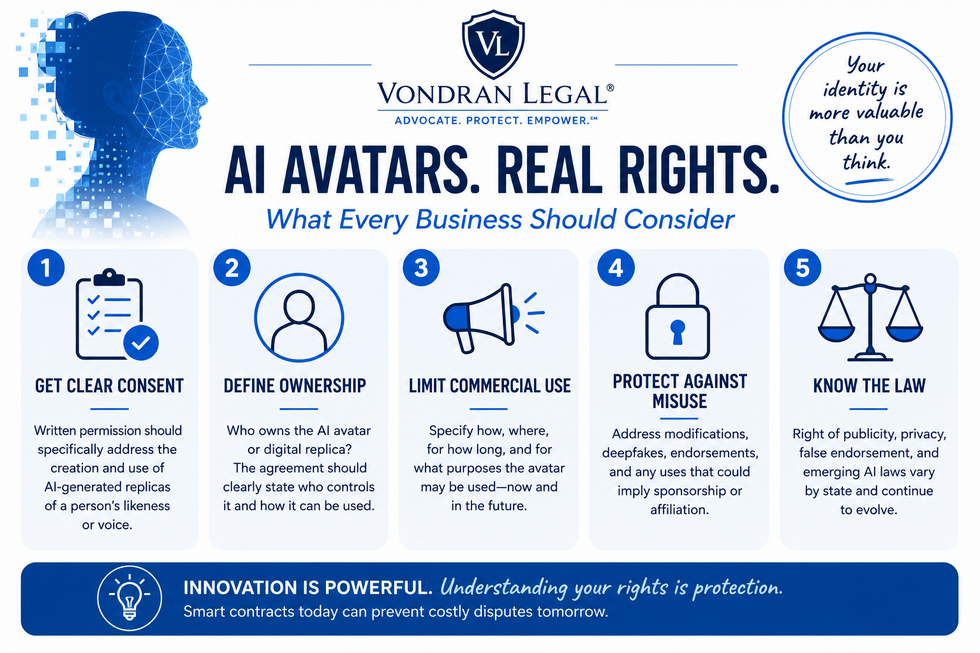
AI avatar technology is moving faster than most contracts.
Many agreements used by brands, agencies, employers, influencers, models, and production companies were drafted before AI replicas became mainstream. As a result, they may not clearly answer the most important question:
Did the person agree to be digitally recreated?
That question may determine whether an AI avatar is a smart business tool or a lawsuit waiting to happen.
BEST PRACTICES
Before creating, licensing, or using an AI avatar, businesses should consider:
- Get clear written consent.
- Use specific AI and digital replica language.
- Define ownership of the avatar.
- Limit duration, territory, platforms, and approved uses.
- Address whether the avatar can be modified.
- Require approval for endorsements or sensitive uses.
- Disclose AI use when necessary.
- Avoid implying endorsement without permission.
- Review state publicity laws.
- Update old talent, influencer, and modeling agreements.
FINAL THOUGHTS
AI avatars are not just a technology trend. They represent a legal shift in how identity is created, licensed, and monetized.
Your face, voice, and likeness may now function like a brand asset. For some people, that asset may be worth substantial money. For businesses, that asset may carry substantial liability.
As AI-generated replicas become more realistic and easier to create, the law will continue to evolve. But one principle is already clear:
Just because AI can recreate someone does not mean a business has the legal right to use that person's likeness.
Vondran Legal® monitors emerging issues involving artificial intelligence, intellectual property, entertainment law, right of publicity, online business, and digital content. For creators, businesses, agencies, and entertainment professionals, now is the time to review contracts, update consent language, and protect valuable identity rights before problems arise.
