
THE GOOGLE GEMINI LAWSUIT MAY CHANGE HOW COPYRIGHT LICENSES ARE WRITTEN
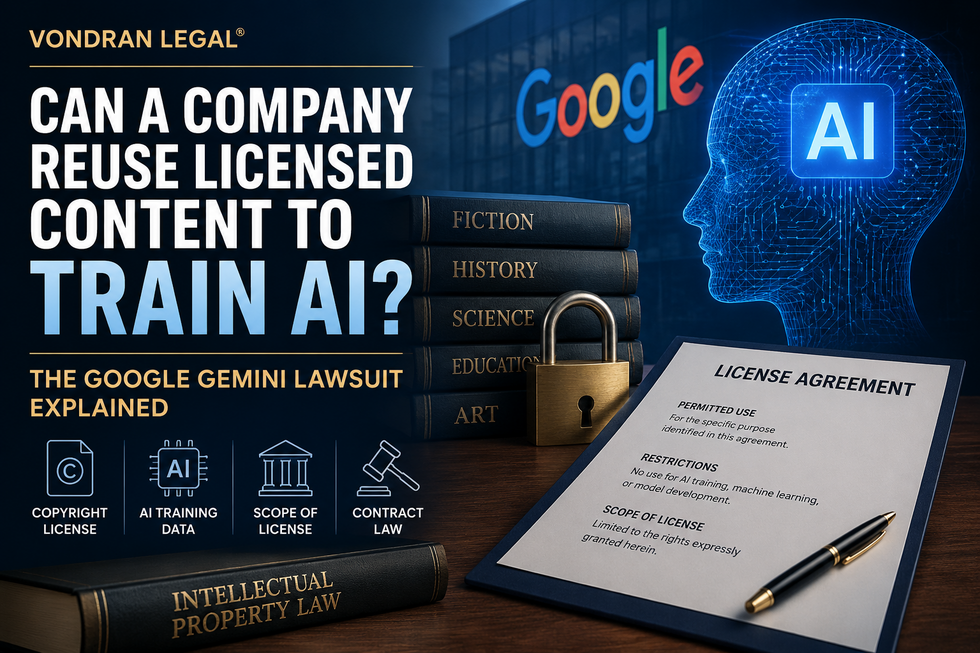
Artificial intelligence has already transformed the way businesses create content, analyze information, and develop new products. Every week seems to bring another lawsuit involving AI, copyright, or intellectual property. While many of those cases focus on whether AI companies copied copyrighted works without permission, one of the newest lawsuits against Google presents a different, and potentially more significant, legal question:
What happens when a company already has permission to possess copyrighted material, but later uses that material for an entirely different purpose?
That issue is at the heart of a proposed class action lawsuit filed by several major publishers and bestselling author Scott Turow against Google over the development of its Gemini artificial intelligence models. Rather than arguing that Google simply copied books without authorization, the plaintiffs contend that Google exceeded the rights it had previously obtained through other licensing arrangements. If courts ultimately agree, the case could influence how copyright licenses are drafted for years to come and reshape the relationship between content creators and companies developing artificial intelligence technologies.
For businesses, software developers, photographers, authors, musicians, educators, and anyone who licenses intellectual property, this lawsuit deserves close attention.
THE DISPUTE IS ABOUT MORE THAN COPYRIGHT
The publishers allege that Google used millions of copyrighted books to train its Gemini AI models. According to the complaint, many of those books had already been provided to Google through commercial relationships involving products such as Google Books and Google Play Books. The plaintiffs argue that those agreements authorized Google to use the books for specific products and services, not to develop commercial generative AI systems.
Whether those allegations are ultimately proven remains to be seen. Google will have the opportunity to present its defenses, and the litigation is still in its early stages. However, the legal theory itself highlights an issue that many businesses have not yet considered.
There is an important legal difference between having access to copyrighted material and having permission to use that material for every conceivable purpose.
COPYRIGHT LICENSES ARE NOT BLANK CHECKS
Many people mistakenly believe that once they purchase or license copyrighted content, they are free to use it however they wish. Intellectual property law rarely works that way.
A copyright license is simply a contract granting limited permission to perform activities that copyright law would otherwise prohibit. Those permissions may be broad or extremely narrow, depending on how the agreement is written. Some licenses authorize only personal use. Others permit commercial use but prohibit modification. Still others allow reproduction while restricting redistribution or sublicensing.
The point is that every license has boundaries.
If a photographer licenses images for use in a company's annual report, that does not automatically authorize the company to sell those images to third parties. Likewise, licensing music for a television commercial does not necessarily permit the same music to be used in a feature film or distributed via a streaming service.
Artificial intelligence introduces a further layer of complexity because many licensing agreements were drafted years before generative AI became commercially viable. As a result, thousands of existing contracts never mention AI training, machine learning, dataset development, embeddings, or large language models.
That silence has created uncertainty, and uncertainty frequently leads to litigation.
WHY THIS CASE MIGHT HAVE FAR-REACHING CONSEQUENCES
Regardless of how the Google litigation is ultimately resolved, the lawsuit demonstrates a broader shift occurring across intellectual property law. Earlier AI lawsuits largely focused on allegations that AI companies copied copyrighted works without permission. Courts have spent considerable time evaluating issues such as fair use, transformative use, and whether training an AI model constitutes copyright infringement.
The newer cases increasingly ask a different question.
Instead of asking whether permission existed, they ask whether the permission that did exist extended to AI development.
That distinction moves the analysis beyond traditional copyright law and into contract interpretation.
Courts may eventually be asked to determine what the parties intended when they entered into licensing agreements years before anyone anticipated today's AI technology. Did both sides expect that licensed books, photographs, software, or videos could later become part of an artificial intelligence training dataset? If the agreement is silent, should courts imply that right, or should they conclude that additional permission was required?
Those questions have enormous financial implications.
For companies developing AI systems, the ability to rely on previously licensed content could dramatically reduce the cost of obtaining training data. For creators, publishers, and copyright owners, the opposite conclusion could preserve greater control over how their intellectual property is used in emerging technologies.
THIS ISSUE EXTENDS FAR BEYOND BOOK PUBLISHERS
Although the lawsuit involves books, the legal principles could apply across countless industries.
Businesses license copyrighted content every day. Marketing agencies purchase stock photography. Manufacturers' license software. Streaming platforms obtain rights to music and films. Educational institutions subscribe to digital publications. Technology companies license databases. Healthcare organizations purchase proprietary research materials.
If courts conclude that permission for one commercial purpose does not automatically include AI training rights, companies across virtually every industry may need to reevaluate their existing agreements.
The same issue could arise with software licenses, video libraries, photography collections, architectural plans, engineering drawings, training manuals, digital archives, customer-generated content, and proprietary databases.
In other words, this is not merely a publishing dispute. It is a licensing dispute that happens to involve artificial intelligence.
WHY EVERY BUSINESS SHOULD REVIEW ITS LICENSE AGREEMENTS
Many companies are racing to integrate AI into their daily operations. Employees are using AI to summarize documents, generate reports, analyze customer data, draft marketing materials, and automate workflows. As those initiatives expand, businesses may begin incorporating licensed content into AI-powered systems without first asking whether their contracts actually permit that use.
That can create unnecessary legal exposure.
A business may assume that because it paid for access to certain materials, it automatically has the right to use those materials for internal AI projects. The contract, however, may say something very different.
This is why intellectual property audits are becoming increasingly important. Businesses should understand exactly what rights they acquired—and just as importantly, what rights they did not.
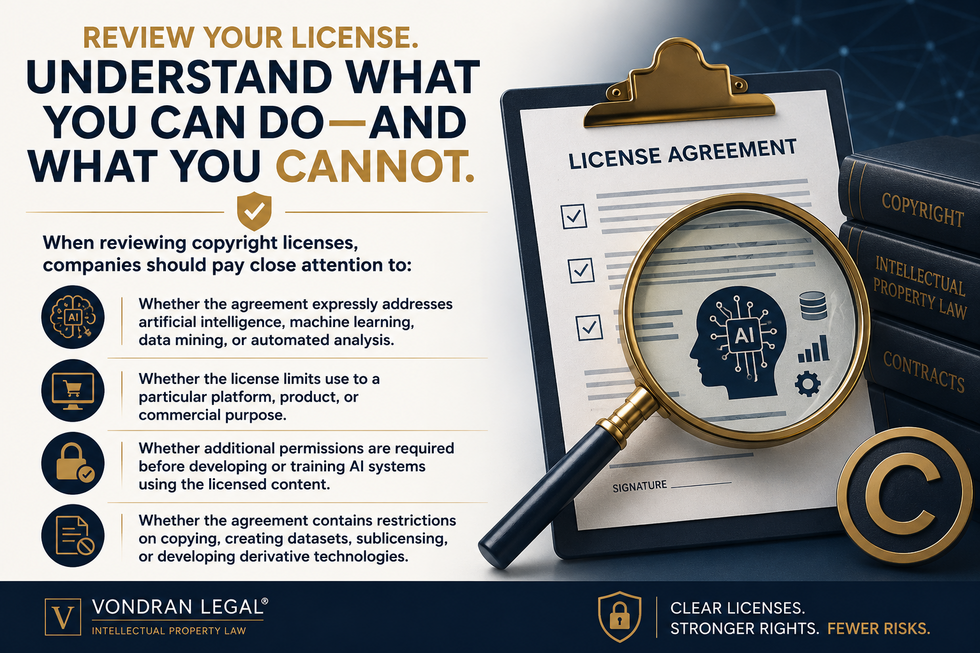
When reviewing copyright licenses, companies should pay close attention to issues such as:
- Whether the agreement expressly addresses artificial intelligence, machine learning, data mining, or automated analysis.
- Whether the license limits use to a particular platform, product, or commercial purpose.
- Whether additional permissions are required before developing or training AI systems using the licensed content.
- Whether the agreement contains restrictions on copying, creating datasets, sublicensing, or developing derivative technologies.
As AI continues to evolve, these provisions may become just as important as traditional copyright ownership clauses.
THE FUTURE OF COPYRIGHT LICENSING IS ALREADY CHANGING
Even if Google ultimately prevails, businesses should expect licensing agreements to become much more detailed.
Publishers, software developers, photographers, musicians, filmmakers, and other creators are increasingly recognizing that AI presents entirely new commercial opportunities—and entirely new risks. Future contracts will likely address AI explicitly rather than leaving courts to interpret agreements drafted before generative AI existed.
We are already seeing licensing agreements include language addressing AI training, dataset creation, synthetic media generation, automated content analysis, ownership of AI-generated outputs, audit rights, and restrictions on downstream machine learning applications.
That trend is likely to accelerate.
The lesson for businesses is straightforward. Contracts that appeared comprehensive just a few years ago may no longer provide sufficient protection in today's technological environment.
FINAL THOUGHTS
The Google publisher lawsuit illustrates how rapidly artificial intelligence is reshaping intellectual property law. While headlines often focus on copyright infringement and fair use, this case highlights another equally important principle: the scope of a license matters.
Having lawful access to copyrighted material does not necessarily grant unlimited authority to use that material in every future technology. Whether courts ultimately determine that Google's existing licenses permitted AI training remains to be seen, but the dispute itself serves as a reminder that intellectual property agreements should be drafted with emerging technologies in mind.
For businesses developing AI tools, licensing creative works, or investing in valuable intellectual property, now is the time to review existing agreements and ensure they clearly define what is—and is not—authorized. Clear contractual language today may help avoid expensive litigation tomorrow.
NEED HELP WITH COPYRIGHT LICENSING OR AI-RELATED INTELLECTUAL PROPERTY ISSUES?
As artificial intelligence continues to evolve, businesses should ensure that their copyright licenses, software agreements, publishing contracts, and technology transactions adequately address AI-related rights and restrictions. Careful drafting today can help prevent costly disputes tomorrow.
Vondran Legal® represents businesses, creators, software developers, publishers, and technology companies in copyright, trademark, licensing, entertainment, and AI-related intellectual property matters. If you have questions about protecting your intellectual property or evaluating the scope of an existing license, experienced legal counsel can help assess your rights and legal options.
