
Trade Secrets and Video Games: How Game Developers Can Protect Their Most Valuable Assets
By Vondran Legal® | Intellectual Property and Entertainment Law
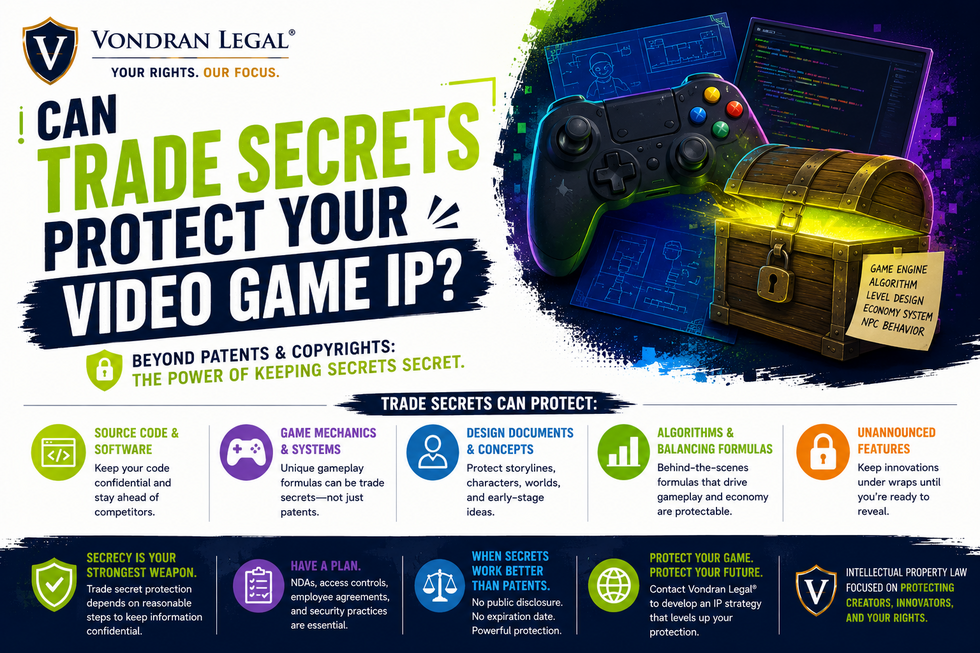
The video game industry has become one of the largest entertainment markets in the world, generating well over $180 billion annually. While most developers understand the importance of copyrights, trademarks, and patents, one of the most valuable forms of intellectual property often receives far less attention: trade secrets.
Many of the most successful gaming companies—including major AAA studios and independent developers—rely heavily on trade secret law to protect the confidential information that gives them a competitive advantage. Unlike copyrights or patents, trade secrets can potentially last forever, provided they remain secret.
Whether you are developing a mobile game, PC title, console game, tabletop game, casino game, board game, VR experience, or online multiplayer platform, understanding trade secret law can help protect years of investment and innovation.
What Is a Trade Secret?
Under both the federal Defend Trade Secrets Act (DTSA), 18 U.S.C. § 1836, and many state laws based on the Uniform Trade Secrets Act (UTSA), a trade secret generally consists of information that:
- derives independent economic value because it is not generally known or readily ascertainable; and
- is subject to reasonable measures to maintain its secrecy.
Unlike patents, trade secrets do not require registration with the United States Patent and Trademark Office.
Unlike copyrights, they do not protect creative expression.
Instead, they protect valuable confidential business information.
Trade Secrets in the Gaming Industry
Many people think only software code qualifies as a trade secret.
In reality, game studios possess hundreds—sometimes thousands—of confidential assets that may qualify.
Examples include:
Proprietary Game Engines
A custom game engine may represent years of engineering effort.
Examples include:
- rendering techniques
- physics systems
- networking architecture
- optimization methods
- memory management
- AI behavior systems
Although portions of software may eventually become publicly available, the internal architecture often remains highly confidential.
Source Code
While source code is protected by copyright, unpublished source code may simultaneously qualify as a trade secret.
The distinction matters because:
- copyright protects against copying;
- trade secret law protects against theft or improper disclosure.
A former employee who steals proprietary code may violate both copyright law and trade secret law.
Artificial Intelligence Systems
Modern games increasingly rely on AI.
Examples include:
- NPC decision-making
- adaptive difficulty systems
- procedural content generation
- dialogue generation
- reinforcement learning
- matchmaking algorithms
These proprietary systems frequently provide substantial competitive advantages.
Anti-Cheat Technology
Cheating remains one of the largest threats facing online games.
Studios invest enormous resources developing:
- cheat detection
- behavioral analytics
- anti-bot systems
- fraud detection
- exploit monitoring
- server-side validation
Publishing these systems would undermine their effectiveness.
Trade secret protection becomes essential.
Matchmaking Algorithms
Competitive online games often rely on sophisticated ranking systems.
Examples include:
- hidden MMR calculations
- Elo variants
- skill balancing
- player retention modeling
- engagement optimization
Keeping these systems confidential prevents manipulation by players and competitors.
Game Balancing Formulas
Developers spend years refining:
- weapon damage
- spawn rates
- loot tables
- probability systems
- economy balancing
- progression curves
The mathematical formulas behind successful games often remain confidential long after release.
Monetization Strategies
Many companies guard confidential information regarding:
- in-game pricing
- player segmentation
- spending analytics
- conversion rates
- subscription models
- advertising algorithms
These data-driven systems often generate millions in revenue.
Future Development Roadmaps
Before launch, studios typically possess confidential information concerning:
- upcoming expansions
- unreleased characters
- downloadable content (DLC)
- sequel planning
- acquisition strategies
- platform launches
Premature disclosure may significantly affect stock prices, marketing campaigns, and competitive positioning.
Why Trade Secrets Matter More Than Patents
Many game developers ask whether they should pursue patents.
Sometimes the answer is yes.
However, patents require public disclosure.
Once issued, anyone can read:
- the invention
- technical drawings
- system architecture
- implementation concepts
Trade secrets work differently.
No disclosure is required.
If secrecy is maintained, protection may last indefinitely.
For many gaming innovations, keeping technology confidential offers greater value than patenting it.
Trade Secrets vs. Copyright
Many developers mistakenly believe copyright protects everything.
It does not.
Copyright protects:
- artwork
- music
- dialogue
- characters
- source code
- audiovisual works
Trade secrets protect confidential business information.
A simple comparison illustrates the difference.
|
Copyright
|
Trade Secret
|
|---|---|
|
Protects creative expression
|
Protects confidential information
|
|
Automatic upon creation
|
Exists only if secrecy is maintained
|
|
Registration recommended
|
No registration required
|
|
Public disclosure acceptable
|
Public disclosure destroys protection
|
|
Fixed duration
|
Potentially perpetual
|
Most game studios own both.
Common Ways Trade Secrets Are Lost
Unfortunately, many companies lose trade secret protection through preventable mistakes.
Examples include:
Hiring Freelancers Without Confidentiality Agreements
Independent contractors often receive access to confidential information.
Without properly drafted:
- NDAs
- confidentiality agreements
- invention assignment agreements
valuable information may become difficult to protect.
Poor Internal Security
Studios should limit access to confidential materials.
Examples include:
- role-based permissions
- password management
- encryption
- secure repositories
- audit logs
Not every employee needs access to every project.
Public Demonstrations
Showing confidential technology at conferences, conventions, or livestreams may unintentionally destroy trade secret status.
Developers should carefully evaluate:
- GDC presentations
- Twitch demonstrations
- beta testing
- investor presentations
before revealing proprietary systems.
Employee Departures
Many trade secret lawsuits begin after employees change jobs.
Departing employees should:
- return company devices;
- certify deletion of confidential files;
- acknowledge continuing confidentiality obligations.
Exit interviews can significantly reduce future disputes.
Reverse Engineering and Trade Secrets
One limitation of trade secret law is that lawful reverse engineering is generally permitted.
If someone independently discovers how your game engine works through legitimate analysis, trade secret law may not prevent that.
However, trade secret law does prohibit:
- industrial espionage;
- hacking;
- theft of confidential files;
- bribery;
- breach of confidentiality agreements;
- unauthorized copying.
Esports and Trade Secrets
Professional gaming organizations also maintain valuable confidential information.
Examples include:
- scouting reports
- player analytics
- proprietary coaching methods
- drafting strategies
- training software
- performance metrics
These assets may qualify for trade secret protection if properly safeguarded.
Board Games and Tabletop Games
Trade secrets are not limited to video games.
Board game companies may protect:
- unpublished expansions
- manufacturing methods
- supplier relationships
- marketing strategies
- playtesting data
- proprietary balancing systems
Before publication, many tabletop creators require testers to sign nondisclosure agreements.
Mobile Games
Mobile developers frequently possess confidential information regarding:
- retention algorithms
- ad optimization
- user acquisition
- in-app purchase modeling
- A/B testing
- live operations strategies
These data-driven assets often represent the company's most valuable intellectual property.
What Happens If Someone Steals Your Trade Secrets?
Victims of trade secret theft may have significant legal remedies.
Potential claims may include:
- federal claims under the Defend Trade Secrets Act (DTSA);
- state trade secret claims under the Uniform Trade Secrets Act or comparable state statutes;
- breach of contract;
- breach of fiduciary duty;
- unfair competition;
- computer fraud claims in appropriate cases.
Possible remedies include:
- temporary restraining orders (TROs);
- preliminary injunctions;
- permanent injunctions;
- monetary damages;
- unjust enrichment;
- reasonable royalties in some circumstances;
- exemplary damages for willful and malicious misappropriation (where authorized);
- attorney's fees in certain cases.
Best Practices for Game Developers
Studios should consider implementing a comprehensive IP protection program that includes:
- Identifying confidential information through periodic trade secret audits.
- Requiring employees, contractors, and consultants to sign confidentiality and intellectual property assignment agreements.
- Restricting access to sensitive repositories on a need-to-know basis.
- Using secure development infrastructure with encryption, logging, and multi-factor authentication.
- Clearly labeling confidential documents and source code.
- Conducting exit interviews and recovering company property when personnel leave.
- Training employees on handling confidential information and reporting suspected leaks.
- Periodically reviewing security policies as technology and threats evolve.
Final Thoughts
Some of the most valuable assets in the gaming industry are never visible to players. Behind every successful title are confidential systems, algorithms, business strategies, development tools, and technical innovations that may provide a lasting competitive edge. While copyrights, trademarks, and patents each play an important role, trade secret law often protects the "secret sauce" that competitors cannot lawfully obtain through theft or breach of confidence.
Because trade secret protection depends on maintaining secrecy, legal planning should begin long before a dispute arises. Well-drafted contracts, thoughtful security practices, and regular IP audits can make the difference between preserving a competitive advantage and losing it.
Whether you are an indie developer, an established studio, an esports organization, or a tabletop game publisher, protecting your confidential information should be an integral part of your overall intellectual property strategy.
Contact Vondran Legal®
Vondran Legal® represents clients in intellectual property, entertainment, software, and technology matters nationwide. Our firm assists game developers, publishers, technology companies, and creative professionals with:
- Trade secret audits and protection strategies
- Confidentiality (NDA) and IP assignment agreements
- Employee and contractor intellectual property issues
- Software licensing and technology transactions
- Copyright and trademark registration
- Trade secret misappropriation litigation
- Entertainment and game publishing agreements
- AI-related intellectual property counseling
If your company develops games, software, or other digital content, proactive legal guidance can help safeguard the innovations that set your business apart and reduce the risk of costly disputes later.

