
VONDRAN LEGAL® | TRADEMARK LAW AND COPYCAT PRODUCTS
INTRODUCTION
Imagine spending years building a recognizable brand.
Your company invests significant time and money developing a quality product, earning customer trust, and establishing a strong reputation in the marketplace. Over time, consumers immediately recognize your brand by its name, logo, and overall identity.
Then a competitor introduces a similar looking product at a fraction of the price.
Many business owners immediately ask the same question.
Can I stop them for trademark infringement?
The answer depends on what is actually being copied.
While trademarks are among the most valuable intellectual property assets a business can own, they were never intended to prevent every competitor from selling similar products. In fact, many companies selling so called "dupes" carefully avoid traditional trademark infringement by creating their own branding while offering products that resemble successful market leaders.
Understanding what trademark law protects, and just as importantly what it does not protect, is essential for both brand owners and businesses bringing new products to market.
WHAT IS THE PURPOSE OF TRADEMARK LAW?
Trademark law exists to protect brand identity.
A trademark allows consumers to identify the source of a product or service. It helps distinguish one company's goods from those of another and allows consumers to purchase products with confidence based on the reputation associated with the brand.
Common trademarks include:
- Company names
- Product names
- Logos
- Slogans
- Symbols
- In certain cases, distinctive colors, packaging, or other source identifying features
Think about some of the most recognizable brands in the world. When consumers see the Nike® Swoosh, the Apple® logo, or the Coca Cola® script, they immediately know who produced the product.
That recognition represents years of investment in advertising, quality control, customer service, and brand development.
Trademark law protects that goodwill.
TRADEMARK LAW DOES NOT PROTECT PRODUCTS
One of the biggest misconceptions in intellectual property law is that a trademark prevents competitors from making similar products.
It does not.
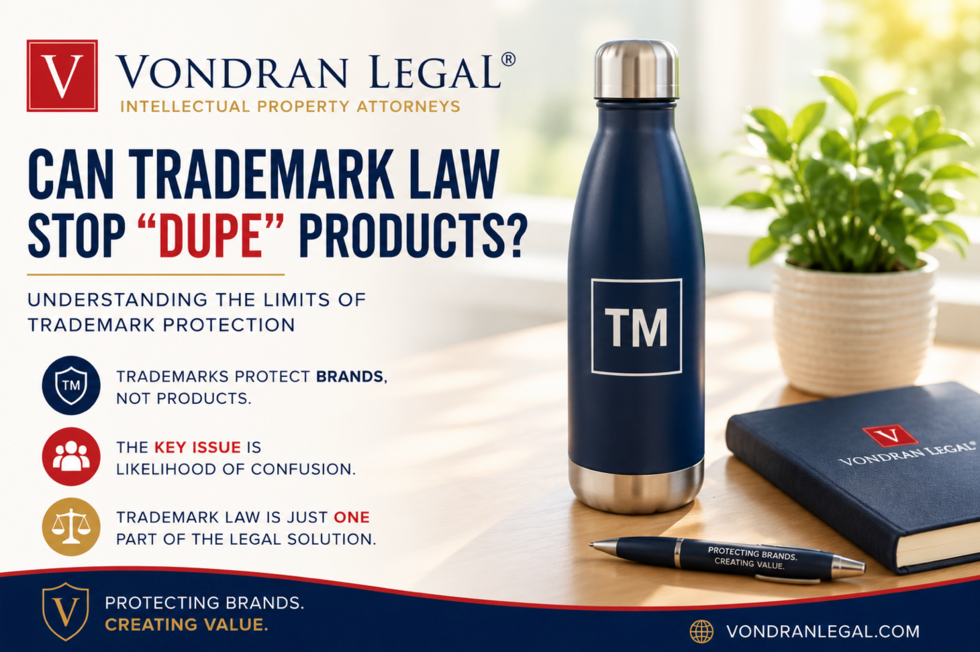
A trademark protects the brand, not the product itself.
For example, trademark law generally does not prevent competitors from selling:
- Black leggings
- Insulated tumblers
- Body lotion
- Modern furniture
- Leather handbags
Businesses are free to compete in the marketplace.
What they cannot do is market their products in a manner that is likely to confuse consumers into believing there is an association with another company.
That distinction is one of the fundamental principles of trademark law.
THE LIKELIHOOD OF CONFUSION STANDARD
Most trademark infringement cases center around one primary question.
Are consumers likely to be confused?
In other words, would an ordinary consumer reasonably believe the defendant's product originates from, is affiliated with, or has been approved by the trademark owner?
Courts evaluate a variety of factors when answering this question, including:
- The similarity of the trademarks
- The similarity of the products
- The strength of the trademark
- The marketing channels used by the parties
- Evidence of actual consumer confusion
- The intent of the alleged infringer
- The sophistication of the purchasers
No single factor determines the outcome. Courts instead consider the overall commercial impression created by the competing products.
WHY TRADEMARK LAW DOES NOT ALWAYS STOP DUPES
This is where many businesses are surprised.
Many companies selling dupe products intentionally avoid copying trademarks.
Instead of placing the Nike® name on a shoe, they sell the product under a completely different brand.
Instead of using the Hermès® name, they market the handbag under their own company name.
Consumers often understand exactly what they are purchasing.
They know they are buying a lower priced alternative rather than the original luxury product.
When consumers are not confused about the source of the goods, traditional trademark claims can become much more challenging. This was one of the primary themes discussed during the recent webinar on the legal landscape surrounding dupe products. The presenters explained that many modern dupe cases require legal theories beyond traditional trademark infringement because consumers often knowingly purchase lower cost alternatives.
This does not mean the competing product is lawful.
It simply means trademark law may not be the strongest legal tool available.
WHAT ABOUT FAMOUS BRANDS?
Federal trademark law also provides additional protection for certain famous trademarks through dilution claims.
Unlike ordinary trademark infringement, trademark dilution does not necessarily require proof that consumers are confused.
Instead, the purpose of dilution law is to protect the unique identity and strength of famous brands.
There are generally two types of dilution claims.
Dilution by blurring occurs when another party's use weakens the distinctiveness of a famous trademark over time.
Dilution by tarnishment occurs when the use harms the reputation of a famous trademark by associating it with inferior or objectionable products or services.
These claims are available only under specific circumstances and generally apply to truly famous trademarks rather than every federally registered mark.
TRADEMARK LAW IS OFTEN ONLY ONE PART OF THE CASE
Businesses pursuing copycat products rarely rely on trademark law alone.
Instead, many lawsuits combine several legal theories, including:
- Trade dress infringement
- Design patent infringement
- Copyright infringement
- False advertising
- Unfair competition
Each legal claim protects a different aspect of a business's intellectual property.
Rather than arguing only that a competitor copied its trademark, a company may also argue that the competitor copied the distinctive appearance of its product, replicated protected design features, or made misleading advertising claims about product quality or equivalence.
This strategy has become increasingly common in recent litigation involving consumer products.
PRACTICAL CONSIDERATIONS FOR BUSINESSES
Whether your business is introducing a new product or protecting an established brand, planning ahead can significantly reduce legal risk.
Businesses should consider:
- Conducting a trademark clearance search before adopting a new brand
- Selecting distinctive names and logos
- Registering valuable trademarks with the United States Patent and Trademark Office
- Monitoring the marketplace for potential infringement
- Avoiding branding that could create consumer confusion
- Consulting experienced intellectual property counsel before launching products that resemble successful competitors
Taking these steps early is often far less expensive than defending a trademark infringement lawsuit after a product has already entered the marketplace.
TRADEMARK LAW HAS LIMITS
Trademark law remains one of the most powerful tools available to protect brand identity.
However, it was never intended to eliminate every competing product from the marketplace.
As copycat products continue to grow in popularity, businesses are discovering that trademark law represents only one part of a much broader intellectual property strategy.
In many cases, stronger claims arise under trade dress law, design patent law, or false advertising principles depending on what has actually been copied.
Understanding those differences is critical for businesses seeking to protect their intellectual property while continuing to compete fairly in today's marketplace.
FINAL THOUGHTS
Trademark law serves an important purpose by protecting consumers from confusion and safeguarding the goodwill businesses have built in their brands.
At the same time, trademark law does not grant a monopoly over successful products or popular designs.
Every infringement claim requires a careful analysis of the trademarks involved, the marketplace, the products at issue, and the likelihood of consumer confusion.
At Vondran Legal®, our intellectual property attorneys regularly assist businesses with trademark registration, trademark enforcement, cease and desist letters, licensing agreements, infringement litigation, and comprehensive brand protection strategies.
If you have questions about trademark infringement, copycat products, or protecting your brand, contact Vondran Legal® AT (877) 276-5084 for a free legal consultation.
