
California Penal Code Section 528.5: California's Online Impersonation Law Explained
The rise of social media, online business platforms, and digital communications has made it easier than ever for bad actors to create fake accounts and impersonate real people. Whether it is a disgruntled former employee, an angry ex-partner, a business competitor, or an anonymous internet troll, online impersonation can cause serious reputational and financial harm.
Fortunately, California has enacted a law specifically addressing this problem.
California Penal Code Section 528.5 makes certain forms of online impersonation a crime and also provides victims with the right to pursue civil remedies against the impersonator.
If someone has created a fake Facebook account, Instagram profile, LinkedIn page, email account, TikTok account, YouTube channel, or other online identity pretending to be you, this statute may provide an important legal remedy.
What Does California Penal Code Section 528.5 Say?
The statute provides that a person may be liable if they:
-
Knowingly impersonate another actual person;
-
Do so without that person's consent;
-
Use an internet website or other electronic means;
-
Create a credible impersonation; and
-
Act for the purpose of harming, intimidating, threatening, or defrauding another person.
The law specifically states that opening an email account or social media profile in another person's name may qualify as online impersonation.
What Is a "Credible" Impersonation?
Not every parody account or anonymous account violates the statute.
The impersonation must be "credible," meaning a reasonable person would believe, or actually did believe, that the fake account belonged to the real individual being impersonated.
Examples may include:
-
Creating a fake LinkedIn profile using another person's name and photograph.
-
Opening a Gmail account pretending to be a business executive.
-
Creating a fake Instagram account using another person's images.
-
Operating a fake Facebook account that appears to belong to the victim.
-
Sending emails while pretending to be another individual.
Practical Examples of Online Impersonation
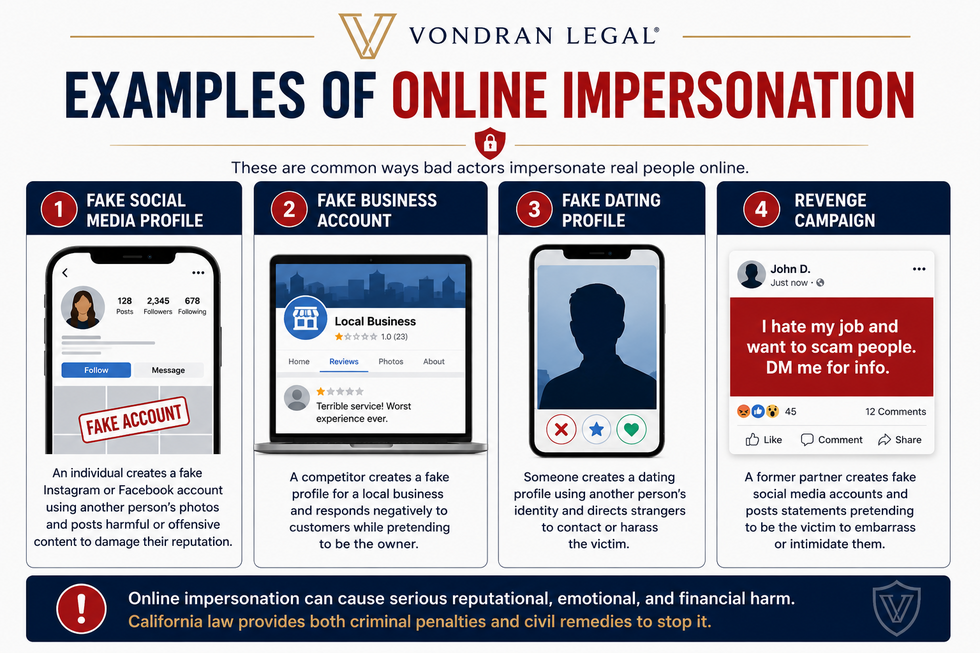
Example 1: Fake Social Media Profile
An individual creates a fake Instagram account using another person's photographs and posts offensive content to damage that person's reputation.
Example 2: Fake Business Account
A competitor creates a fake profile for a local business and responds negatively to customers while pretending to be the owner.
Example 3: Fake Dating Profile
Someone creates a dating profile using another person's identity and directs strangers to contact or harass the victim.
Example 4: Revenge Campaign
A former romantic partner creates fake social media accounts and posts statements pretending to be the victim in an effort to embarrass or intimidate them.
These are the types of factual situations the statute was designed to address.
Is Online Impersonation a Crime?
Yes.
A violation of Penal Code § 528.5 may be prosecuted as a misdemeanor punishable by:
-
Up to one year in county jail;
-
A fine of up to $1,000; or
-
Both jail time and a fine.
The criminal penalties are often less important to victims than the civil remedies available under the statute.
Can You Sue for Online Impersonation?
Absolutely.
One of the most important parts of Penal Code § 528.5 is subsection (e), which expressly authorizes a civil lawsuit by victims who suffer damage or loss because of the impersonation.
The statute allows a victim to pursue:
-
Compensatory damages;
-
Injunctive relief;
-
Other equitable remedies authorized by law.
This means a victim may seek both money damages and court orders requiring the impersonator to stop the misconduct.
What Damages Can You Recover?
The statute itself primarily references compensatory damages. Depending on the facts of the case, recoverable damages may include:
Reputational Harm
If the impersonation damaged your reputation, personal brand, or professional standing, those losses may be recoverable.
Lost Business Opportunities
Business owners, influencers, professionals, and content creators may be able to recover lost profits or lost business opportunities resulting from the fake account.
Emotional Distress
In appropriate cases, emotional distress damages may be recoverable through related causes of action such as defamation, invasion of privacy, or intentional infliction of emotional distress.
Investigation Costs
Victims often incur substantial expenses attempting to identify anonymous perpetrators, preserve evidence, and investigate misconduct.
Injunctive Relief
In many cases, the most valuable remedy is obtaining a court order requiring:
-
Removal of fake accounts;
-
Deletion of impersonating content;
-
Prohibition against future impersonation;
-
Preservation of electronic evidence.
What Other Claims Are Commonly Filed Alongside Section 528.5?
Experienced internet litigators often pair Section 528.5 claims with additional causes of action, including:
-
Defamation (libel)
-
False light invasion of privacy
-
Intentional infliction of emotional distress
-
Misappropriation of likeness
-
Right of publicity violations
-
California Penal Code § 502 computer access claims
-
Unfair competition claims
-
Trademark infringement (business cases)
The availability of these additional claims often increases potential damages substantially.
Has California Case Law Discussed Penal Code Section 528.5?
Yes, although published decisions directly interpreting the statute remain relatively limited.
ZL Technologies, Inc. v. Doe
One of the more significant California appellate decisions involving online anonymity and impersonation-related allegations is ZL Technologies, Inc. v. Doe (2017). The case addressed the standards for unmasking anonymous online speakers and recognized that plaintiffs may pursue claims involving online impersonation and related misconduct. The court emphasized the need for plaintiffs to make a prima facie evidentiary showing before obtaining discovery identifying anonymous users.
People v. Rowe
In People v. Rowe (2014), the defendant allegedly posted sexually explicit advertisements while impersonating the victim online and directed strangers to the victim's residence. The case demonstrates how online impersonation can escalate into serious criminal conduct when the impersonation creates risks of harassment or physical harm.
Can You Force Social Media Platforms to Reveal the Impersonator?
Often, yes.
Many online impersonators operate anonymously.
Through litigation, victims may seek subpoenas directed to:
-
Meta (Facebook and Instagram)
-
Google
-
TikTok
-
X (formerly Twitter)
-
Reddit
-
YouTube
-
Internet service providers
Obtaining identifying information generally requires court approval and compliance with constitutional protections for anonymous speech. Courts often require a prima facie showing that actionable misconduct occurred before allowing disclosure.
What Evidence Should You Preserve?
If you are being impersonated online, preserve:
-
Screenshots
-
URLs
-
Profile pages
-
Posts and comments
-
Direct messages
-
Emails
-
Account creation information
-
Dates and timestamps
Prompt preservation is critical because online accounts can disappear quickly.
Final Thoughts
California Penal Code Section 528.5 provides a powerful weapon against online impersonation. The statute not only criminalizes credible online impersonation undertaken to harm, intimidate, threaten, or defraud another person, but also gives victims the right to seek civil remedies including compensatory damages and injunctive relief. In many cases, the statute serves as a foundation for broader internet litigation involving defamation, cyberharassment, invasion of privacy, identity theft, and reputational attacks.
If someone has created a fake online profile pretending to be you or your business, it is important to act quickly to preserve evidence, identify the perpetrator, and evaluate potential civil remedies.

