
Federal Court Awards $78,000 for Copyright Infringement of LEGO® Education Guides: What Consultants, Content Creators, and Businesses Need to Know
By Attorney Steve® | Vondran Legal®
Instruction manuals, educational guides, training materials, software documentation, and quick-reference sheets often become some of a company's most valuable intellectual property. Yet many businesses mistakenly assume that if they pay someone to create these materials, they automatically own the copyright.
A recent decision from the Federal Court of Canada, Rayman v. Red Crayon Inc., 2026 FC 951, serves as an important reminder that copyright ownership is not always so simple. In this case, the court awarded approximately CAD $78,000 after finding that a company continued using copyrighted educational guides created by a consultant after their business relationship ended.
Although this is a Canadian case, many of its principles closely parallel U.S. copyright law. If you are a consultant, software trainer, curriculum developer, engineer, technical writer, educator, franchise operator, or business owner, this case contains valuable lessons about copyright ownership and protecting creative works.
The Facts of the Case
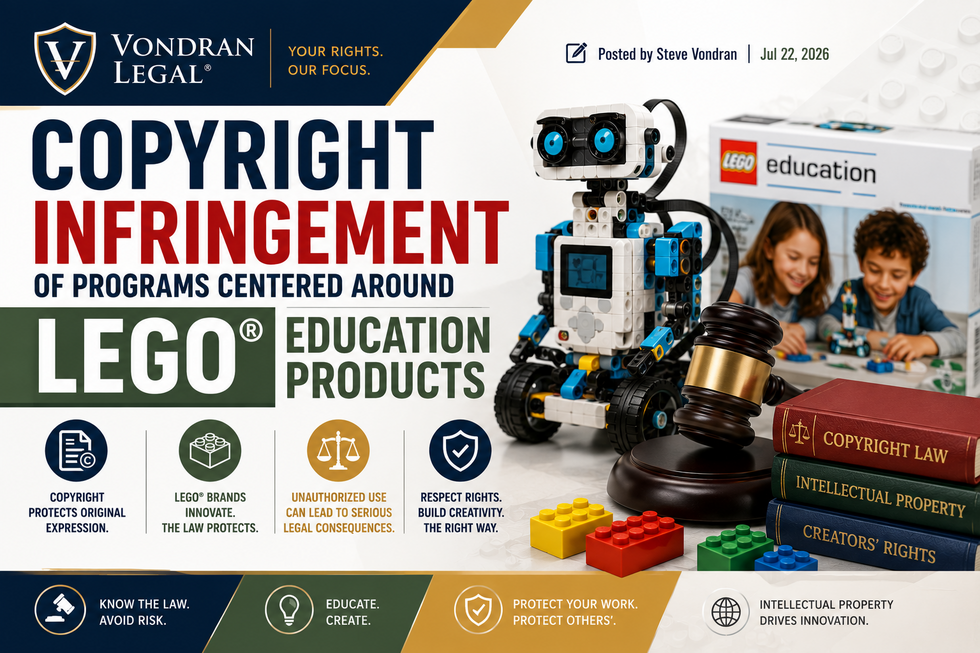
The plaintiff worked as the STEM Director for Red Crayon Inc., a company providing educational programs centered around LEGO® Education products.
As part of his consulting relationship with the company, the plaintiff developed six original Quick Reference Guides designed to help instructors and franchisees understand how to assemble, organize, and effectively teach using LEGO Education kits.
These were not LEGO manuals copied from LEGO itself.
Instead, they were independently authored instructional materials explaining how to use LEGO educational products in a classroom environment.
Eventually, the relationship between the parties deteriorated.
According to the lawsuit:
- invoices allegedly went unpaid;
- communications broke down;
- the consulting relationship ended; and
- the company allegedly continued using and distributing the guides throughout its franchise network without the plaintiff's authorization.
The plaintiff then filed a copyright infringement action.
The Initial Default Judgment Was Denied
One interesting procedural aspect of the case is that the plaintiff did not win immediately.
Because the defendant failed to defend the lawsuit, the plaintiff sought a default judgment.
However, the Federal Court initially refused to grant judgment because the evidentiary record contained deficiencies regarding matters such as proof of service and evidence supporting the infringement claim.
Rather than abandoning the case, the plaintiff corrected those issues and renewed the motion with stronger evidence.
Only then did the court enter judgment.
This serves as an important reminder that default judgments are not automatic simply because the defendant fails to appear.
The plaintiff must still prove the elements of the claim.
The Legal Issues Before the Court
The court addressed several important copyright questions.
Issue One
Who owned the copyright?
The central issue was whether the plaintiff retained ownership of the instructional guides or whether ownership had somehow transferred to Red Crayon.
Issue Two
Did the company infringe the copyrights?
The court examined whether continuing to distribute and use the guides after the consulting relationship ended constituted copyright infringement.
Issue Three
What damages should be awarded?
After determining infringement occurred, the court had to determine appropriate monetary compensation.
The Court's Holding
The Federal Court ruled in favor of the plaintiff.
Among other things, the court concluded:
- the plaintiff owned the copyrights in the six instructional guides;
- the guides were original copyrightable works;
- Red Crayon continued using the works after authorization had ended; and
- damages totaling approximately CAD $78,000 were appropriate.
Why the Court Ruled for the Plaintiff
Several legal principles drove the court's decision.
1. Original Educational Materials Receive Copyright Protection
Many people mistakenly believe only books, music, movies, and photographs receive copyright protection.
That is incorrect.
Copyright also protects original expression found in:
- employee manuals
- training manuals
- software documentation
- engineering guides
- educational curricula
- instructional videos
- classroom materials
- quick-reference guides
- charts
- diagrams
- presentations
- technical writing
Although the underlying concepts or teaching methods may remain unprotected ideas, the author's unique expression is protected.
The court found the plaintiff's guides reflected sufficient originality.
2. Paying Someone Does Not Automatically Transfer Copyright
Perhaps the most significant lesson involves ownership.
Businesses frequently hire:
- consultants
- independent contractors
- instructional designers
- curriculum developers
- engineers
- software trainers
- freelance writers
Many assume payment automatically conveys ownership.
It usually does not.
Instead, absent a valid written assignment or an applicable statutory exception, the creator generally retains copyright ownership.
That principle appears to have played a major role in this case.
3. Continuing to Use the Materials After Authorization Ends Can Constitute Infringement
Even if a company initially had permission to use copyrighted materials during an active consulting relationship, that authorization may terminate when the contractual relationship ends.
Continuing to reproduce or distribute those materials afterward may constitute infringement unless the agreement expressly provides otherwise.
That appears to be exactly what happened here.
The Damages Award
The court ultimately awarded approximately CAD $78,000.
While publicly available summaries do not fully explain each component of the damages calculation, the award reflects the court's conclusion that the unauthorized continued use of the plaintiff's educational materials warranted substantial compensation.
The decision illustrates that instructional content can possess significant commercial value.
Why This Case Matters Beyond LEGO®
Although LEGO Education products were involved, this lawsuit was not about LEGO owning copyrights.
Instead, it concerned the independent copyrights owned by the consultant who created original educational materials explaining how to use LEGO products.
The broader lesson applies across countless industries.
Examples include:
- software training manuals
- AI prompt libraries
- cybersecurity documentation
- CAD software guides
- engineering procedures
- medical protocols
- franchise operating manuals
- employee onboarding materials
- certification programs
- online courses
- educational videos
Every one of these works may enjoy copyright protection.
Comparison to United States Copyright Law
Although this decision arose under Canadian law, many of the same concepts exist in the United States.
Under the U.S. Copyright Act:
- Copyright arises automatically upon creation of an original work fixed in a tangible medium.
- Independent contractors generally own the copyrights they create unless ownership is transferred by a valid written agreement or the work qualifies as a statutory "work made for hire."
- A copyright assignment generally must be in writing and signed by the copyright owner. See 17 U.S.C. § 204(a).
- Copyright registration is generally required before filing an infringement action in federal court, and timely registration can significantly affect the availability of statutory damages and attorney's fees under 17 U.S.C. §§ 412, 504, and 505.
For U.S. businesses, relying on an assumption that payment equals ownership can create costly legal exposure.
Practical Lessons for Consultants
If you create educational or technical materials for clients:
Use written contracts.
Clearly state who owns the copyrights.
Specify license rights.
If your client may continue using the materials after the engagement ends, define exactly what those rights are.
Register valuable works.
In the United States, timely copyright registration provides significant litigation advantages.
Maintain evidence of authorship.
Keep drafts, working files, emails, and revision histories showing your creative contributions.
Practical Lessons for Businesses
If you hire outside professionals:
Obtain written copyright assignments.
Do not assume payment transfers ownership.
Review existing consultant agreements.
Many businesses discover years later that they never acquired copyrights to important training materials.
Understand termination provisions.
Determine whether your license to use the materials survives termination.
Conduct intellectual property audits.
Review manuals, documentation, training videos, presentations, and online learning materials to ensure your company possesses the rights it believes it owns.
Frequently Asked Questions
Does paying a consultant automatically transfer copyright ownership?
Generally, no. In both Canada and the United States, copyright ownership typically remains with the creator unless ownership is transferred through a valid written agreement or another applicable legal doctrine applies.
Are instructional manuals protected by copyright?
Yes. Original text, graphics, illustrations, charts, organization, and other expressive elements are generally protected, although underlying ideas, systems, and methods are not.
Can a company continue using training materials after terminating a consultant?
It depends entirely on the parties' agreement. If the consultant retained ownership and the license ended with the engagement, continued use may constitute copyright infringement.
Can internal business documents be copyrighted?
Absolutely. Employee manuals, engineering documents, onboarding materials, software guides, and technical documentation frequently qualify for copyright protection.
Final Thoughts
The Federal Court's decision in Rayman v. Red Crayon Inc. is a powerful reminder that valuable intellectual property often exists in places businesses overlook. Educational guides, training manuals, technical documentation, and instructional content can represent substantial creative investment—and they deserve careful legal protection.
The case also underscores a recurring issue in intellectual property law: ownership cannot be assumed. Whether you are a consultant creating proprietary materials or a company commissioning them, the rights to those works should be clearly addressed in a written agreement before the relationship begins. Waiting until a dispute arises is often too late.
For consultants, the decision highlights the importance of preserving authorship evidence, registering valuable works where appropriate, and carefully defining licensing terms. For businesses, it demonstrates why intellectual property due diligence—including reviewing consultant agreements and confirming ownership of key content—is an essential part of risk management.
As instructional content, online training, AI-assisted educational materials, and digital learning platforms continue to grow in value, disputes over ownership are likely to become more common. A well-drafted contract today can prevent costly litigation tomorrow.
Need Help with Copyright Ownership or Copyright Infringement?
Vondran Legal® represents businesses, consultants, software developers, educators, photographers, authors, engineers, designers, and content creators in copyright disputes throughout the United States.
Our firm handles matters involving:
- Copyright ownership disputes
- Work-made-for-hire and independent contractor agreements
- Copyright infringement litigation
- Copyright registration strategy
- Software documentation and technical manuals
- Employee and consultant intellectual property agreements
- Licensing and assignment agreements
- DMCA takedown notices and counter-notices
To learn more about our copyright litigation and counseling services, contact Attorney Steve® at Vondran Legal® for a confidential consultation.

