
Vondran Legal® California Music Lawyer. Tips to show off your musical skills without getting sued. Cover Songs & the Law.
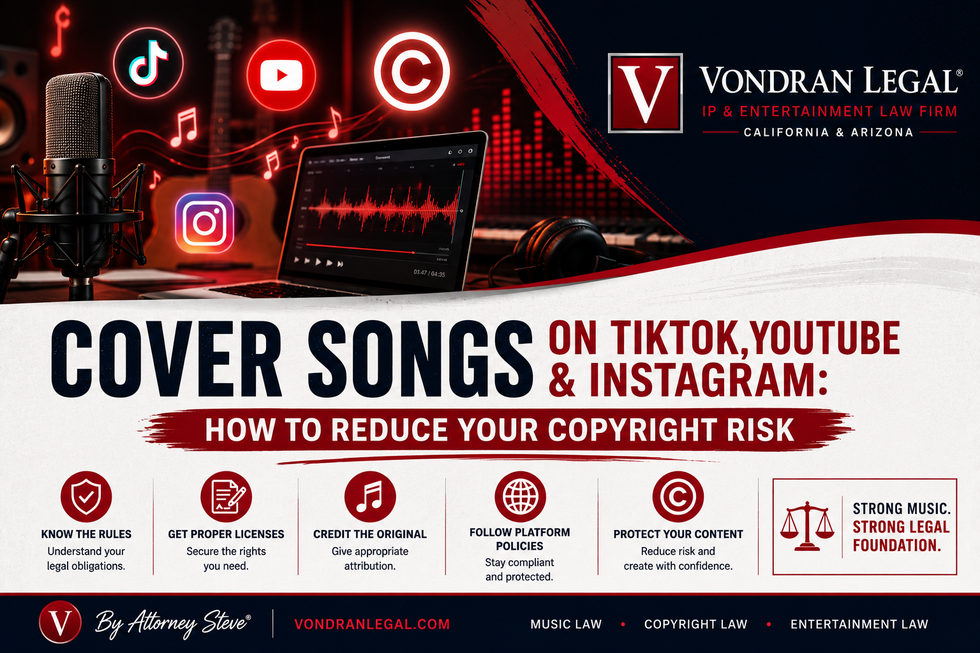
By Attorney Steve® | Vondran Legal® | Music Law • Copyright Law • Entertainment Law
"Everybody's posting cover songs. Does that mean it's legal?"
Not necessarily.
Every day, thousands of musicians upload acoustic covers, piano covers, guitar covers, karaoke performances, vocal performances, and full-band renditions to YouTube, TikTok, Instagram, Facebook, and other social media platforms.
Many stay online for years.
Others disappear overnight after receiving a DMCA takedown notice or copyright claim.
So how can creators reduce their legal risk?
Let's look at some practical considerations.
First: There Is No Universal "Cover Song Exception"
One of the biggest myths on the Internet is:
"If it's just a cover song, you don't need permission."
That statement is too broad.
Copyright law protects musical compositions, and various rights may be implicated depending on how a cover is recorded, synchronized with video, distributed, monetized, or otherwise exploited.
Different platforms also have different licensing arrangements.
The legal analysis is often far more complicated than social media comments suggest.
Why Are So Many Cover Songs Allowed?
Many social media platforms have entered into licensing agreements with music publishers, record labels, or collecting societies.
These agreements may allow certain uses of music on those platforms under specific terms.
However:
those licenses may not cover every situation.
Important variables include:
-
commercial use
-
advertising
-
sponsorships
-
synchronization with video
-
geographic restrictions
-
monetization
-
platform policies
The existence of music on a platform does not necessarily mean every upload is fully licensed.
Best Practices to Reduce Copyright Risk
While no checklist can eliminate all legal risk, these practices may help reduce the likelihood of copyright problems.
1. Use the Platform's Licensed Music Library
If TikTok, Instagram, or YouTube offers music through its licensed music catalog, using those tools is generally safer than uploading your own unauthorized recording of someone else's work.
Always review the platform's current terms.
2. Don't Assume "Everyone Else Does It"
Millions of videos remain online for reasons that may have nothing to do with legality.
Some are licensed.
Some haven't been detected.
Some rights holders simply choose not to enforce.
Don't assume another creator's video establishes what is lawful.
3. Avoid Using the Original Master Recording
Using the artist's original recording generally presents different legal issues than creating your own independent performance.
Many copyright claims arise because users incorporate commercially released recordings into their videos.
4. Create Your Own Performance
Recording your own vocals and instrumentation may reduce certain risks associated with using someone else's sound recording, but it does not automatically eliminate copyright issues involving the underlying musical composition.
5. Don't Claim the Song Is Yours
Always identify the original songwriter or recording artist where appropriate.
Giving credit does not create a legal defense, but falsely claiming authorship may create additional problems.
6. Be Careful with Monetization
Commercial exploitation often receives greater scrutiny.
Ask yourself:
-
Is this sponsored?
-
Am I selling merchandise?
-
Is this generating advertising revenue?
-
Is it promoting my business?
Commercial use may increase the likelihood of enforcement.
7. Avoid Posting Full Albums or Numerous Songs by the Same Artist
Uploading an entire catalog—or repeatedly posting works from the same artist—may attract greater attention from copyright owners and automated detection systems.
8. Understand YouTube's Content ID System
Many uploads are detected automatically.
Possible outcomes include:
-
monetization redirected to the copyright owner
-
geographic blocking
-
muted audio
-
tracking
-
removal
-
copyright strikes
A Content ID claim is different from a DMCA takedown, and creators should understand the distinction before responding.
9. Read the Platform's Copyright Policies
TikTok.
Instagram.
Facebook.
YouTube.
Each platform has its own copyright procedures, dispute process, and repeat-infringer policies.
Knowing the rules can help you respond appropriately if a claim arises.
10. When in Doubt, Seek Permission
Obtaining the appropriate license may be the safest option for commercial projects or important releases.
While licensing is not always practical, asking first can often prevent disputes later.
Common Copyright Myths
"I Gave Credit."
Giving credit is courteous.
It is not, by itself, a defense to copyright infringement.
"I Only Used 30 Seconds."
There is no automatic "30-second rule."
The amount used is only one factor that may be relevant in certain legal analyses.
"I'm Not Making Money."
Noncommercial use does not automatically eliminate infringement risk.
"It's Fair Use."
Fair use is a fact-specific legal doctrine.
Whether a particular cover song qualifies depends on the circumstances and cannot be determined by a single rule of thumb.
"It's Educational."
Simply labeling a video "educational" does not automatically make it fair use.
Courts examine what actually occurred, not merely the title of the video.
Are Some Artists More Aggressive Than Others?
There is no official list of artists whose songs you should avoid.
That said, industry observers have long noted that some artists, estates, publishers, and music companies have reputations for actively protecting their intellectual property.
Examples frequently mentioned over the years include organizations associated with:
-
The Eagles
-
The Prince Estate
-
Metallica
-
The Beatles / Apple Corps
-
Disney Music Group
-
Led Zeppelin
-
AC/DC
-
Queen
-
Pink Floyd
Large music publishers such as Universal Music Publishing, Sony Music Publishing, and Warner Chappell also administer extensive catalogs and routinely enforce copyright interests on behalf of songwriters.
This does not mean these artists always object to cover performances, nor does it mean other artists are unlikely to enforce their rights. Any copyright owner may choose to protect their works.
Inside Tips from Attorney Steve®
After years practicing intellectual property law, here are a few practical observations.
Tip #1
Don't build your entire social media business around someone else's music.
Create original content whenever possible.
Tip #2
Original music is one of your greatest business assets.
Invest in writing songs you own.
Tip #3
If you're planning a commercial release—not just casual social media posts—consult a music lawyer before launch.
Tip #4
Keep excellent records.
If you wrote the arrangement, changed the instrumentation, or collaborated with others, preserve drafts, project files, and communications.
Tip #5
If you receive a copyright claim, don't panic.
Not every claim requires litigation, and not every claim should be ignored. Evaluate the notice carefully before deciding how to respond.
Frequently Asked Questions
Can I legally post myself singing a cover song on TikTok?
It depends on several factors, including the platform's licensing arrangements, the nature of your use, and whether your video complies with the platform's policies. There is no universal rule that makes all cover-song uploads lawful.
Can YouTube remove my cover song?
Yes. Depending on the circumstances, your video may be claimed through Content ID, blocked, monetized by the rights holder, muted, or removed following a copyright complaint.
Does changing the key make it legal?
No. Musical changes alone generally do not eliminate copyright protection for the underlying composition.
Does adding a disclaimer protect me?
No. A disclaimer by itself does not create permission or a legal defense.
Is getting permission always required?
The answer depends on the nature of the project, the rights involved, and any applicable licenses already in place. For significant commercial uses, obtaining the appropriate permissions is often the most prudent course.
How Vondran Legal® Can Help
At Vondran Legal®, P.C., we advise musicians, creators, influencers, producers, and entertainment professionals on copyright compliance, licensing, fair use, publishing, and music-related disputes.
Our services include:
-
Copyright counseling
-
Music licensing guidance
-
Fair use evaluations
-
Copyright registration
-
DMCA takedown and counter-notice matters
-
Entertainment contract review
-
Copyright infringement defense
-
Music publishing issues
-
Creator legal compliance
Whether you're launching a YouTube channel, growing on TikTok, or building a music career, proactive legal advice can often help you reduce risk while protecting your own creative work.
The smartest creators don't just create content—they understand the copyright rules that govern it.

