
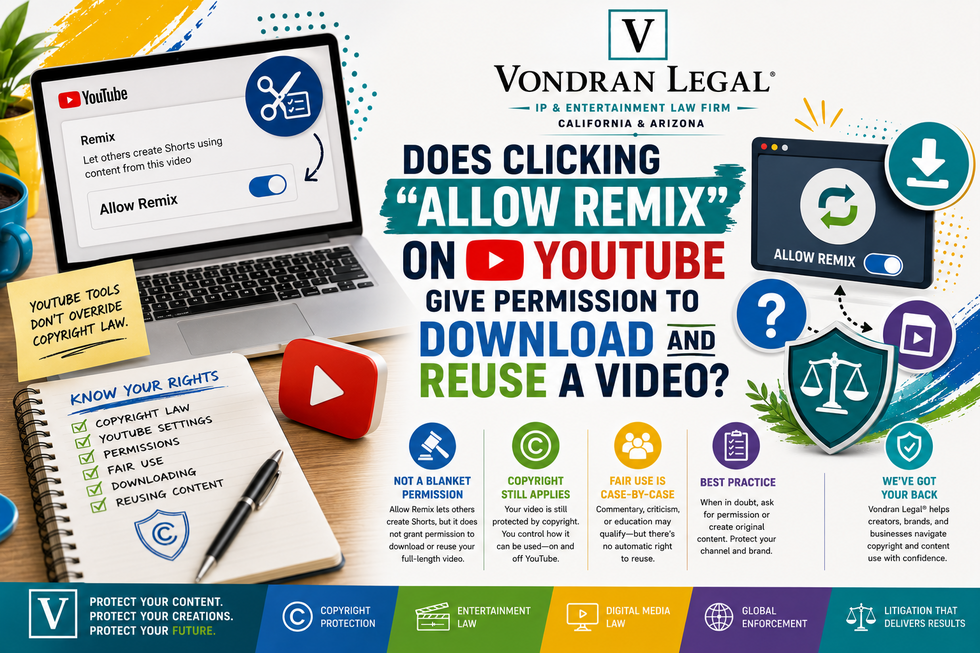
A Copyright Lawyer Explains
Keywords: YouTube Remix copyright, Allow Remix legal meaning, YouTube remix copyright infringement, YouTube fair use lawyer, implied license copyright, download YouTube video legal, remix vs download copyright, YouTube copyright defense
Artificial intelligence, reaction videos, podcasts, and YouTube Shorts have made "remixing" one of the most common forms of online content creation. But an important legal question has emerged:
If a YouTube creator checks the "Allow Remix" box, have they legally consented to others using their video?
Even more importantly:
Does allowing remixing also authorize someone to download the video with third-party software, edit it offline, and reupload it?
As of today, there appears to be no reported federal appellate decision squarely answering these questions. That makes this one of the more interesting—and unsettled—areas of modern copyright law.
Let's take a closer look.
What Does "Allow Remix" Actually Mean?
YouTube allows creators to decide whether their videos can be remixed into Shorts.
When a creator enables remixing, YouTube permits other users to create derivative Shorts using built-in tools such as:
- Cut
- Green Screen
- Collab
- Use Audio
- AI-powered Remix tools
- Other authorized Shorts creation tools
According to YouTube's Help Center, creators can later revoke remix permissions, and existing remixes may even be removed if remixing is disabled or the original video is deleted. YouTube also expressly distinguishes remixes created with its own tools from videos created outside those tools.
That distinction may become legally significant.
Remixing Inside YouTube vs. Downloading Outside YouTube
These are two very different situations.
Scenario One: Built-In YouTube Remix
Suppose you:
- click "Remix,"
- use YouTube's editing tools,
- publish the Short directly through YouTube.
This is almost certainly the situation YouTube contemplated.
The creator voluntarily enabled remixing.
YouTube provides the technology.
The resulting Short links back to the original video.
Everything occurs within YouTube's licensing ecosystem.
In this scenario, a copyright owner would likely have difficulty arguing that the remixer lacked permission.
Scenario Two: Downloading the Video First
Now consider something different.
A user:
- downloads the video using a third-party downloader,
- edits it in Premiere Pro, Final Cut, DaVinci Resolve, or CapCut,
- uploads the finished video as a new work.
This raises a different legal question.
Downloading creates a reproduction of the copyrighted work.
Editing creates another copy.
Uploading creates additional copies and distributions.
The copyright owner may argue:
"I allowed remixing through YouTube—not unrestricted downloading of my copyrighted work."
That is a substantially stronger copyright argument.
Is There Any Case Law?
Surprisingly, there appears to be no published federal appellate decision specifically addressing whether enabling YouTube's "Allow Remix" feature creates a copyright license for offline downloading and editing.
There are no Ninth Circuit, Federal Circuit, or Supreme Court decisions directly interpreting the legal effect of YouTube's remix permission.
Instead, courts would likely analyze the issue using traditional copyright doctrines.
The Implied License Doctrine
One possible defense is the doctrine of implied nonexclusive license.
Federal courts have long recognized that copyright owners may grant permission through their conduct—even without signing a formal written license.
Some of the leading cases include:
- Effects Associates, Inc. v. Cohen, 908 F.2d 555 (9th Cir. 1990)
- Foad Consulting Group, Inc. v. Azzalino, 270 F.3d 821 (9th Cir. 2001)
- Asset Marketing Systems, Inc. v. Gagnon, 542 F.3d 748 (9th Cir. 2008)
These cases establish that permission can sometimes arise from the parties' conduct rather than from an express written agreement.
Although none of these cases involve YouTube, they provide the legal framework a court would likely use.
Could "Allow Remix" Create an Implied License?
This is where things become interesting.
A defendant might argue:
"The creator affirmatively invited people to remix the video."
The defendant reasonably relied on that invitation.
The defendant created exactly the type of derivative work the creator authorized.
The only difference was that the editing occurred outside YouTube instead of inside YouTube.
That becomes a scope-of-license question.
The plaintiff says:
"I licensed remixing only through YouTube."
The defendant says:
"You licensed remixing generally."
There is currently no reported appellate opinion resolving this dispute.
Copyright Estoppel May Also Apply
Another possible defense is equitable estoppel.
Copyright estoppel generally requires proof that:
- the copyright owner made representations or engaged in conduct,
- the defendant reasonably relied upon those representations,
- the defendant changed position because of that reliance.
If a creator publicly enables remixing and another creator relies on that permission, a defendant may argue that the copyright owner should not later claim infringement for the very conduct they encouraged.
Whether estoppel applies will depend heavily on the specific facts.
Does Downloading Automatically Defeat the Defense?
Not necessarily.
Downloading may exceed the scope of YouTube's platform permissions.
But that does not automatically eliminate every defense.
The defendant may still argue:
- implied license,
- equitable estoppel,
- lack of damages,
- fair use,
- or that the remix was substantially transformative.
Each defense depends on the particular facts.
What About Fair Use?
Fair use is a completely separate legal doctrine.
Unlike consent or license, fair use does not require permission.
Under 17 U.S.C. § 107, courts evaluate:
- Purpose and character of the use
- Nature of the copyrighted work
- Amount used
- Effect upon the market
If the remixed video:
- comments on the original,
- criticizes it,
- educates viewers,
- parodies it,
- transforms its meaning,
the defendant may have a viable fair use defense even if the work was downloaded before editing. Whether downloading occurred is relevant to the facts but does not, by itself, determine the fair use analysis. YouTube likewise notes that fair use is a legal doctrine decided by courts on a case-by-case basis and that using content outside YouTube's creation tools may still trigger Content ID claims or takedowns.
What If the Video Was Just Reuploaded?
The analysis changes considerably.
If someone simply:
- downloads the video,
- removes the YouTube branding,
- reuploads substantially the same work,
the implied license argument becomes much weaker.
Likewise, fair use is less likely to succeed where there is little or no new expression, commentary, criticism, or transformation.
The more a new work resembles a straightforward repost, the greater the infringement risk.
Practical Questions Every Copyright Lawyer Should Ask
Whenever a remix dispute arises, important questions include:
- Was "Allow Remix" enabled?
- When was it enabled?
- Was the remix created using YouTube's built-in tools?
- Was the video downloaded?
- How transformative was the new work?
- Was commentary added?
- Was it monetized?
- Was the original work registered with the U.S. Copyright Office before the alleged infringement?
- Did the remix compete with the original work?
These facts can significantly affect both liability and damages.
Practical Takeaways
The law in this area is still developing.
Today, several conclusions appear reasonable:
- Enabling YouTube's Remix feature likely grants permission for remixes created through YouTube's authorized tools.
- That permission does not necessarily extend to downloading videos using third-party software.
- There is currently no published federal appellate decision directly deciding whether "Allow Remix" creates an implied copyright license for offline editing and redistribution.
- Traditional doctrines—including implied license, equitable estoppel, and fair use—may still provide substantial defenses depending on the facts.
- Each dispute should be evaluated individually, taking into account YouTube's platform permissions, the creator's conduct, the nature of the remix, and the extent of any transformation.
As YouTube, AI-assisted editing tools, and social media continue to evolve, courts will likely be asked to define the legal boundaries between platform-authorized remixing and copyright infringement. Until then, creators and copyright owners alike should recognize that the "Allow Remix" setting may carry legal consequences that extend beyond YouTube's user interface—but precisely how far those consequences reach remains an open question.
Need Help With a YouTube Copyright or Fair Use Dispute?
Whether you are a content creator, YouTuber, filmmaker, influencer, photographer, or business facing a copyright demand letter, Vondran Legal can help evaluate potential defenses, including implied license, fair use, copyright registration issues, damages, and platform-specific consent arguments. Because this area of law is rapidly evolving, careful analysis of the facts, the Copyright Act, YouTube's policies, and applicable case law is essential before deciding whether to pursue or defend a copyright claim.

