
Vondran Legal Copyright Fair Use Updates 2026: How Courts Are Redefining Copyright for the AI Revolution
By Attorney Steve® | Vondran Legal®
Artificial intelligence has triggered one of the most significant copyright debates since the arrival of the internet.
For decades, courts have applied the doctrine of fair use to technologies ranging from photocopiers and VCRs to search engines and software reverse engineering. Today, judges are confronting a much larger question:
Does fair use permit AI companies to copy millions of copyrighted works to train generative AI models?
The answer is becoming clearer—but not necessarily simpler.
Recent federal court decisions involving OpenAI, Anthropic, Meta, Thomson Reuters, and other companies suggest that copyright law is entering a new phase. While many courts appear receptive to applying fair use to AI training, they are simultaneously signaling that AI-generated outputs, market substitution, and licensing issues may shape the next generation of copyright litigation.
For businesses, creators, publishers, software companies, and AI developers, understanding where the law is heading has never been more important.
What Is Fair Use?
Fair use is one of the most important doctrines in American copyright law.
Codified in 17 U.S.C. § 107, it permits certain unauthorized uses of copyrighted works when those uses advance broader societal interests such as:
- Education
- Research
- Scholarship
- Criticism
- Commentary
- News reporting
- Technological innovation
Fair use is intentionally flexible.
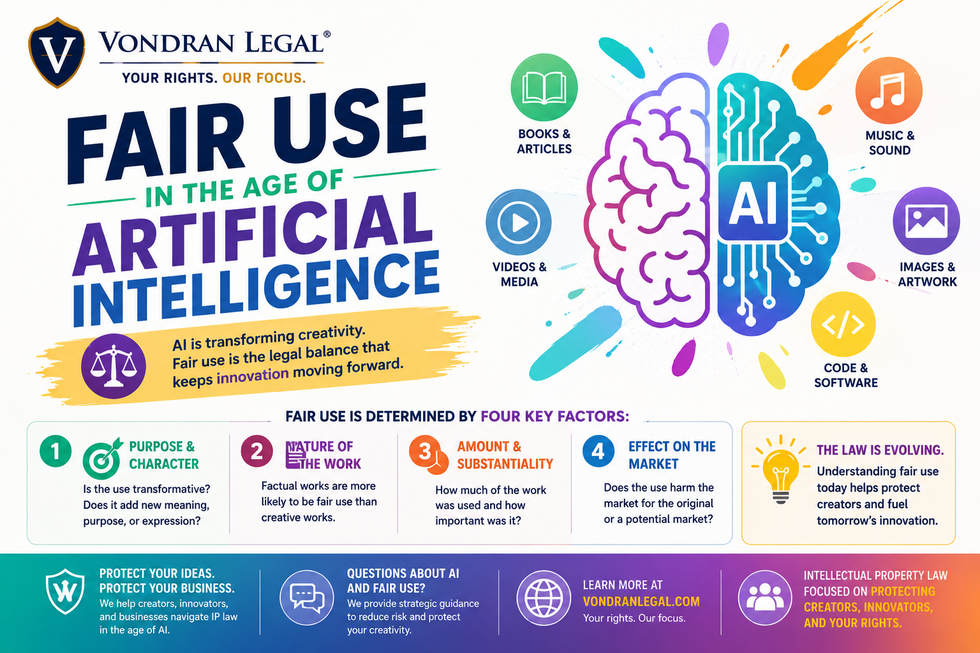
Rather than establishing bright-line rules, Congress instructed courts to evaluate four statutory factors.
Those four factors have become the legal framework for nearly every major AI copyright lawsuit.
Why AI Has Put Fair Use Under the Microscope
Modern generative AI systems—including large language models—require enormous datasets.
Training may involve billions of words gathered from:
- Books
- Newspapers
- Academic journals
- Websites
- Software code
- Images
- Photographs
- Public repositories
Obtaining licenses from every copyright owner would often be practically impossible.
As a result, many AI developers trained their models using publicly available—but copyrighted—materials.
That decision sparked dozens of lawsuits.
Unlike earlier copyright disputes involving isolated acts of copying, AI cases involve copying at an unprecedented scale.
Courts are now being asked whether existing copyright principles are flexible enough to accommodate this technological revolution.
The Four Fair Use Factors Applied to AI
1. Purpose and Character of the Use
This has emerged as the most important factor.
Courts ask a simple question:
Did the AI create something fundamentally different from the original works?
Lawyers call this transformative use.
If AI merely reproduces copyrighted material, fair use becomes much harder to establish.
If AI instead learns statistical relationships and generates entirely new expression, courts have generally been more receptive.
For example, in Bartz v. Anthropic, the Northern District of California concluded that Anthropic's use of copyrighted books to train Claude was highly transformative because the model learned language patterns rather than distributing the books themselves.
The court compared AI learning to how humans read books, absorb ideas, and later create original works.
That analogy may become one of the defining themes of future AI copyright law.
2. Nature of the Copyrighted Work
Not all copyrighted works receive identical treatment.
Creative works such as:
- novels,
- paintings,
- photographs,
- films,
- music,
typically receive stronger protection than factual or functional works.
This factor may become especially important as AI expands beyond books into industries such as:
- software engineering,
- medical research,
- engineering,
- legal research,
- financial analysis.
3. Amount and Substantiality
Historically, courts examined how much of a copyrighted work was copied.
AI changes that analysis.
Training often requires copying entire works.
Several courts have recognized that copying an entire work does not automatically defeat fair use when complete copying is technologically necessary.
This principle previously appeared in:
- Sony v. Connectix
- Sega v. Accolade
- Authors Guild v. Google
AI developers increasingly rely upon these cases.
4. Market Effect
Perhaps the most unpredictable factor is market harm.
Traditionally, courts asked whether copying reduced sales of the original work.
AI introduces entirely new questions.
For example:
- Does AI reduce demand for original journalism?
- Does AI replace textbook sales?
- Does AI substitute for software documentation?
- Does AI eliminate demand for licensing creative works?
- Does AI generate competing books, music, or artwork?
The answers remain uncertain.
The Most Important AI Cases So Far
Several recent decisions are beginning to define the legal landscape.
Bartz v. Anthropic
One of the first major AI training decisions.
The court concluded that using copyrighted books to train an AI model could constitute fair use because the resulting outputs were highly transformative.
This decision was widely viewed as a significant victory for AI developers.
Kadrey v. Meta Platforms
The court likewise found insufficient evidence of market harm on the record before it.
However, Judge Chhabria raised an intriguing possibility.
Even if AI does not reproduce copyrighted works directly, future plaintiffs may be able to show that AI-generated content competes economically with original creative works.
That observation may become one of the most important developments in AI copyright litigation.
Thomson Reuters v. Ross Intelligence
This case serves as an important reminder that fair use has limits.
Ross copied Westlaw headnotes while building a competing legal research platform.
The court rejected the fair-use defense because the copied material functioned as a commercial substitute rather than a transformative use.
The lesson:
Not every AI-related use qualifies as fair use.
The Next Wave of AI Copyright Litigation
The first generation of lawsuits focused on training.
The next generation may focus on outputs.
Increasingly, courts may ask questions such as:
- Did the AI reproduce protected expression?
- Did it summarize copyrighted works too closely?
- Did it reveal paywalled content?
- Did it generate market substitutes?
- Did it interfere with licensing opportunities?
This transition is already becoming visible in litigation involving AI-powered search engines and Retrieval-Augmented Generation (RAG) systems.
Instead of asking:
What data trained the model?
Courts may increasingly ask:
What did the AI actually deliver to users?
That distinction could fundamentally reshape AI copyright law.
Will Fair Use Evolve?
Perhaps.
Historically, fair use has adapted to every major technological disruption.
Consider:
Photocopiers
Initially controversial.
Now commonplace.
VCRs
Studios predicted disaster.
The Supreme Court recognized time-shifting as fair use in Sony Corp. of America v. Universal City Studios.
Search Engines
Google copied billions of webpages.
Courts recognized enormous public benefits while imposing reasonable limits.
Artificial intelligence presents an even bigger challenge.
Unlike prior technologies, AI does not merely copy.
It analyzes.
Synthesizes.
Predicts.
Generates.
Collaborates.
Those characteristics may require courts to refine traditional fair-use analysis without abandoning its core principles.
Rather than creating an entirely new doctrine, judges may gradually reinterpret existing factors to address technologies Congress never imagined in 1976.
What Could the Future Look Like?
Several developments seem increasingly likely.
Greater Focus on AI Outputs
Courts may spend less time examining datasets and more time evaluating AI responses.
Increased Emphasis on Market Substitution
Economic competition—not merely copying—may become the dominant issue.
More Licensing Markets
Publishers are already negotiating AI licensing agreements.
Private contracts may increasingly supplement copyright law.
Technical Safeguards
Developers may implement:
- output filters,
- quotation limits,
- attribution systems,
- provenance tracking,
- retrieval controls,
- content watermarking.
These measures may influence future fair-use analyses by demonstrating responsible AI governance.
Industry Standards
As happened with software licensing, DMCA compliance, and online copyright enforcement, voluntary industry standards may emerge long before Congress enacts comprehensive AI legislation.
Practical Tips for AI Developers
Organizations deploying AI should consider:
- Conducting copyright risk assessments before training models.
- Reviewing dataset provenance and licensing restrictions.
- Implementing policies limiting verbatim reproduction.
- Monitoring AI outputs for copyrighted material.
- Establishing governance programs for enterprise AI.
- Keeping records demonstrating good-faith compliance.
- Evaluating contractual restrictions separately from copyright law.
- Consulting experienced intellectual property counsel before commercial deployment.
Legal compliance should become part of every AI development lifecycle.
Key Takeaways
The law governing AI and copyright is evolving faster than almost any other area of intellectual property law.
Several important themes are already emerging:
- Fair use remains the primary legal defense for AI training, but it is highly fact-specific.
- Transformative use continues to be the cornerstone of modern fair-use analysis.
- Market substitution may become the most influential issue in future AI litigation.
- Courts are beginning to distinguish between AI training and AI outputs, with output-focused cases likely to increase.
- Licensing markets for AI training data will continue to expand, even where fair use may ultimately apply.
- Businesses deploying generative AI should adopt governance, compliance, and output-control policies now, rather than waiting for definitive appellate guidance.
- Congress may eventually revisit the Copyright Act, but until then, federal courts will continue to shape the law case by case.
Final Thoughts
Artificial intelligence represents both an extraordinary technological breakthrough and one of the greatest legal challenges copyright law has faced in decades. The doctrine of fair use—long celebrated for its flexibility—will almost certainly remain at the center of that debate. Yet the questions judges are asking are changing. The conversation is moving beyond whether copyrighted works can be used to train AI models and toward whether AI systems can compete with, summarize, or replace the very works that helped make them possible.
For creators, publishers, software companies, AI developers, and businesses deploying enterprise AI, the lesson is clear: fair use is not a static doctrine. It has evolved alongside every major technological innovation, and it is likely to continue evolving as courts balance the Copyright Act's twin objectives of rewarding creativity while promoting innovation.
Those organizations that understand both the legal risks and the emerging judicial trends will be best positioned to innovate responsibly in the rapidly changing world of artificial intelligence.

