
VARA abd the Dallas Whale Mural: Understanding the Visual Artists Rights Act (VARA)
By Vondran Legal® – Copyright & Intellectual Property Attorneys
When most people think about copyright law, they think about copying photographs, music, movies, books, or software. Few realize that federal copyright law also protects an artist's personal rights in certain original works of visual art.
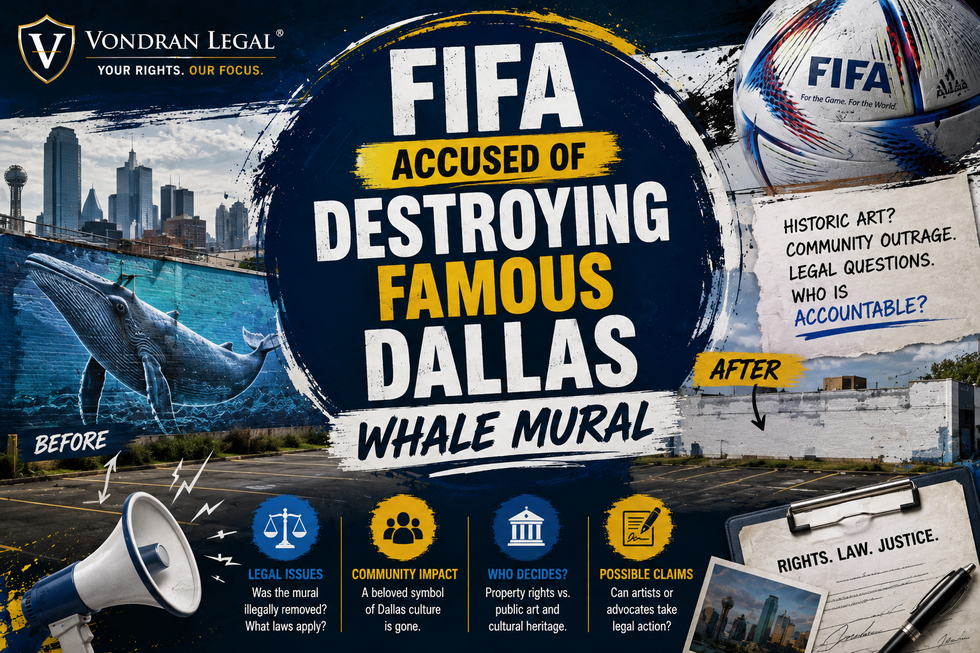
That is exactly what happened when internationally known marine artist Robert Wyland sued FIFA after workers allegedly painted over his famous Dallas "Whaling Wall" mural in preparation for the 2026 FIFA World Cup festivities.
The lawsuit has thrust one of the least understood provisions of the Copyright Act—the Visual Artists Rights Act (VARA)—into the spotlight.
The Case
Wyland v. FIFA
United States District Court, Northern District of Texas (2026)
Robert Wyland painted the enormous "Ocean Life" (Whaling Wall No. 82) mural on an eight-story building in downtown Dallas in 1999.
According to the complaint:
- the mural covered approximately 17,000 square feet
- it remained visible for nearly thirty years
- it became an iconic Dallas landmark
- workers allegedly painted most of it blue to prepare for FIFA World Cup artwork
- Wyland alleges he never consented to the destruction and was never notified.
Rather than bringing an ordinary copyright infringement claim, Wyland sued under VARA, alleging that FIFA and others intentionally destroyed or mutilated a work of recognized stature.
The Legal Issue
The principal legal questions include:
- Does the mural qualify as a work of recognized stature?
- Did defendants intentionally destroy or modify the artwork?
- Did any written VARA waiver exist?
- Was the building owner required to provide advance notice before altering the mural?
Those questions are likely to determine whether VARA protection applies.
The Rule
VARA is found at:
17 U.S.C. §106A
Unlike ordinary copyright law, VARA protects an artist's moral rights, including:
- the right of attribution
- the right of integrity
- protection against intentional distortion
- protection against mutilation
- protection against destruction of qualifying artwork
These rights belong to the artist personally and generally last for the artist's lifetime.
Analysis
Wyland's case appears to focus on two major arguments.
1. The mural had recognized stature.
Courts generally require evidence that the artwork has achieved recognition within the artistic community.
Evidence may include:
- museum recognition
- media coverage
- expert testimony
- awards
- historical significance
- public recognition
Wyland appears to possess substantial evidence in many of these categories.
2. The mural was intentionally destroyed.
Unlike accidental damage, painting directly over an existing mural could qualify as intentional destruction under VARA.
The case may ultimately turn on whether:
- defendants provided legally sufficient notice,
- a written waiver exists,
- removal could have been accomplished without destroying the artwork.
Conclusion
Although the lawsuit is in its early stages, it could become one of the most significant VARA decisions in recent years.
It reminds building owners, developers, municipalities, and event organizers that artwork installed on buildings may carry federal legal protections—even decades after it was created.
What Is VARA?
The Visual Artists Rights Act of 1990 ("VARA") amended the Copyright Act to recognize certain "moral rights" long protected in many European countries.
Unlike traditional copyright—which protects economic rights—VARA protects the artist's personal relationship to the artwork.
VARA generally protects:
- paintings
- drawings
- prints
- sculptures
- limited-edition photographs
provided they meet statutory requirements.
These protections exist even after ownership of the physical artwork changes.
Works That Usually Qualify Under VARA
Examples include:
- original paintings
- sculptures
- murals
- fine art prints
- limited-edition photographs
- certain commissioned public art
Works That Usually Do NOT Qualify
VARA generally excludes:
- posters
- advertising
- logos
- maps
- motion pictures
- audiovisual works
- books
- magazines
- clothing designs
- product packaging
- mass-produced merchandise
- most commercial graphics
- works made for hire
Simply being creative does not make a work eligible for VARA protection.
Five Important VARA Decisions Over the Last Twenty Years
1. Castillo v. G&M Realty (5Pointz) (2d Cir. 2020)
Perhaps the most famous VARA decision.
A New York developer whitewashed dozens of internationally recognized graffiti murals before demolition.
Result:
- approximately $6.75 million in statutory damages
- court found many murals possessed recognized stature
- established important precedent for public murals
2. Wyland v. FIFA (2026)
Potentially the next landmark VARA case.
Will likely explore:
- public murals
- major sporting events
- building-owner responsibilities
- recognized stature
The litigation remains pending.
3. Martin v. City of Indianapolis
A leading case recognizing that public sculpture may receive VARA protection where removal damages the work.
4. Cohen v. G&M Realty (related 5Pointz proceedings)
Further clarified:
- recognized stature
- expert testimony
- destruction of public artwork
5. Massachusetts Museum of Contemporary Art Foundation v. Büchel
Although involving installation art and contractual issues, the litigation significantly influenced discussions about artists' moral rights and the treatment of unfinished works under federal law.
Frequently Asked Questions About VARA
Does VARA apply automatically?
Generally yes, if the work qualifies under the statute.
Can VARA rights be sold?
No.
The physical artwork may be sold, but VARA rights remain with the artist unless expressly waived in writing.
Can VARA rights be waived?
Yes.
However, the waiver must:
- be written,
- identify the artwork,
- specifically describe the waiver.
General contract language is often insufficient.
Does every mural receive VARA protection?
No.
Many disputes center on whether the work has achieved recognized stature.
Does VARA protect buildings?
No.
VARA protects qualifying artwork—not the building itself.
Can a building owner remove artwork?
Sometimes.
The Copyright Act contains special procedures governing artwork incorporated into buildings. Notice requirements and prior written agreements may be critical.
Does VARA apply after the artist dies?
Generally no.
Most VARA rights expire upon the artist's death.
Key Takeaways from the FIFA Case
- Public murals may receive powerful federal protection.
- Property ownership does not necessarily include the right to destroy artwork.
- Written waivers matter.
- Building owners should consult counsel before altering significant artwork.
- Major sporting events and redevelopment projects can create unexpected copyright liability.
- The concept of "recognized stature" continues to evolve through litigation.
How Vondran Legal Can Help
Vondran Legal represents clients nationwide in sophisticated copyright and intellectual property matters, including:
- Copyright infringement litigation
- Copyright registration strategy
- DMCA takedown and counter-notice proceedings
- Fair use opinions
- Public art and mural disputes
- Artist rights and licensing
- Software copyright litigation
- Photography infringement defense
- Copyright audits
- Entertainment and media law
- Intellectual property licensing
- Federal copyright litigation
Whether you are an artist, property owner, developer, municipality, event organizer, or business facing a copyright dispute, experienced counsel can help evaluate your rights, negotiate resolutions, and, when necessary, litigate in federal court.
Final Thoughts
The Wyland v. FIFA lawsuit illustrates that copyright law protects more than economic interests—it also safeguards the personal and artistic integrity of certain visual works. As cities increasingly transform public spaces for redevelopment, entertainment, and global events, VARA will likely become an even more important area of intellectual property law. Artists, developers, and property owners alike should understand these protections before altering or removing significant works of public art.

