
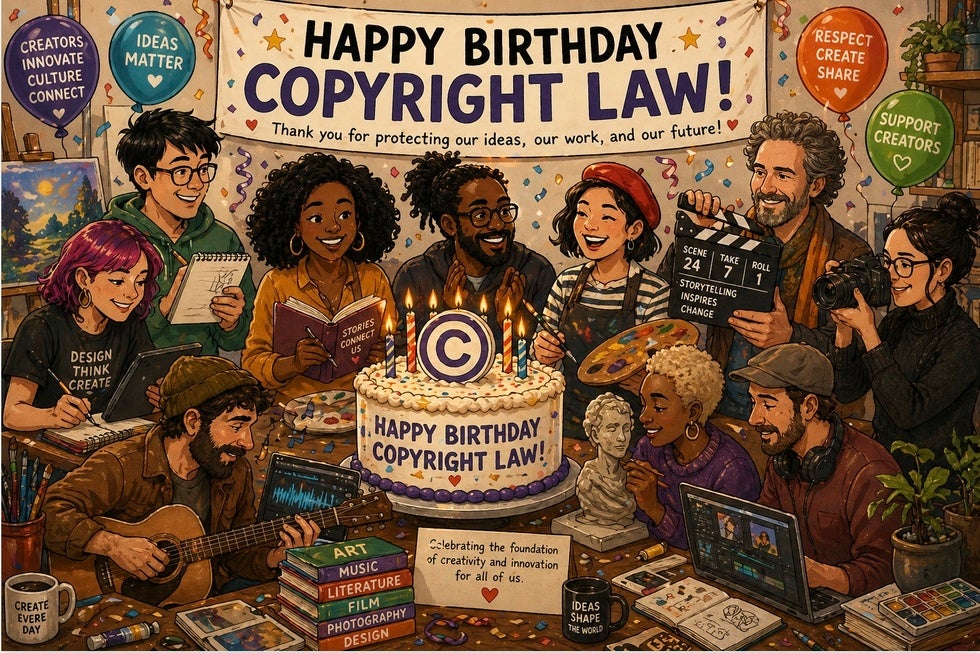
Vondran Legal® joins in celebrating the 50th anniversary of the 1976 Copyright Act!
Introduction
The year 2026 quietly marks a major milestone in American legal history: the 50th anniversary of the Copyright Act of 1976—a statute that fundamentally reshaped how creativity is protected in the United States and continues to influence global intellectual property law.
A Long Road to 1976
To understand the significance of the 1976 Act, you have to rewind nearly two centuries.
The first U.S. Copyright Act of 1790 was modest—just a few pages long—and protected only maps, charts, and books for a term of 14 years (renewable once). It reflected a young nation's desire to encourage learning, rooted directly in the Constitution's Intellectual Property Clause: “to promote the progress of science and useful arts.”
But by the early 20th century, the law was badly outdated. The 1909 Copyright Act attempted to modernize things, expanding protection to include music and other forms of expression, but it still revolved around a formalistic system: publication triggered protection, notice was mandatory, and failure to comply could result in losing rights entirely.
By the mid-1900s, cracks were everywhere:
- Television and film had exploded.
- Sound recordings raised entirely new ownership questions.
- Photocopying and emerging computer technologies challenged traditional concepts of copying.
- Internationally, the U.S. lagged behind countries adhering to the Berne Convention.
Congress began studying reform in the 1950s, and what followed was one of the longest legislative gestation periods in U.S. history—over 20 years of hearings, reports, and drafts before the final bill emerged.
The Breakthrough: The 1976 Act
When the Copyright Act of 1976 finally took effect on January 1, 1978, it was nothing short of revolutionary.
At its core, the Act shifted copyright from a rigid, publication-based system to a modern, flexible framework based on “original works of authorship fixed in a tangible medium of expression.”
That single concept did enormous work.
No longer did authors need to publish or comply with strict formalities to gain protection. The moment a work was fixed—written down, recorded, saved—it was protected.
Key Innovations That Still Define Copyright Today
1. Automatic Protection (No Formalities Required)
The Act moved away from the trap-laden system of notice and registration. While registration still carries benefits (especially for litigation), copyright now exists upon creation.
2. Expanded Subject Matter
The law explicitly recognized a wide range of works:
- Literary
- Musical
- Dramatic
- Pictorial, graphic, and sculptural
- Motion pictures and audiovisual works
- Sound recordings
- Architectural works (added later in 1990)
This flexibility allowed copyright to evolve alongside technology.
3. The Bundle of Rights (Section 106)
For the first time, the law clearly articulated the exclusive rights of copyright owners:
- Reproduction
- Distribution
- Public performance
- Public display
- Creation of derivative works
This “bundle of sticks” framework remains the backbone of copyright litigation today.
4. Fair Use Codified (Section 107)
Although courts had long recognized fair use, the 1976 Act formally codified it—providing a flexible, four-factor test that continues to govern disputes in everything from parody to AI training datasets.
5. Duration Overhaul
The Act replaced the old fixed-term system with a life-of-the-author plus 50 years (later extended to 70 years in 1998 via the Sonny Bono Act). This aligned U.S. law more closely with international standards.
6. Termination Rights (A Hidden Power Tool)
One of the most fascinating—and often overlooked—features is the ability for authors to terminate prior transfers of copyright after a set period (typically 35 years).
This provision has fueled major modern disputes involving music legends reclaiming their catalogs—proof that Congress anticipated the imbalance between creators and early contracts.
Interesting Tidbits You Might Not Know
- It almost didn't happen: The bill faced repeated delays and intense lobbying from publishers, broadcasters, educators, and emerging tech industries. Compromise was the only way it survived.
- The photocopying wars: Libraries and educators were deeply concerned about infringement liability. The result? Section 108 (library exceptions) and the fair use framework we still debate today.
- Cable TV was a battleground: The rise of cable systems led to the creation of compulsory licensing schemes—a concept that still exists in various forms (including music licensing).
- Software wasn't fully anticipated: While computers were on the horizon, the Act didn't explicitly address software. Courts later interpreted programs as “literary works,” laying the groundwork for the software industry.
- It set the stage for the digital age: Even though the internet didn't exist yet, the Act's flexible language made it adaptable. Later laws like the DMCA (1998) were layered on top rather than replacing it.
Why the 1976 Act Still Matters
Fifty years later, the 1976 Act is still the foundation of U.S. copyright law. Every major legal issue you see today—AI-generated content, streaming royalties, NFTs, social media infringement—traces back to its structure.
It struck a delicate balance:
- Encouraging creators by granting exclusive rights
- Preserving public access through limitations like fair use
That balance is under constant pressure, but the framework has proven remarkably durable.
A Living Legacy
If the 1909 Act belonged to the industrial age, the 1976 Act belongs to the information age—and beyond.
It anticipated change without knowing exactly what that change would be. That's rare in legislation.
Fifty years on, the questions remain the same, even if the technology has evolved:
- What does it mean to “copy” in a digital world?
- How do we reward creators without stifling innovation?
- Where is the line between inspiration and infringement?
The 1976 Act didn't answer these questions permanently—but it gave us the tools to keep answering them.
And that may be its greatest achievement.
Happy Birthday Copyright Law!!

