
A PRACTICAL GUIDE TO PROTECTING YOUR LEGAL CLAIM BEFORE IMPORTANT EVIDENCE DISAPPEARS
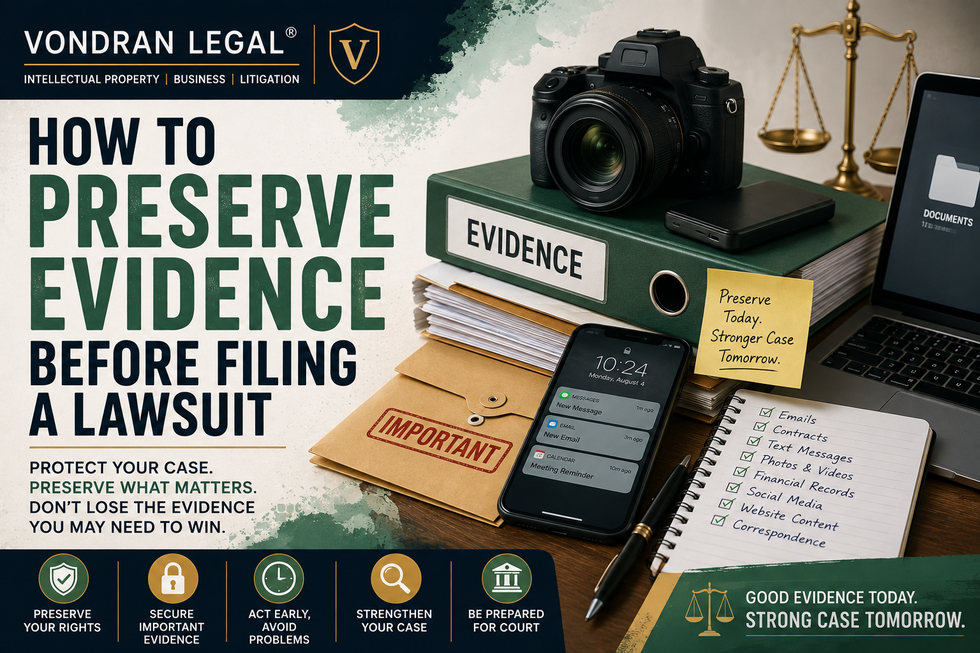
Some of the most important work in a lawsuit occurs long before a complaint is ever filed. One of the biggest mistakes individuals and businesses make is failing to preserve evidence while they are still evaluating whether litigation is appropriate.
In today's digital world, evidence can disappear surprisingly quickly. Emails are routinely deleted, text messages are overwritten, security camera footage may be erased within days, social media posts can be edited or removed, and electronic records may be lost through routine data retention policies. Once that evidence is gone, recovering it may be difficult or impossible.
Whether you are considering a copyright infringement claim, breach of contract lawsuit, trademark dispute, business tort, or other civil action, preserving relevant evidence from the outset can significantly strengthen your case. Likewise, failing to preserve evidence can make it more difficult to prove liability or damages and, in some situations, may even result in legal sanctions.
WHY EVIDENCE PRESERVATION MATTERS
Every lawsuit is built on evidence. While legal arguments are certainly important, courts ultimately decide cases based on admissible facts. Documents, photographs, contracts, invoices, emails, financial records, videos, and witness testimony often become the foundation upon which a claim succeeds or fails.
Unfortunately, many forms of evidence have a limited lifespan. Businesses frequently maintain automatic deletion policies for emails and electronic files. Messaging applications may permanently delete conversations after a certain period. Security systems commonly overwrite surveillance footage after 7, 14, or 30 days. Even websites can change overnight, making it difficult to establish what was publicly displayed on a particular date.
By the time a lawsuit is filed months later, critical evidence may no longer exist.
That is why experienced litigators often begin by identifying and preserving relevant evidence before formal litigation begins.
THE DUTY TO PRESERVE EVIDENCE
Once litigation becomes reasonably foreseeable, parties may have a legal obligation to preserve evidence relevant to the dispute. This duty generally extends beyond documents sitting in a filing cabinet. It can include electronically stored information ("ESI"), emails, text messages, cloud storage, internal communications, metadata, accounting records, and other digital information.
Destroying or failing to preserve evidence after that duty arises can lead to allegations of spoliation of evidence. Depending on the circumstances, courts may impose sanctions, exclude evidence, instruct juries that missing evidence would have been unfavorable, or impose other remedies.
For that reason, evidence preservation is not simply good practice—it can become a legal obligation.
DIGITAL EVIDENCE REQUIRES SPECIAL ATTENTION
Modern litigation increasingly revolves around electronic evidence. In many business disputes, the most valuable evidence never exists on paper. Instead, it lives on smartphones, cloud servers, email platforms, messaging applications, websites, or social media accounts.
Digital evidence can also be altered more easily than traditional documents. A website may be updated within minutes. A social media account can be deleted with a few clicks. Text messages may disappear automatically depending on application settings. Even metadata—such as creation dates, modification history, and file properties—can become relevant in litigation.
Because of these realities, parties should think carefully before deleting files, replacing devices, resetting phones, or modifying online content once a dispute appears likely.
PRACTICAL STEPS TO PRESERVE EVIDENCE
While every case is different, several practical steps can help preserve important evidence before litigation begins:
- Gather and organize relevant contracts, invoices, emails, correspondence, and financial records in a secure location.
- Preserve text messages, social media posts, website content, photographs, videos, and electronic communications before they can be modified or deleted.
- Retain the original electronic files whenever possible rather than relying solely on printed copies, as they often contain valuable metadata.
- Avoid deleting documents, resetting devices, or altering potentially relevant evidence once litigation is reasonably anticipated.
- Consult experienced legal counsel early to determine whether preservation letters or litigation hold notices should be sent.
These simple measures can help protect valuable evidence and reduce the risk of important information disappearing before litigation begins.
SHOULD YOU SEND A PRESERVATION LETTER?
In some situations, an attorney may recommend sending a preservation letter—sometimes called a litigation hold letter—to another individual or business before filing suit.
A preservation letter typically notifies the recipient that litigation is anticipated and requests that relevant evidence be preserved rather than destroyed through routine business practices. Depending on the circumstances, the letter may identify categories of documents, electronic communications, surveillance footage, financial records, or other information believed to be relevant to the dispute.
While a preservation letter does not guarantee that evidence will be preserved, it can become an important part of the litigation record if questions later arise regarding missing evidence.
Whether such a letter is appropriate depends upon the specific facts and should generally be evaluated with the assistance of legal counsel.
DON'T FORGET PUBLICLY AVAILABLE EVIDENCE
Not all evidence comes from your own files. Valuable information may already be publicly available online.
Company websites, online advertisements, marketplace listings, social media posts, product pages, news articles, videos, and archived web pages may all become relevant depending on the nature of the dispute. Because online content can change quickly, documenting what existed at a particular point in time may become important.
Simple screenshots can sometimes be helpful, but depending on the circumstances, more formal methods of preserving online evidence may be appropriate to improve authenticity and admissibility.
COMMON MISTAKES TO AVOID
Many otherwise strong legal claims become more difficult because avoidable mistakes were made before litigation even began. Parties sometimes wait too long to gather documents, assume electronic evidence will remain available indefinitely, or inadvertently delete information while attempting to organize their files.
Some individuals also contact opposing parties without first considering how those communications may affect future litigation. Others edit social media accounts or discard old devices, believing they are simply cleaning house, without realizing those materials could later become important evidence.
Taking a deliberate and organized approach at the beginning of a dispute often helps avoid these unnecessary complications.
FINAL THOUGHTS
Evidence preservation is one of the most important—and most overlooked—steps in preparing for litigation. By the time a lawsuit reaches the courtroom, the opportunity to recover missing emails, deleted text messages, overwritten surveillance footage, or altered website content may already be gone.
Acting early allows individuals and businesses to protect the information needed to evaluate potential claims, negotiate from a stronger position, and, if necessary, present the strongest possible case in court.
If you believe litigation may be on the horizon, consulting experienced legal counsel before important evidence is lost can make a meaningful difference.
NEED HELP PREPARING FOR LITIGATION?
Whether you are considering filing a lawsuit or responding to a legal dispute, early legal guidance can help protect your rights and preserve critical evidence. Developing an appropriate evidence preservation strategy before litigation begins may significantly improve your ability to pursue or defend a claim.
Vondran Legal® represents businesses, entrepreneurs, creators, and individuals in intellectual property disputes, business litigation, contract matters, technology law, and other complex civil litigation throughout California and beyond.
