
Vondran Legal® AI Insights:
Legal and Technical Strategies Every Website Owner Should Know
Can AI Companies Legally Scrape Your Website Content?
Artificial intelligence companies are racing to collect massive amounts of data to train their large language models, image generators, and machine learning systems. In many cases, this data comes directly from publicly accessible websites, blogs, online databases, images, articles, and other creative works.
As AI systems continue to evolve, website owners are increasingly asking an important question:
Can AI companies legally scrape my website content and use it to train their artificial intelligence systems?
The answer is complicated. While AI companies often argue that publicly available content is fair game for collection and analysis, website owners may have powerful legal and technical tools available to deter scraping, strengthen enforcement rights, and potentially pursue legal remedies when their content is taken without authorization.
This article explores how website owners can protect their websites from AI scraping and position themselves for stronger legal claims if their content is misappropriated.
What Is AI Scraping?
AI scraping refers to the automated collection of website content, data, images, code, articles, videos, and other digital materials by bots or crawlers that feed information into artificial intelligence systems.
Common examples include:
-
Copying blog articles
-
Downloading photographs and artwork
-
Collecting product descriptions
-
Harvesting business databases
-
Gathering computer code
-
Extracting legal forms and templates
-
Capturing user-generated content
The collected information may then be used to:
-
Train large language models (LLMs)
-
Create AI-generated content
-
Build datasets
-
Develop machine learning systems
-
Generate derivative outputs
For many website owners, this raises serious concerns regarding intellectual property rights, data ownership, and unauthorized commercial exploitation.
Why Website Owners Should Care About AI Scraping
Many websites represent years of investment, research, writing, coding, and creativity.
Examples include:
-
Law firm websites
-
News organizations
-
Educational platforms
-
E-commerce businesses
-
Software companies
-
Content creators
-
Photographers and artists
If AI companies use that content to train systems that eventually compete against the original creator, the website owner may lose traffic, customers, licensing opportunities, and revenue.
The concern is not merely theoretical.
Numerous lawsuits have already been filed against AI developers alleging:
-
Copyright infringement
-
Unauthorized copying
-
Dataset creation
-
Unjust enrichment
-
Breach of contract
-
Misappropriation of intellectual property
Strategy #1: Strengthen Your Website Terms of Use
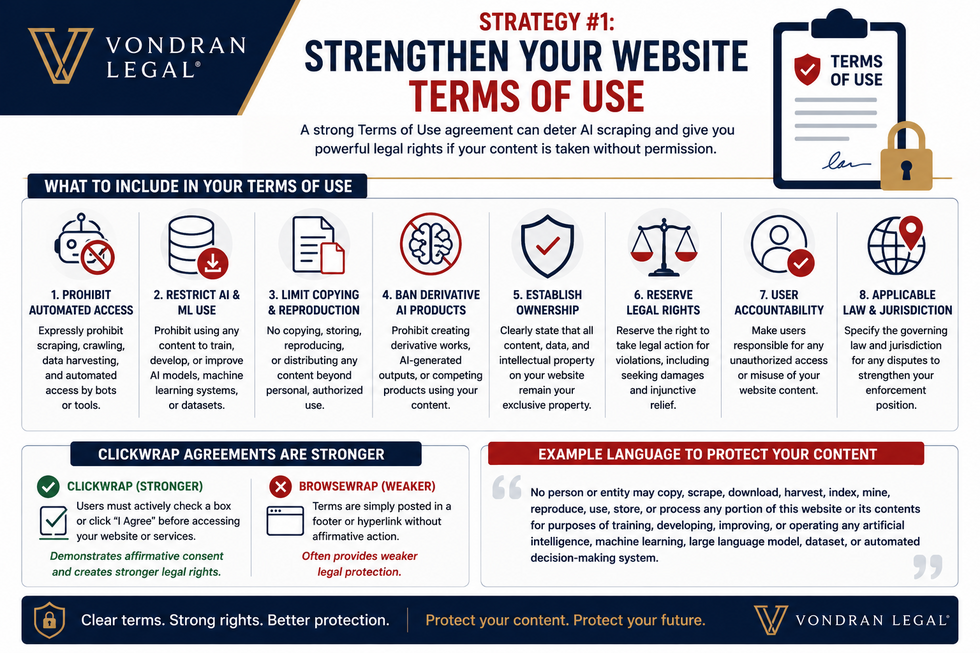
One of the most effective legal tools available is a carefully drafted Terms of Use agreement.
Many websites already have terms and conditions, but few specifically address artificial intelligence.
A modern website agreement should expressly prohibit:
-
Automated scraping
-
Data harvesting
-
Web crawling
-
AI model training
-
Machine learning uses
-
Text-and-data mining
-
Dataset creation
-
Content extraction
-
Derivative AI products
The agreement should clearly state that users are granted only a limited license to access and view the website for authorized purposes.
Example Language
A website agreement might state:
"No person or entity may copy, scrape, download, harvest, index, mine, reproduce, use, store, or process any portion of this website or its contents for purposes of training, developing, improving, or operating any artificial intelligence, machine learning, large language model, dataset, or automated decision-making system."
The more specific the restriction, the stronger the potential contractual claim.
Clickwrap Agreements Are Stronger Than Passive Notices
Courts often distinguish between different forms of online agreements.
Strongest Protection
Clickwrap Agreements
Users must actively:
-
Check a box
-
Click "I Agree"
-
Accept terms before access
Weaker Protection
Browsewrap Agreements
Terms merely appear in a footer or hyperlink.
Because clickwrap agreements demonstrate affirmative consent, they often create stronger contractual rights if litigation becomes necessary.
Strategy #2: Register Copyrights for Valuable Content
Copyright law may be one of the most powerful legal weapons against unauthorized AI scraping.
Copyright protection applies to:
-
Articles
-
Blog posts
-
Website copy
-
Images
-
Videos
-
Graphics
-
Software code
-
Original compilations
Although copyright protection generally arises automatically upon creation, registration provides significant advantages.
Why Copyright Registration Matters
Federal copyright registration may allow website owners to seek:
Statutory Damages
Instead of proving actual damages, copyright owners may seek statutory damages under federal law.
Attorneys' Fees
Successful copyright plaintiffs may recover attorneys' fees in many circumstances.
Enhanced Settlement Leverage
Registered works often receive greater attention during litigation and settlement discussions.
This issue became especially important in recent AI litigation involving books allegedly used to train artificial intelligence systems. In some settlements, copyright registration significantly affected who could recover compensation.
Strategy #3: Consider Claims Under the Computer Fraud and Abuse Act (CFAA)
The Computer Fraud and Abuse Act (CFAA) is a federal law that prohibits certain unauthorized computer access activities.
Not every scraping incident violates the CFAA.
However, potential claims may arise where a scraper:
-
Circumvents access controls
-
Bypasses login restrictions
-
Evades technical barriers
-
Uses false credentials
-
Exceeds authorized access
When AI companies intentionally defeat technical protections, additional legal theories beyond copyright and contract law may become available.
Because CFAA claims can be highly technical, website owners should consult experienced counsel before pursuing litigation.
Strategy #4: Deploy Technical Anti-Scraping Measures
Legal protections become stronger when combined with technical safeguards.
Courts may view active protective measures as evidence that access restrictions were clearly communicated and intentionally bypassed.
Recommended measures include:
Robots.txt Instructions
Specify which portions of the website may or may not be crawled.
While not legally binding by themselves, robots.txt directives can support broader claims regarding unauthorized access.
Rate Limiting
Restrict excessive requests from individual users or IP addresses.
Benefits include:
-
Reduced server strain
-
Bot detection
-
Scraping prevention
IP Blocking
Block suspicious IP addresses and networks.
Many scraping operations originate from known hosting providers or bot networks.
Geofencing
Restrict access based on geographic location when appropriate.
This can help reduce unauthorized international scraping activity.
CAPTCHA and Human Verification
Require visitors to verify they are human before accessing sensitive content.
These measures create additional barriers for automated systems.
Login Requirements
Move premium or valuable content behind authentication walls.
Restricted-access content may support stronger arguments regarding unauthorized access.
Session Controls
Limit the amount of content accessible during a user session.
Monitor unusual download patterns and terminate suspicious activity.
Digital Watermarks and Trap Content
Some website owners intentionally embed:
-
Watermarks
-
Hidden markers
-
Unique identifiers
-
Honeytoken content
These tools may help identify unauthorized copying and establish evidentiary trails during litigation.
What Should You Do If AI Companies Scrape Your Website?
If you discover unauthorized scraping:
Step 1: Preserve Evidence
Document:
-
Server logs
-
IP addresses
-
Screenshots
-
Traffic spikes
-
Download activity
Step 2: Identify the Scraper
Determine:
-
Who owns the crawler
-
Which company collected the data
-
Whether the activity violated website terms
Step 3: Send a Demand Letter
A properly drafted cease-and-desist letter may cite:
-
Breach of contract
-
Copyright infringement
-
Unauthorized access
-
CFAA concerns
-
Intellectual property violations
In some situations, a strongly worded demand letter may resolve the dispute without litigation.
Step 4: Evaluate Litigation Options
Potential claims may include:
-
Copyright infringement
-
Breach of contract
-
Trespass to chattels
-
Unfair competition
-
Computer Fraud and Abuse Act violations
-
State law claims
Because AI litigation is rapidly evolving, legal counsel should carefully evaluate available causes of action.
Will Class Action Lawsuits Become the Future of AI Scraping Litigation?
Many website owners lack the resources to challenge major AI companies individually.
As a result, class actions may become an increasingly important mechanism for addressing widespread scraping practices.
Class litigation may allow:
-
Cost sharing
-
Coordinated discovery
-
Greater leverage
-
Broader industry impact
Several ongoing lawsuits are already testing the limits of copyright law, fair use defenses, and AI training practices.
The outcomes of these cases could shape the future relationship between website owners and artificial intelligence developers.
Final Thoughts
Artificial intelligence presents extraordinary opportunities, but it also creates significant challenges for website owners whose content fuels AI systems.
No single strategy will completely prevent scraping. However, combining strong contractual protections, copyright registration, technical safeguards, and prompt enforcement actions can substantially improve a website owner's legal position.
If your business depends upon original content, now is the time to evaluate whether your website terms, copyright registrations, and technical protections adequately address AI scraping and machine learning risks.
As courts continue to address the legality of AI training practices, website owners who take proactive measures today may be in the strongest position tomorrow.

