
Vondran Legal® Internet Law
Introduction
Have you discovered an embarrassing photograph, unauthorized video, fake social media profile, revenge porn image, deepfake video, or other unwanted content featuring you online?
If so, you're not alone.
Every day, thousands of people search for ways to remove pictures and videos of themselves from the internet. Whether the content is harming your reputation, affecting your employment opportunities, damaging personal relationships, or violating your privacy rights, there are often legal and practical options available.
This guide explains how to remove photos and videos from websites, social media platforms, search engines, and other online sources.
Why You May Want Content Removed
People seek removal of online images and videos for many reasons, including:
-
Revenge porn or nonconsensual intimate imagery
-
Deepfake videos or AI-generated content
-
Harassment and cyberbullying
-
Copyright infringement
-
Defamation and false accusations
-
Unauthorized commercial use of your image
-
Stalking or privacy concerns
-
Old criminal records or mugshots
-
Embarrassing personal content
-
Fake social media accounts
-
Unauthorized recordings
The first step is determining exactly where the content appears and who controls it.
Step 1: Document Everything
Before attempting removal, preserve evidence.
Take screenshots showing:
-
The image or video
-
The URL address
-
The date and time
-
Usernames involved
-
Comments or captions
-
Number of views if visible
Also save:
-
Webpage source URLs
-
Search engine results
-
Copies of communications
This evidence may become critical if legal action becomes necessary.
Step 2: Identify the Type of Website
Different websites have different removal procedures.
Common categories include:
Social Media Platforms
Examples:
-
Facebook
-
Instagram
-
TikTok
-
X (Twitter)
-
LinkedIn
-
Snapchat
-
Reddit
Video Platforms
Examples:
-
YouTube
-
Vimeo
-
Dailymotion
Adult Websites
Examples:
-
Adult content hosting platforms
-
Revenge porn sites
News Websites
Examples:
-
Local newspapers
-
Online blogs
-
Gossip websites
Search Engines
Examples:
-
Google
-
Bing
-
Yahoo
The removal strategy depends heavily on the type of website involved.
Step 3: Contact the Person Who Posted the Content
Sometimes the fastest solution is direct communication.
You may request:
-
Removal of the content
-
Deletion of copies
-
Correction of false information
-
Termination of future postings
Remain professional and avoid threats.
In many situations, a simple request resolves the issue.
If it does not, legal remedies may become necessary.
Step 4: Use Website Reporting Tools
Most platforms offer reporting systems.
Common reporting grounds include:
Privacy Violations
If the image reveals:
-
Home address
-
Phone number
-
Personal information
-
Financial information
Many platforms may remove it.
Harassment
Content targeting an individual for abuse may violate platform policies.
Nonconsensual Intimate Images
Most major platforms prohibit:
-
Revenge porn
-
Intimate images shared without consent
-
Sexually explicit content involving private individuals
Impersonation
If someone is pretending to be you online, many platforms provide impersonation reporting procedures.
Step 5: Consider Copyright Ownership
Copyright law is often one of the most powerful removal tools.
Ask:
Did You Take the Photograph?
If you created the photo or video, you may own the copyright.
Did You Hire the Photographer?
Ownership may depend on:
-
Contracts
-
Work-for-hire agreements
-
Licensing terms
Did Someone Copy Your Content?
If another party reposted your copyrighted work without authorization, a DMCA takedown notice may be appropriate.
Step 6: Submit a DMCA Takedown Notice
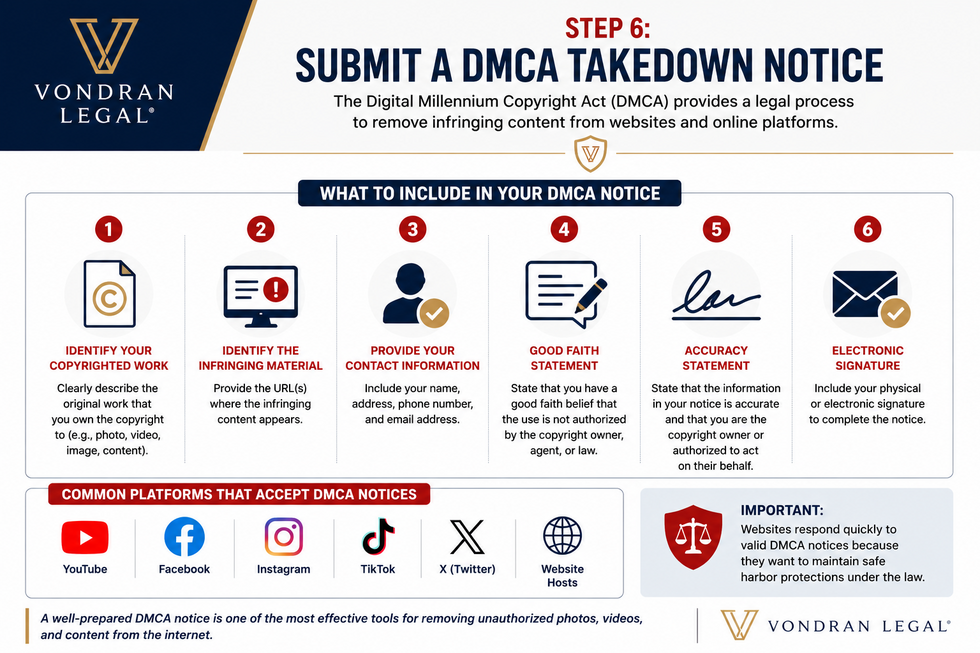
The Digital Millennium Copyright Act (DMCA) provides a legal mechanism to remove infringing content.
A DMCA notice typically includes:
-
Identification of copyrighted work
-
Identification of infringing material
-
Contact information
-
Good-faith statement
-
Electronic signature
Many websites respond quickly to valid DMCA notices because they want to preserve statutory safe harbor protections.
Common platforms accepting DMCA notices include:
-
YouTube
-
Facebook
-
Instagram
-
TikTok
-
X
-
Website hosting companies
Step 7: Request Removal from Google Search Results
Even if content remains online, it may be possible to reduce visibility.
Google offers removal requests for:
Nonconsensual Explicit Images
Google may remove search results displaying:
-
Revenge porn
-
Nonconsensual intimate imagery
Personal Information
Google may remove certain content exposing:
-
Social Security numbers
-
Financial account information
-
Government-issued identification numbers
Doxxing Content
Information revealing private personal details may qualify for removal.
Fake Pornographic Deepfakes
Google has expanded policies addressing certain deepfake-related content.
Removing content from Google does not necessarily remove it from the internet, but it can significantly reduce visibility.
Step 8: Contact the Website Host
If a website ignores removal requests, identify the hosting provider.
Common hosts include:
-
GoDaddy
-
Bluehost
-
HostGator
-
DigitalOcean
-
AWS
-
Cloudflare-related services
Hosts may respond to complaints involving:
-
Copyright infringement
-
Harassment
-
Illegal content
-
Terms-of-service violations
A lawyer can often assist in identifying anonymous operators and hosting providers.
Step 9: Evaluate Defamation Claims
If the content includes false statements harming your reputation, defamation laws may apply.
Examples include:
-
False criminal accusations
-
Fake reviews
-
Fabricated stories
-
Misleading edited videos
Potential remedies may include:
-
Removal demands
-
Retractions
-
Injunctions
-
Monetary damages
Not every negative statement is defamatory.
Truthful statements generally receive legal protection.
Step 10: Explore Right of Publicity Claims
The right of publicity protects against unauthorized commercial use of a person's name, image, voice, or likeness.
Examples include:
-
Unauthorized advertising
-
Fake endorsements
-
AI-generated celebrity content
-
Commercial exploitation of personal images
State laws vary significantly.
An experienced attorney can evaluate whether a right-of-publicity claim exists.
Step 11: Address Deepfake Images and Videos
AI-generated deepfakes are becoming increasingly common.
Potential legal claims may include:
-
Defamation
-
False light invasion of privacy
-
Right of publicity violations
-
Copyright infringement
-
State deepfake statutes
-
Harassment claims
Immediate action is often recommended because deepfakes can spread rapidly.
Step 12: Consider Revenge Porn Laws
Many states have enacted laws addressing nonconsensual intimate imagery.
Victims may pursue:
-
Civil lawsuits
-
Injunctions
-
Monetary damages
-
Criminal complaints
Platforms generally maintain expedited reporting systems for this type of content.
Step 13: Use an Internet Content Removal Lawyer
Some situations require professional assistance.
An internet lawyer may help:
-
Draft cease-and-desist letters
-
Prepare DMCA notices
-
Contact hosting providers
-
Negotiate removals
-
File lawsuits
-
Obtain court orders
-
Pursue anonymous defendants
Complex cases involving multiple websites often benefit from legal guidance.
Step 14: Monitor the Internet Going Forward
After removal, continue monitoring.
Consider:
-
Google Alerts
-
Reverse image searches
-
Reputation monitoring services
-
Social media monitoring tools
Early detection often prevents widespread distribution.
Frequently Asked Questions
Can I force Google to remove my picture?
Sometimes. Google may remove search results involving privacy violations, nonconsensual intimate imagery, and certain sensitive personal information.
Can I remove a picture someone else took of me?
Possibly. Copyright ownership usually belongs to the photographer, but privacy, publicity, harassment, and platform-policy issues may still provide removal options.
Can a lawyer remove content from the internet?
A lawyer cannot guarantee removal, but may help through copyright enforcement, defamation claims, privacy claims, takedown notices, negotiations, and litigation.
Can deepfake videos be removed?
Yes. Depending on the facts, legal remedies may include defamation, right of publicity, privacy violations, platform reporting procedures, and state deepfake laws.
Conclusion
Removing pictures or videos of yourself from the internet can be challenging, but many options exist. The appropriate strategy depends on who posted the content, where it appears, whether copyrights are involved, and whether the content violates privacy, publicity, harassment, or defamation laws.
The key is to act quickly, preserve evidence, understand your legal rights, and pursue the appropriate takedown mechanisms before the content spreads further.
If you are dealing with unauthorized photos, videos, deepfakes, revenge porn, impersonation accounts, or other harmful online content, consulting an experienced internet law attorney may help identify the fastest and most effective path toward removal.

