
Independent Creation and Copyright Law: A Powerful Defense to Copyright Infringement Claims
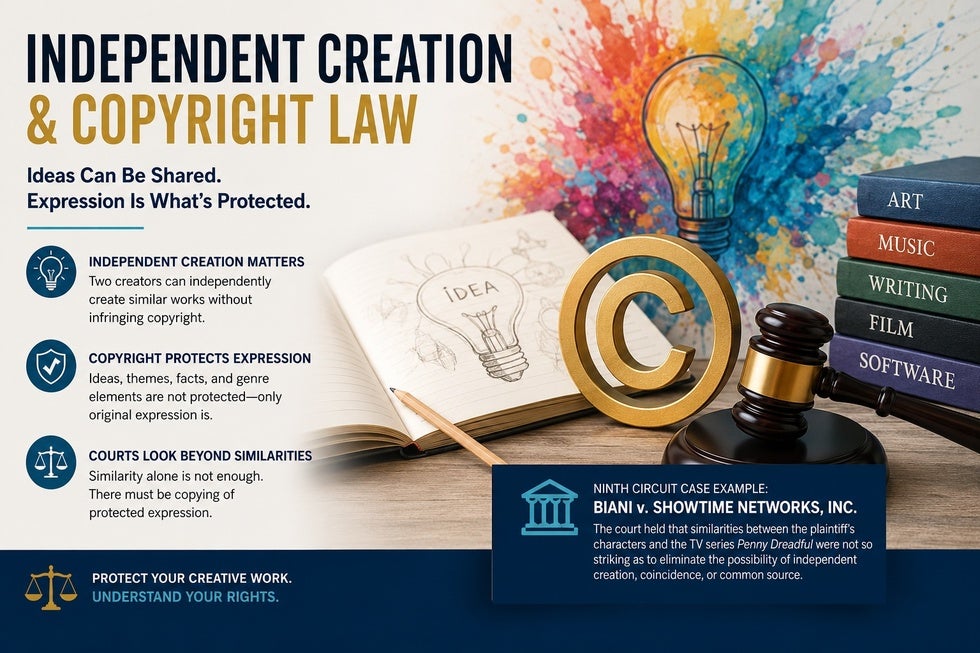
Understanding Independent Creation in Copyright Law
One of the most misunderstood concepts in copyright law is the doctrine of independent creation. Many creators, artists, authors, software developers, filmmakers, musicians, and content producers mistakenly believe that if two works look similar, copyright infringement automatically exists. That is not the law.
Under United States copyright law, copyright protects original expression, but it does not give the copyright owner a monopoly over ideas, concepts, themes, facts, or creative genres. As a result, two creators can independently create remarkably similar works without violating copyright law.
The doctrine of independent creation serves as one of the most important defenses to copyright infringement claims and reflects a fundamental principle of copyright law: copyright does not prohibit coincidence.
What Is Independent Creation?
Independent creation occurs when a defendant creates a work on his or her own without copying from the plaintiff's copyrighted work.
Even if two works appear substantially similar, there is no infringement if the defendant can demonstrate that the work was independently created rather than copied.
The Supreme Court has long recognized that copyright protects original works of authorship, but originality does not require novelty. Two authors can independently create the same or substantially similar expression and each may own a valid copyright in their respective works.
For this reason, copyright infringement requires more than similarity. A plaintiff generally must prove:
-
Ownership of a valid copyright; and
-
Copying of protected expression.
Without proof of copying, there can be no infringement.
Why Similarity Alone Is Not Enough
Many copyright lawsuits begin because one creator sees another work and concludes:
"My work looks similar to theirs, therefore they copied me."
Courts consistently reject this reasoning.
Similarity can result from:
-
Independent creation
-
Common source material
-
Shared inspiration
-
Industry conventions
-
Scènes à faire (standard elements naturally flowing from a genre)
-
Coincidence
As the Ninth Circuit has repeatedly explained, copyright law protects expression—not ideas, stock characters, or common themes.
For example:
Not Protected
-
A detective solving crimes
-
A wizard attending a magical school
-
A superhero with extraordinary powers
-
A vampire romance
-
A reality television competition
Potentially Protected
-
The specific dialogue
-
Unique character development
-
Original plot sequences
-
Distinct visual artwork
-
Creative selection and arrangement
Therefore, merely pointing to similarities in concepts or themes rarely establishes infringement.
The Role of Copying in Copyright Cases
Copyright plaintiffs generally attempt to prove copying through one of two methods:
Direct Evidence
Direct evidence might include:
-
Admissions
-
Emails
-
Drafts showing copying
-
Witness testimony
Direct evidence is uncommon.
Circumstantial Evidence
Most cases rely on circumstantial evidence showing:
-
Access to the copyrighted work; and
-
Similarity between the works
If access cannot be proven, plaintiffs often attempt to show that similarities are so extraordinary that independent creation is impossible.
This is where the doctrine of "striking similarity" enters the analysis.
Striking Similarity and Independent Creation
Some plaintiffs argue that the similarities between works are so significant that copying must have occurred.
Courts are cautious with such arguments because independent creators frequently arrive at similar creative choices.
To overcome an independent creation defense through striking similarity, the similarities generally must be so overwhelming that coincidence becomes implausible.
The Ninth Circuit has observed that similarities must effectively preclude the possibility of coincidence, independent creation, or a common source before an inference of copying can arise.
This is an extremely demanding standard.
Ninth Circuit Case Example: Biani v. Showtime Networks, Inc.
A recent Ninth Circuit decision provides an excellent illustration of how courts analyze independent creation.
The Facts
In Biani v. Showtime Networks, Inc., the plaintiff alleged that characters she created for an online Victorian-era role-playing forum were copied by the creators of Showtime's television series Penny Dreadful. The plaintiff pointed to various similarities between her characters and the show's characters, including physical traits, supernatural abilities, personality characteristics, and story elements.
The plaintiff argued that the similarities were so striking that copying should be inferred.
The Ninth Circuit's Analysis
The Ninth Circuit rejected the claim.
The court explained that to establish copyright infringement, a plaintiff must plausibly allege:
-
Ownership of a valid copyright; and
-
Copying of protected expression.
The court further explained that the copying element contains two separate inquiries:
-
Factual copying
-
Unlawful appropriation
Regarding factual copying, the plaintiff failed to establish access to her work. She therefore attempted to rely on alleged striking similarity.
The Ninth Circuit concluded that the alleged similarities were insufficient to infer copying because the resemblances were not so extensive as to eliminate the possibility of:
-
Coincidence,
-
Independent creation, or
-
A common source.
The court also found that many of the claimed similarities involved unprotectable elements associated with Victorian supernatural fiction and genre conventions. After filtering out those unprotectable elements, the plaintiff could not establish substantial similarity in protected expression.
As a result, the Ninth Circuit affirmed dismissal of the copyright infringement claim.
Why the Case Matters
The Biani decision reinforces several important principles:
-
Similarity alone is not enough.
-
Copyright does not protect generic character traits.
-
Genre conventions are generally unprotectable.
-
Plaintiffs must identify protected expression.
-
Courts remain willing to recognize independent creation as a legitimate explanation for similarities.
Another Important Ninth Circuit Example: Rentmeester v. Nike
Another influential Ninth Circuit case is Rentmeester v. Nike, Inc.
The plaintiff, a professional photographer, alleged that Nike copied his famous Michael Jordan photograph when creating its later Jordan imagery and the iconic Jumpman logo.
Although the Ninth Circuit acknowledged that Nike may have had access to the photograph and that some similarities existed, the court held that the plaintiff failed to demonstrate unlawful appropriation of protected expression. The court emphasized that copyright protects the author's particular expressive choices—not broad concepts or ideas.
The decision demonstrates that even where access is assumed, infringement still requires copying of protected expression rather than merely borrowing general concepts or inspiration.
Practical Lessons for Creators
Keep Development Records
Independent creation is easier to prove when creators maintain:
-
Drafts
-
Notes
-
Storyboards
-
Design iterations
-
Source code repositories
-
Emails documenting development
These records can establish that the work was developed independently.
Avoid Unnecessary Access
If possible, creators should avoid reviewing competing works while developing similar projects.
The less access that can be shown, the stronger an independent creation defense may become.
Focus on Original Expression
Creators should concentrate on developing unique expression rather than relying heavily on existing works.
Original creative choices provide stronger copyright protection and reduce litigation risk.
Understand Genre Limitations
Many creative fields contain common elements that cannot be monopolized through copyright law.
Examples include:
-
Crime-solving detectives
-
Space battles
-
Love triangles
-
Fantasy creatures
-
Sports competitions
Copyright generally protects the unique expression of these concepts, not the concepts themselves.
Independent Creation in Music, Software, and Artificial Intelligence
The independent creation doctrine frequently appears in:
Music Cases
Songwriters often create similar melodies, chord progressions, or lyrical themes without copying each other.
Software Cases
Programmers may independently develop similar functionality or interfaces because technical requirements often dictate certain design choices.
AI and Generative Content
As artificial intelligence becomes more prevalent, independent creation issues may become increasingly important. Similar outputs generated by different users may not necessarily indicate copying if they result from independent prompts, different training influences, or coincidental convergence.
Courts will likely continue applying traditional copyright principles to these emerging technologies.
Conclusion
Independent creation remains one of the cornerstones of American copyright law. The doctrine ensures that copyright protects genuine originality without granting creators monopolies over ideas, themes, genres, or coincidental similarities.
The Ninth Circuit's decision in Biani v. Showtime Networks demonstrates that even substantial similarities will not automatically establish infringement where coincidence, common sources, genre conventions, or independent creation remain plausible explanations.
For creators and businesses facing copyright disputes, understanding the distinction between similarity and copying is critical. Copyright law does not punish independent creativity—it encourages it. The law protects original expression while preserving the freedom of others to create their own works, even when those works share common ideas, themes, or creative inspirations.

