
DOES FENDER OWN THE STRATOCASTER DESIGN?
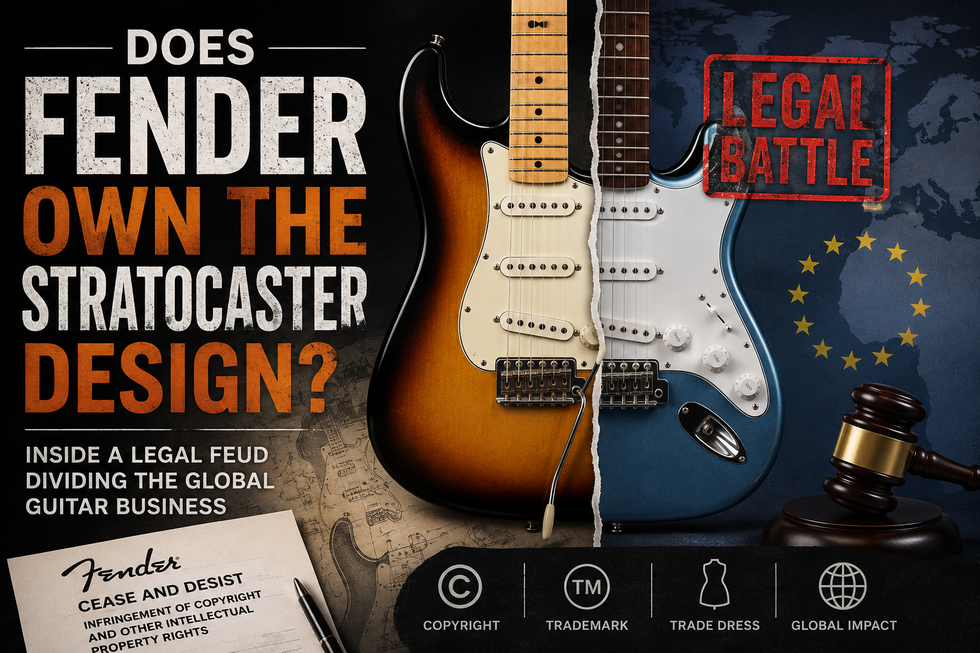
INSIDE A LEGAL FEUD DIVIDING THE GLOBAL GUITAR BUSINESS
The Fender Stratocaster is more than simply a guitar. Since its introduction in 1954, it has become one of the most recognizable product designs in the world. From Jimi Hendrix and Eric Clapton to John Mayer and countless garage bands, the Stratocaster's distinctive double-cutaway body has become an icon of modern music.
For decades, however, dozens of manufacturers have produced "S-style" guitars that closely resemble the Stratocaster. Companies ranging from boutique builders to international manufacturers have offered instruments with similar body shapes, often differing only in headstock design, electronics, or branding.
Now, that long-standing industry practice is under legal attack.
Fender has launched an aggressive effort to protect the Stratocaster body design in Europe, sparking one of the most closely watched intellectual property disputes in the music industry. The controversy raises an important legal question:
Can a company own the shape of a guitar?
The answer depends on where you are, and which area of intellectual property law applies.
THE HISTORY OF FENDER'S LEGAL BATTLE
Fender has attempted to protect its iconic guitar shapes for years.
In the United States, Fender previously sought trademark protection for the outlines of the Stratocaster, Telecaster, & Precision Bass. Those efforts ultimately failed after competing manufacturers argued that the body shapes had become common within the guitar industry. In 2009, the Trademark Trial and Appeal Board refused registration, concluding that the shapes were generic to many consumers or had not acquired sufficient trademark distinctiveness.
Many in the guitar industry believed the issue had been settled, but that was far from true.
A NEW STRATEGY: COPYRIGHT INSTEAD OF TRADEMARK
Rather than relying on trademark law, Fender turned to copyright law in Germany.
In 2026, Fender announced that the Regional Court of Düsseldorf concluded the Stratocaster body design qualified as a copyright-protected work of applied art under German and European law. The case involved a Chinese manufacturer accused of selling near-identical Stratocaster copies into Germany through online marketplaces.
That ruling gave Fender something it had never achieved in the United States:
Judicial recognition that the body shape itself could qualify for copyright protection.
Unlike trademarks, which identify the source of goods, copyright protects original creative expression. If a product design contains sufficient artistic originality under applicable law, it may receive copyright protection in some jurisdictions.
WHY THIS CASE MATTERS
Following the ruling, reports surfaced that Fender sent cease-and-desist letters to several manufacturers and retailers producing Stratocaster-style guitars.
The legal campaign has reportedly affected companies selling guitars into Europe and has generated considerable concern among boutique builders, aftermarket parts manufacturers, and retailers who have long relied on the popularity of "S-style" guitars.
For decades, many companies assumed the general Stratocaster body shape was effectively available for competitors to use so long as they avoided Fender's trademarks and branding.
That assumption is now being tested.
COPYRIGHT, TRADE DRESS, OR TRADEMARK?
One reason this dispute has generated so much confusion is that several different areas of intellectual property law may apply.
A Copyright protects original artistic expression. A trademark protects words, logos, and symbols identifying the source of goods. Trade dress protects the distinctive overall appearance of a product when consumers associate that appearance with a particular company.
Each legal theory requires different proof.
A company may lose under one theory while succeeding under another, depending on the facts and the country involved.
WHY EUROPE AND THE UNITED STATES MAY REACH DIFFERENT RESULTS
Intellectual property laws vary by country.
The recent German decision applies German and European copyright principles (not United States copyright law).
American courts analyze product-design protection differently, and U.S. trademark authorities previously declined to register Fender's guitar body outlines as trademarks. That distinction reveals an important lesson for companies operating internationally:
Winning—or losing—in one country does not automatically determine the outcome elsewhere.
WHAT THIS COULD MEAN FOR GUITAR BUILDERS
If Fender ultimately succeeds in broadly enforcing the Stratocaster body design throughout Europe, manufacturers may need to:
- Redesign existing guitar bodies.
- Modify contours and proportions.
- Reevaluate international distribution.
- Review licensing opportunities.
- Consider country-specific intellectual property risks before selling abroad.
For companies that manufacture, import, or distribute musical instruments internationally, these legal developments could become increasingly important.
LESSONS FOR ALL BUSINESSES

Even if your company has never sold a guitar, this dispute presents valuable intellectual property lessons.
1. Product design can be valuable intellectual property.
A distinctive product design can become one of a company's most recognizable and valuable forms of intellectual property.
2. Different IP rights can overlap.
The same product may involve copyrights, trademarks, trade dress, patents, and contractual protections.
3. International law matters.
Businesses selling online often reach customers worldwide without realizing that foreign intellectual property laws may apply.
4. Enforcement strategies evolve.
A company that cannot prevail under one legal theory may pursue another.
THE BOTTOM LINE
Does Fender own the Stratocaster design?
The answer is not as simple as "yes" or "no."
In the United States, Fender's efforts to secure trademark protection over the body shape were unsuccessful.
In Germany, however, Fender recently secured a significant copyright ruling recognizing the Stratocaster body as a protected work of applied art, and the company has begun enforcing those rights against manufacturers selling into Europe. The scope and long-term impact of those rights remain the subject of ongoing legal disputes and industry attention.
As this controversy develops, one thing is clear:
The battle over the Stratocaster has become a landmark dispute over how far intellectual property law can extend to protect iconic product designs—and businesses in every industry should be paying attention.
NEED HELP PROTECTING YOUR INTELLECTUAL PROPERTY?
Whether you are protecting an iconic product design, responding to a cease-and-desist letter, enforcing copyrights, defending trademark claims, or navigating complex intellectual property litigation, experienced legal counsel can make all the difference.
Contact Vondran Legal® to discuss your copyright, trademark, trade dress, or entertainment law matter.
