
Is It Time for Federal Litigators to Look Beyond Westlaw® and Lexis®?
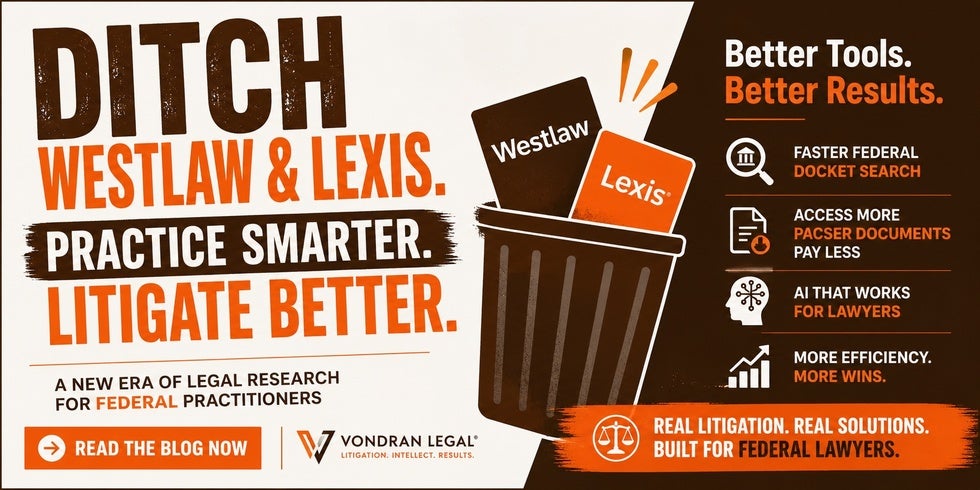
By Attorney Steve® | Vondran Legal®
For decades, two names have dominated legal research: Westlaw® and Lexis®. For many lawyers, they have been as essential as a legal pad and a courtroom suit.
But legal research is changing.
Artificial intelligence, public access initiatives, cloud-based litigation tools, and sophisticated docket-search platforms are transforming how lawyers practice—especially those of us who spend our days in federal court.
The question many lawyers are beginning to ask is no longer, "Which one should I choose?" Instead, it is:
"Do I still need a traditional legal research platform at all?"
The Modern Federal Litigator Has Different Needs
My practice focuses heavily on:
-
Federal copyright litigation
-
Trademark disputes
-
Software audit defense
-
DMCA matters
-
Federal motions practice
-
Temporary restraining orders
-
Preliminary injunctions
-
Settlement negotiations
When I open my computer each morning, I'm rarely looking for a fifty-state survey of negligence law.
Instead, I need to know:
-
What did opposing counsel file yesterday?
-
Has the judge ruled on a similar motion?
-
What allegations are being made in comparable federal cases?
-
How are other litigants resolving similar disputes?
-
Can I quickly download the complaint, TRO, exhibits, or settlement agreement?
For many federal practitioners, docket intelligence has become just as important as case law research.
The Hidden Cost of PACER
Federal practitioners know that PACER remains the official source for federal court filings.
The challenge?
Those charges can add up quickly over the course of a month, particularly for firms handling large numbers of federal cases.
If your practice involves reviewing complaints, motions, exhibits, declarations, and orders every day, document-access costs become a meaningful operating expense.
That reality has prompted many lawyers to explore tools that complement PACER by making already-public filings easier to locate and organize.
AI Isn't the Whole Answer
Artificial intelligence has obvious potential.
It can summarize cases.
It can explain opinions.
It can identify legal issues.
It can even help draft motions.
But AI should enhance—not replace—the core litigation workflow.
Most federal litigators still need direct access to:
-
actual complaints
-
declarations
-
exhibits
-
injunction papers
-
discovery disputes
-
settlement filings
-
docket activity
Sometimes the most valuable legal research is simply reading what another lawyer filed in a similar case last week.
The Rise of Litigation Intelligence
Today's legal technology market includes a growing number of platforms that emphasize:
-
federal docket searching
-
judge analytics
-
litigation tracking
-
public court filings
-
AI-assisted document review
-
workflow automation
These tools may provide a better fit for some litigation practices than traditional all-purpose research platforms.
The legal technology marketplace is becoming more competitive, and that's good news for lawyers and clients alike.
Questions Every Federal Practitioner Should Ask
Before renewing an expensive legal research subscription, consider the following:
-
How much time do you actually spend reading treatises?
-
How much time do you spend reviewing federal pleadings?
-
Are you paying for thousands of features you never use?
-
Could a litigation-focused platform better match your workflow?
-
Would a combination of specialized tools provide greater value?
There may not be a one-size-fits-all answer, but asking these questions can help ensure you're investing in technology that supports the way your practice actually operates.
My Wish for the Legal Research Industry
Competition drives innovation.
Lawyers deserve:
-
faster research
-
cleaner interfaces
-
transparent pricing
-
predictable billing
-
better customer support
-
smarter AI
-
stronger federal docket tools
-
flexible subscription options for small firms
Whether that innovation comes from established companies or newer entrants, increased competition benefits the legal profession as a whole.
Final Thoughts
Westlaw and Lexis have made enormous contributions to the practice of law and remain valuable tools for many attorneys.
At the same time, federal litigators should periodically evaluate whether their current research platform still aligns with the realities of modern practice.
If your work revolves around federal litigation, intellectual property, copyright, trademarks, software licensing disputes, or federal injunctions, it may be worth exploring newer litigation-focused solutions alongside traditional research services.
Technology should make lawyers more efficient—not simply more expensive.
Need a Federal Copyright or Trademark Lawyer?
Vondran Legal® represents clients nationwide in federal intellectual property matters, including:
-
Federal copyright litigation
-
Trademark infringement
-
DMCA disputes
-
Software audit defense
-
Preliminary injunctions and TROs
-
Federal litigation strategy
-
Copyright licensing
-
IP counseling for creators, software companies, and businesses
To discuss your matter, call (877) 276-5084 or contact us through our online intake form to schedule a consultation.
This article reflects the author's opinions regarding legal technology and practice management and is intended for informational purposes only. Every law practice has different research needs, and attorneys should evaluate products based on their own workflow and budget.

