
Nintendo v. Yuzu Emulator: What Every Software Developer Needs to Know About Copyright, the DMCA, and Reverse Engineering
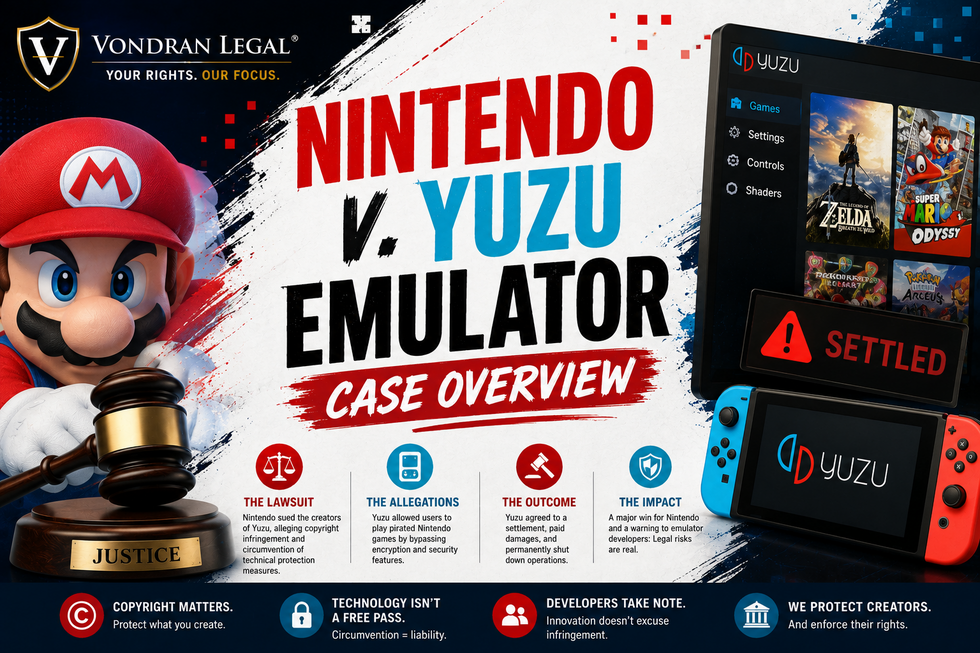
Can software developers legally create emulators? Where is the line between lawful interoperability and copyright infringement? The Nintendo v. Yuzu case has become one of the most important software copyright disputes in recent years, raising significant questions under the Copyright Act, the Digital Millennium Copyright Act (DMCA), and the law governing reverse engineering.
Although the case ultimately settled before a court issued a ruling, the allegations and legal theories asserted by Nintendo provide valuable insight for software developers, emulator creators, AI companies, SaaS businesses, cybersecurity researchers, and technology startups seeking to understand where the legal risks lie.
This article examines the case using a traditional legal framework—including the facts, issues, applicable law, analysis, and practical lessons—to help businesses better understand the evolving landscape of software copyright law.
Table of Contents
- Background of the Yuzu Emulator
- The Facts of the Case
- The Legal Issues
- The Applicable Law
- Nintendo's Legal Arguments
- Why This Case Was Different
- The Settlement
- Key Legal Principles
- Reverse Engineering and Fair Use
- The DMCA's Anti-Circumvention Rules
- Secondary Copyright Liability
- Lessons for Software Developers
- Frequently Asked Questions
- How an Intellectual Property Attorney Can Help
Background: What Is the Yuzu Emulator?
Yuzu was an open-source emulator developed by Tropic Haze LLC that allowed users to play Nintendo Switch games on Windows, Linux, and Android devices.
An emulator recreates the functionality of a hardware console through software. Importantly, emulators themselves are not automatically illegal.
For decades, legitimate emulators have been used for:
- software preservation
- hardware compatibility
- accessibility
- interoperability
- academic research
- lawful reverse engineering
The legal controversy generally arises not from emulation itself, but from how the emulator interacts with copyrighted software and technological protection measures.
The Facts of Nintendo v. Tropic Haze
Nintendo filed suit against Tropic Haze in federal court in Rhode Island in early 2024.
According to Nintendo's complaint:
- Yuzu enabled users to play Nintendo Switch games without using Nintendo hardware.
- Users were required to obtain encryption keys from their own Switch consoles.
- Nintendo alleged the process necessarily bypassed its technological protection measures.
- Nintendo claimed Yuzu developers knew many users were playing unauthorized copies of Nintendo games.
- Nintendo relied heavily on the unauthorized leak of The Legend of Zelda: Tears of the Kingdom, which allegedly resulted in over one million illegal downloads before the game's official release.
Nintendo also alleged that the developers financially benefited from Patreon subscriptions and other revenue generated by the popularity of the emulator.
The Legal Issue
The central legal question was not whether emulators are illegal.
Instead, the case presented several more nuanced questions:
- Does software violate the DMCA when it facilitates circumvention of technological protection measures?
- Can developers be liable for encouraging users to infringe copyrights?
- When does reverse engineering cross the line into unlawful conduct?
- Can an otherwise legitimate technology become unlawful because of how it is marketed or used?
These questions sit at the intersection of copyright law, software engineering, and digital rights.
The Governing Law
Several areas of federal law were implicated.
1. Copyright Act
The Copyright Act grants copyright owners the exclusive rights to:
- reproduce software
- distribute copies
- prepare derivative works
- publicly perform or display protected works
Unauthorized copying generally constitutes infringement unless an exception applies.
2. Digital Millennium Copyright Act (17 U.S.C. § 1201)
The DMCA prohibits:
- circumventing technological measures controlling access to copyrighted works
- manufacturing or distributing tools primarily designed for circumvention
- trafficking in circumvention technologies
Importantly, a party may violate the DMCA even if no direct copyright infringement is ultimately proven.
This distinction often surprises software developers.
3. Secondary Copyright Liability
Even where users commit direct infringement, software developers may face liability under theories including:
- contributory infringement
- vicarious liability
- inducement of infringement
The Supreme Court's decision in MGM Studios v. Grokster established that distributing technology with the objective of promoting infringement may result in liability.
Nintendo's Arguments
Nintendo advanced several significant legal theories.
Circumvention
Nintendo alleged Yuzu effectively bypassed Nintendo's encryption system protecting Switch games.
This formed the backbone of its DMCA claims.
Facilitating Piracy
Nintendo argued that although emulation can have lawful uses, Yuzu had become closely associated with piracy.
According to Nintendo:
- users routinely downloaded unauthorized game copies;
- developers understood this conduct;
- the software ecosystem encouraged infringement.
Inducing Copyright Infringement
Nintendo further alleged the developers promoted and maintained Yuzu despite knowing it was being used primarily for infringing activity.
This theory resembles the inducement doctrine recognized in Grokster.
Financial Benefit
Nintendo alleged Tropic Haze generated substantial Patreon revenue while widespread infringement continued.
This allegation strengthened Nintendo's claims regarding secondary liability.
The Settlement
Rather than litigate the merits, Tropic Haze entered into a settlement.
The agreement required:
- payment of $2.4 million
- permanent shutdown of Yuzu development
- termination of distribution
- closure of Discord, Patreon, and GitHub repositories
- transfer of the Yuzu domain name to Nintendo
- destruction of remaining copies under defendants' control
Why the Settlement Matters
One important point is frequently misunderstood.
The settlement does not establish legal precedent.
The court never ruled:
- that Yuzu violated the DMCA;
- that emulators are unlawful;
- that reverse engineering was illegal.
Instead, the parties voluntarily resolved the dispute before any judicial findings were made.
Nevertheless, the case has become enormously influential because it illustrates the legal theories copyright owners may pursue in future litigation.
Reverse Engineering Remains Lawful in Many Circumstances
One of the most misunderstood areas of software law concerns reverse engineering.
Reverse engineering is not automatically illegal.
Several important cases recognize circumstances in which reverse engineering may constitute fair use or otherwise be permissible.
Among the leading cases is:
Sony Computer Entertainment, Inc. v. Connectix Corp.
In Connectix, the Ninth Circuit held that intermediate copying during reverse engineering could qualify as fair use when necessary to achieve interoperability.
That decision remains an important precedent supporting legitimate software compatibility efforts.
However, Connectix did not eliminate the separate restrictions imposed by the DMCA.
The DMCA Creates Independent Risk
Developers often focus exclusively on copyright law.
That can be a costly mistake.
The DMCA creates liability independent of traditional copyright infringement.
Even where software itself may be lawful, distributing technology that bypasses access-control systems can expose developers to substantial legal risk.
Understanding this distinction is critical when designing:
- APIs
- interoperability tools
- security software
- firmware utilities
- jailbreak tools
- emulator projects
Practical Lessons for Software Developers
The Yuzu dispute offers several practical lessons.
Design Matters
How software functions can be as important as its intended purpose.
Marketing Matters
Statements made on websites, Discord channels, GitHub pages, documentation, and social media may later become evidence in litigation.
Revenue Matters
Subscription models tied to technology associated with infringement may strengthen secondary liability claims.
User Conduct Matters
Courts often evaluate whether developers actively discouraged infringement or instead appeared to tolerate or encourage unlawful uses.
Documentation Matters
Maintaining clear internal documentation regarding lawful objectives—such as interoperability, preservation, accessibility, or research—may prove valuable if litigation arises.
Frequently Asked Questions
Are emulators illegal?
Generally, no. Emulators themselves are not automatically unlawful.
Is reverse engineering legal?
Often yes, depending on the purpose and methods used. Courts have recognized reverse engineering for interoperability in appropriate circumstances.
Can the DMCA apply even without copyright infringement?
Yes.
The anti-circumvention provisions create separate causes of action independent of traditional infringement claims.
Did Nintendo win the case?
The parties settled.
There was no judicial decision determining liability.
Does this case establish binding precedent?
No.
Because the dispute settled, it does not create binding legal authority.
Key Takeaways
- Emulators are not inherently illegal.
- Reverse engineering remains lawful under certain circumstances.
- The DMCA creates separate anti-circumvention liability.
- Marketing and business practices may affect secondary liability.
- Settlement does not equal judicial precedent.
- Companies developing interoperability tools should evaluate both copyright and DMCA risks before launch.
Why This Case Matters Beyond Video Games
While Nintendo's lawsuit focused on a video game emulator, the legal principles extend far beyond gaming. Companies developing AI systems, cybersecurity tools, IoT devices, firmware utilities, API integrations, industrial software, and compatibility layers often encounter the same legal issues involving reverse engineering, access controls, interoperability, software licensing, and copyright. As software ecosystems become increasingly interconnected, businesses must balance innovation with compliance under the Copyright Act, the DMCA, and applicable license agreements.
How Vondran Legal Can Help
Technology companies frequently ask whether they can lawfully reverse engineer software, develop compatible products, or integrate with existing platforms without violating intellectual property laws. These questions often involve a complex interplay of copyright law, the DMCA, contract law, and software licensing.
Vondran Legal represents clients nationwide in matters involving:
- Software copyright disputes
- DMCA anti-circumvention claims
- Reverse engineering and interoperability issues
- Software license compliance and audit defense
- Copyright infringement litigation
- Open-source software compliance
- API and SDK licensing issues
- Technology contract review
- Intellectual property risk assessments
Early legal guidance can often help identify and mitigate risks before a product is launched or a dispute arises.
Contact Vondran Legal
If your company is developing software that interacts with third-party platforms, devices, or copyrighted works, experienced intellectual property counsel can help evaluate potential risks and develop strategies that support innovation while reducing exposure to costly litigation.

