
Vondran Legal® Trae Secret Litigation Insights: What Comet Technologies v. XP Power Means for Trade Secret Litigation Going Forward
By Attorney Steve® | Vondran Legal®
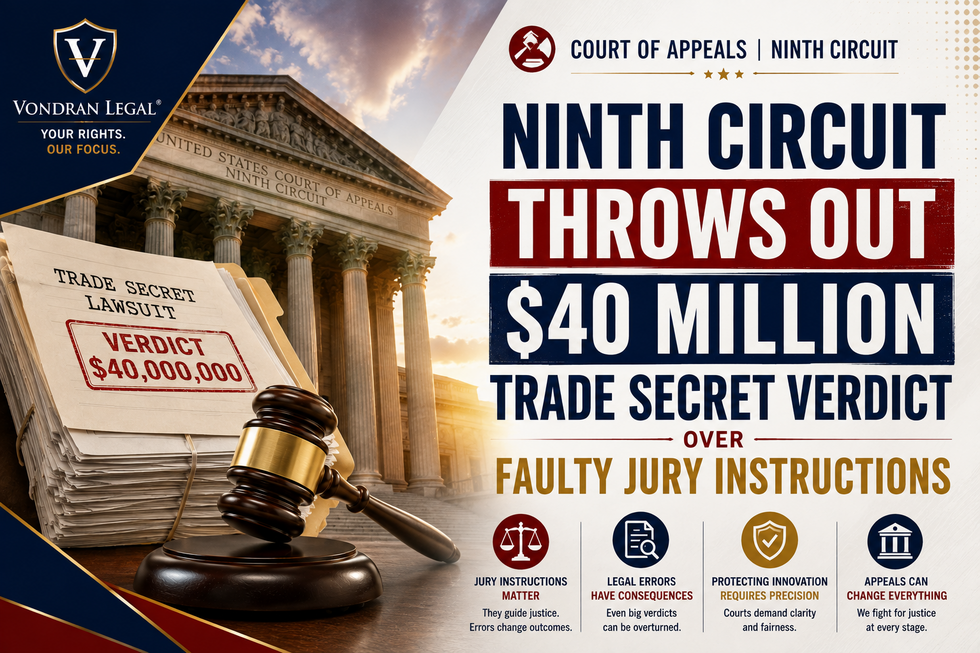
A Single Jury Instruction Can Cost $40 Million
Trade secret litigation is often won or lost on highly technical issues involving engineering, software, confidential business information, employee mobility, and expert testimony. But sometimes the most important issue isn't the evidence—it is how the jury is instructed to evaluate the evidence.
That is exactly what happened in Comet Technologies USA, Inc. v. XP Power, LLC, Nos. 23-15601, 23-15709 & 25-745 (9th Cir. July 14, 2026), where the United States Court of Appeals for the Ninth Circuit vacated a $40 million jury verdict, a permanent injunction, and more than $17 million in attorney's fees because the district court assigned the burden of proof to the wrong party on one element of the federal Defend Trade Secrets Act ("DTSA").
The opinion serves as an important reminder that in complex intellectual property litigation, procedural precision matters just as much as substantive proof. It also provides valuable guidance to attorneys litigating trade secret cases throughout the Ninth Circuit.
Table of Contents
-
The Facts
-
The Legal Issue
-
The Governing Rule
-
The Ninth Circuit's Analysis
-
The Dissent
-
The Concurrence
-
Why This Decision Matters
-
What This Means Going Forward
-
Practical Lessons for Businesses
-
Practical Lessons for Trial Lawyers
-
Frequently Asked Questions
-
How Vondran Legal Can Help
Background of the Case
Comet Technologies develops sophisticated electrical products and proprietary technologies.
According to Comet, three engineers left the company to work for competitor XP Power.
Before departing, the employees allegedly downloaded thousands of confidential company files, including:
-
Engineering drawings
-
Technical schematics
-
Calibration data
-
Product specifications
-
Manufacturing information
-
Testing protocols
-
Research and development plans
Comet alleged that XP Power used this confidential information to dramatically accelerate development of competing products.
One allegation was particularly striking.
Comet asserted XP was able to create development plans for new product lines in only nine days after obtaining the information.
Comet filed suit alleging trade secret misappropriation under:
-
the federal Defend Trade Secrets Act (18 U.S.C. §1836); and
-
California's Uniform Trade Secrets Act (CUTSA).
However, during trial Comet voluntarily dismissed its California trade secret claims and proceeded solely under the federal DTSA.
The jury nevertheless returned a blockbuster verdict:
-
$20 million compensatory damages
-
$20 million exemplary (punitive) damages
The district court later entered:
-
a permanent injunction; and
-
over $17 million in attorney's fees.
XP appealed.
The Legal Issue
The appeal ultimately centered on one deceptively simple question:
Who bears the burden of proving whether the alleged trade secrets were "readily ascertainable through proper means"?
That issue became critical after Comet dismissed its California claims.
The Rule Under the Defend Trade Secrets Act
To prevail under the DTSA, a plaintiff generally must establish:
-
ownership of protectable trade secrets;
-
reasonable efforts to maintain secrecy;
-
independent economic value arising from secrecy;
-
misappropriation; and
-
resulting damages.
An important component of proving a protectable trade secret is demonstrating that the information is not readily ascertainable through proper means.
Unlike California's model jury instructions—which may treat ready ascertainability differently depending on the procedural posture—the DTSA places the burden on the plaintiff to establish this element.
That distinction proved dispositive.
The Jury Instruction Error
While both state and federal claims remained in the case, Jury Instruction No. 20 stated that:
XP Power had the burden of proving that Comet's alleged trade secrets were readily ascertainable by proper means.
That instruction arguably fit the California framework.
But once Comet dismissed its California claims, the instruction no longer reflected the governing federal law.
XP immediately objected and asked the district court to modify the instruction.
The court refused.
The jury therefore deliberated under an instruction placing the burden on the defendant instead of the plaintiff.
The Ninth Circuit's Analysis
The Ninth Circuit held the instructional error required a new trial.
1. XP Properly Preserved the Issue
Comet argued XP had "invited" the error because counsel later supported Instruction No. 20 during discussions about final jury instructions.
The Ninth Circuit rejected that argument.
The court explained:
-
XP made a timely objection.
-
XP clearly identified the legal error.
-
The district court ruled definitively.
-
Later fallback arguments did not waive the preserved objection.
This portion of the opinion reinforces an important appellate principle:
Once a party clearly preserves an objection and receives an adverse ruling, alternative arguments made thereafter generally do not constitute invited error.
2. The Error Was Not Harmless
Comet next argued:
Even if the burden instruction was wrong, the jury would have reached the same conclusion.
The Ninth Circuit disagreed.
The court emphasized that two concepts must remain distinct.
Independent Economic Value
Information must derive economic value from remaining secret.
Ready Ascertainability
The information also must not be readily discoverable through legitimate means.
These are related concepts.
They are not identical concepts.
Information may be:
-
commercially valuable but publicly available;
-
confidential but economically insignificant;
-
or both confidential and valuable.
Because experts sharply disputed whether XP could have reverse engineered or independently developed the technology, the burden allocation could have affected the verdict.
Accordingly, the court vacated the judgment and remanded for an entirely new trial.
The Dissent
Judge Bumatay agreed the instruction misstated the law.
However, he believed reversal was unnecessary.
According to the dissent:
-
Comet's evidence overwhelmingly demonstrated secrecy.
-
The technical files were highly confidential.
-
Reverse engineering was largely unsupported.
-
The jury necessarily found secrecy when awarding damages.
In Judge Bumatay's view, no reasonable jury could have reached a different conclusion regardless of who carried the burden.
The majority disagreed.
The Concurrence: An Important Remedies Discussion
Judge Hamilton wrote separately to discuss an issue likely to arise again after remand.
Can a plaintiff recover:
-
unjust enrichment damages measured by avoided development costs,
while also obtaining
-
a permanent injunction?
Judge Hamilton concluded:
Yes.
He reasoned the remedies compensate different injuries.
Avoided-cost damages address the defendant's past enrichment.
An injunction prevents future misuse.
Forcing plaintiffs to elect between them could effectively allow defendants to purchase a continuing license to use stolen trade secrets.
Although technically dicta, this concurrence could influence future trade secret litigation.
Why This Case Matters
The significance of Comet Technologies extends well beyond this dispute.
It reinforces several important principles governing federal trade secret litigation.
Jury Instructions Matter
Appellate courts frequently defer to jury verdicts.
They do not defer when jurors receive incorrect legal instructions.
One improperly worded instruction can erase:
-
years of litigation;
-
millions in damages;
-
permanent injunctions;
-
attorney fee awards.
Burdens of Proof Matter
Lawyers sometimes treat burden allocations as technical details.
Jurors do not.
The question:
"Who must prove this?"
often shapes deliberations.
Changing the burden can change the outcome.
Federal and State Trade Secret Laws Are Similar—but Not Identical
Many complaints plead both:
-
DTSA
-
state Uniform Trade Secrets Act claims.
Attorneys must remember that these claims may differ regarding:
-
burdens of proof;
-
available remedies;
-
statutes of limitation;
-
preemption issues;
-
exemplary damages;
-
attorney fees;
-
jury instructions.
When one claim disappears during litigation, every instruction should be re-evaluated.
What This Means Going Forward in the Ninth Circuit
This opinion will likely become an important citation in future DTSA litigation.
Expect litigants to rely on Comet Technologies when arguing:
Proper Burden Allocation
Plaintiffs should expect defendants to scrutinize every proposed instruction concerning protectable trade secrets.
Preservation of Error
Defense counsel will cite Comet when arguing they preserved objections despite later compromise positions.
Harmless Error Analysis
Appellate courts may more carefully evaluate whether instructional mistakes involving trade secret elements truly influenced the verdict.
Remedies
Judge Hamilton's concurrence may encourage plaintiffs to pursue both:
-
avoided-cost damages; and
-
permanent injunctive relief.
Practical Lessons for Businesses
Businesses seeking to protect trade secrets should:
-
Implement robust confidentiality agreements.
-
Restrict employee access using least-privilege principles.
-
Maintain detailed access logs.
-
Conduct exit interviews.
-
Immediately secure devices when employees depart.
-
Monitor unusual downloading activity.
-
Maintain written trade secret protection policies.
-
Train employees regularly regarding confidentiality obligations.
-
Document reasonable secrecy measures.
Trade secret protection begins long before litigation.
Practical Lessons for Trial Lawyers
For litigators, this case offers several practical reminders.
Audit Jury Instructions Throughout Trial
Whenever claims are added, dismissed, narrowed, or bifurcated, revisit:
-
instructions;
-
verdict forms;
-
damages questions;
-
burdens of proof.
Preserve Objections Clearly
Make:
-
timely objections;
-
specific legal objections;
-
complete records.
Appellate courts cannot review issues that were never properly preserved.
Distinguish Every Statutory Element
Do not merge distinct legal requirements.
Economic value.
Secrecy.
Ownership.
Misappropriation.
Improper acquisition.
Damages.
Each element deserves careful treatment.
Frequently Asked Questions
Does this decision change the DTSA?
No.
The Ninth Circuit applied existing DTSA principles.
The opinion primarily clarifies how jury instructions should allocate the burden of proof after state-law claims are dismissed.
Does this apply outside California?
Yes.
The DTSA is a federal statute.
Although this decision binds federal district courts within the Ninth Circuit, attorneys nationwide may cite its reasoning as persuasive authority.
Will every instructional error require reversal?
No.
Appellate courts apply harmless-error review.
But where the error concerns an important disputed issue—as here—the chances of reversal increase substantially.
How Vondran Legal Can Help
At Vondran Legal®, we represent businesses, executives, entrepreneurs, software developers, engineers, manufacturers, technology companies, creative professionals, and employers in complex intellectual property disputes throughout the United States.
Our trade secret services include:
Trade Secret Litigation
We prosecute and defend claims involving:
-
Trade secret misappropriation
-
Employee mobility disputes
-
Confidential information theft
-
Proprietary software and source code
-
Customer lists and pricing information
-
Manufacturing processes
-
Engineering designs
-
Research and development materials
-
Business methods
-
Algorithms and AI-related confidential information
Emergency Injunctive Relief
When trade secrets are at immediate risk, we assist clients in seeking or opposing:
-
Temporary restraining orders (TROs)
-
Preliminary injunctions
-
Permanent injunctions
-
Asset preservation orders
-
Evidence preservation orders
Employment and Confidentiality Agreements
We advise businesses regarding:
-
NDAs
-
Confidentiality agreements
-
Employee invention assignments
-
Trade secret policies
-
Exit procedures
-
Executive employment agreements
Internal Investigations
We help companies investigate suspected trade secret theft involving:
-
departing employees;
-
competitors;
-
vendors;
-
consultants;
-
former executives; and
-
cybersecurity incidents.
Defense Representation
Not every accusation of trade secret theft is justified.
We also defend individuals and companies accused of:
-
improper downloading;
-
confidential information misuse;
-
employee solicitation;
-
unfair competition;
-
breach of confidentiality agreements;
-
computer access claims; and
-
related business torts.
Final Thoughts
The Ninth Circuit's decision in Comet Technologies USA, Inc. v. XP Power, LLC is a powerful reminder that successful trade secret litigation depends not only on compelling evidence but also on meticulous adherence to procedural rules. A single flawed jury instruction regarding the burden of proof was enough to erase a $40 million verdict, a permanent injunction, and a substantial attorney-fee award.
For businesses, the decision underscores the importance of building strong trade secret protection programs before disputes arise. For trial lawyers, it reinforces the need to continually reassess jury instructions as claims evolve and to preserve objections clearly on the record. And for parties litigating under the DTSA in the Ninth Circuit, Comet will likely become a leading case on burden allocation, preservation of error, and appellate review of jury instructions.
Whether you are seeking to protect valuable proprietary information or defending against allegations of trade secret misappropriation, experienced legal counsel can make a critical difference at every stage of the case—from implementing preventive measures to trying the case before a jury and preserving issues for appeal.
Contact Vondran Legal®
Vondran Legal® is a nationwide intellectual property and business litigation law firm handling complex trade secret disputes, software litigation, employee mobility cases, unfair competition claims, and federal intellectual property litigation.
If your business believes valuable confidential information has been stolen—or if you have been accused of misappropriating trade secrets—contact Attorney Steve® to discuss your legal rights and strategic options.
Keywords: Ninth Circuit trade secret lawyer, DTSA attorney, Defend Trade Secrets Act litigation, California trade secret attorney, trade secret misappropriation defense, employee confidentiality disputes, software source code litigation, trade secret injunction lawyer, intellectual property litigation, Vondran Legal.

